
Pricing
Apparel Markdown Strategy: The Margin Math of When, How Deep, and How Often to Discount
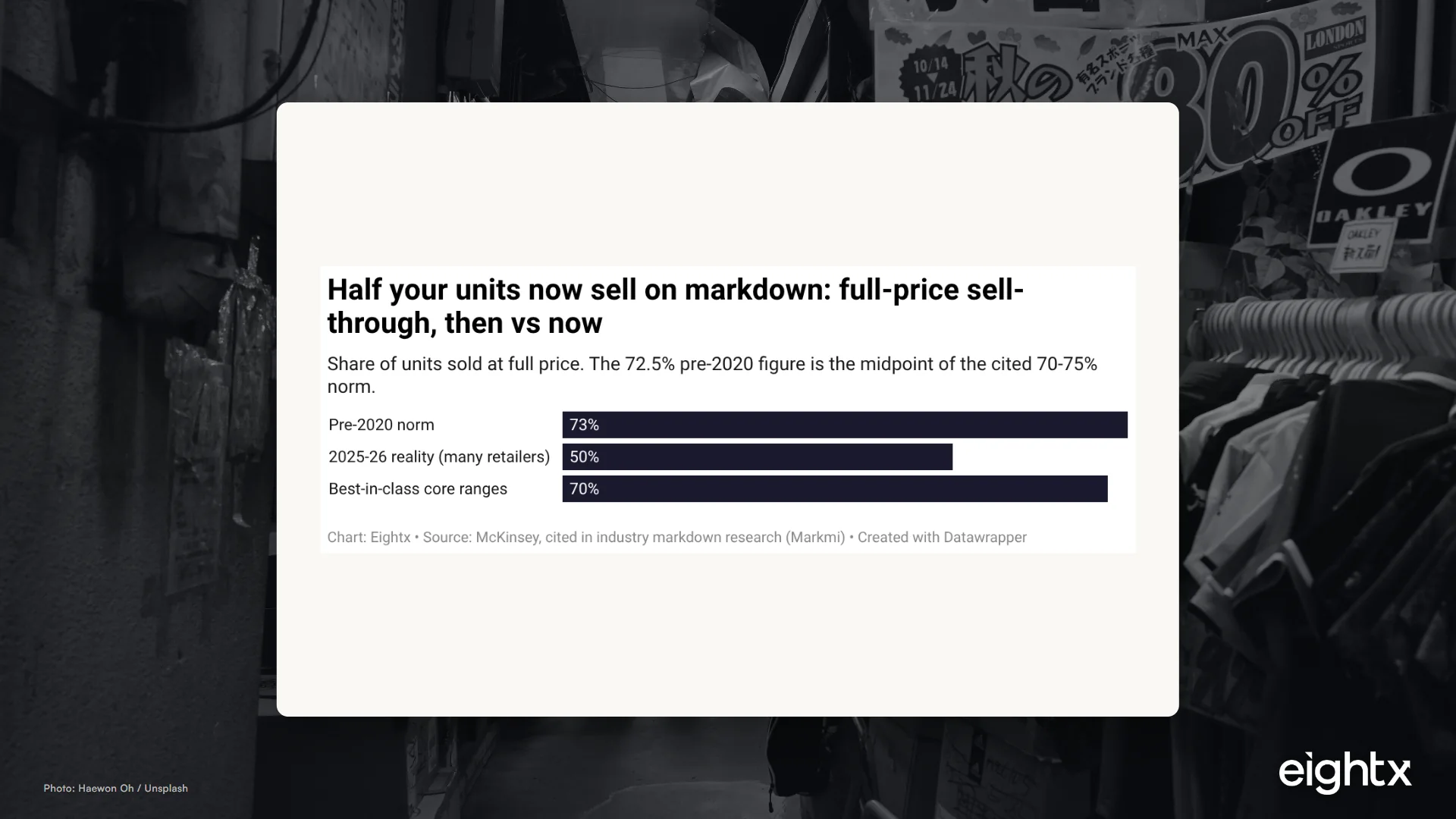
Markdown is the single largest controllable margin leak in apparel: full-price sell-through has fallen from a 70-75% norm to about 50%, and markdowns eat 20-50% of net sales. The fix is shallow, planned cuts triggered by sell-through, not one deep end-of-season blowout. You can always discount deeper. You can never put the price back up.
Key Takeaways
- Half your units now sell on markdown. Full-price sell-through has fallen from a 70-75% norm to roughly 50% at many fashion retailers, and markdowns consume an estimated 20-50% of net sales.
- Disciplined markdown management is worth 400-800 basis points of gross margin, all from changing how you discount, not whether you discount at all.
- Shallow and early beats deep and late. A small first markdown (10-25%) triggered by sell-through, with only 2-3 steps per season, protects far more margin than one big clearance.
- The margin swing cuts both ways. American Eagle's gross margin slipped 2.7 points in FY2025 and operating income fell 47%, from $427M to $226M.
- Aged stock is a cash problem, not just a margin one. Even a well-run DTC brand like Revolve carries ~147 days of inventory, so every markdown is also a cash decision.
Every apparel brand ends a season with stock it has to clear. The question is never whether you will discount, it is how deep, how often, and when you take the first cut. Markdown is the single largest controllable margin leak in apparel, and it has quietly gotten worse: at many fashion retailers full-price sell-through has fallen from the old 70-to-75 percent norm to roughly 50 percent, which means about half of all units now move at a discount.
This post is the markdown-strategy companion to our work on apparel drop model economics. The drop-model piece covers how you buy and release product. This one covers what happens at the other end: when stock ages, how you discount it, and what each markdown actually costs you in margin and cash. The short version is that the instinct most founders have, sit on full price and then run a big end-of-season blowout, is exactly backwards.
Why markdown is the biggest margin leak in apparel
Markdowns consume an estimated 20 to 50 percent of net sales at many fashion retailers (McKinsey, cited in industry markdown research). That makes the discount line the single biggest controllable item sitting between your list price and your gross margin. Rent is fixed. Freight is mostly fixed. How and when you discount is not, and yet most brands manage it on instinct.
The structural shift is the part operators miss. Full-price sell-through used to sit at 70 to 75 percent. At a lot of retailers it is now closer to 50 percent, while the strongest brands, by these estimates, still hold near 70 percent on their core ranges. When half your units sell at a discount, markdown is no longer a clean-up tool at the back of the season. It is half the business, and it deserves a plan, not a panic.
When I talk to founders running an apparel brand of any size, the thing they keep saying is that the margin is already gone before markdown even enters the conversation. One operator put it plainly: "apparel, by the time you do wholesale, you're at 50 percent at best" on gross margin. Start from a thin number like that and every point you give back to discounting is a point you did not have to spare. The good news is the upside is real: disciplined markdown optimization is worth an estimated 400 to 800 basis points of gross margin, purely from changing how you discount rather than whether you do.
What every markdown step actually costs you
Here is the math that should govern the whole decision. Take an illustrative apparel unit at a 55 percent gross margin: it lists at $100 and costs you $45, so a full-price sale earns $55 of gross profit. Every markdown comes straight out of that $55.
| Markdown step | Discount off list | Selling price | Gross profit per unit | Full-price margin retained |
|---|---|---|---|---|
| Full price | 0% | $100 | $55 | 100% |
| First markdown | 15% | $85 | $40 | 73% |
| Second markdown | 30% | $70 | $25 | 45% |
| Third markdown | 40% | $60 | $15 | 27% |
| Clearance | 55% | $45 | $0 | 0% |
| Liquidation | 70% | $30 | -$15 | negative |
A 15 percent markdown does not cost you 15 percent of your margin. It takes gross profit from $55 to $40, more than a quarter of your gross profit dollars gone. By 40 percent off you are keeping just over a quarter of your full-price profit, and at a 55 percent clearance you are selling at cost: nothing left, before you have even paid to pick, pack, ship, and process the order.
This effect is not theoretical, and it cuts both ways at scale. American Eagle's gross margin slipped to 36.5 percent in FY2025 from 39.2 percent the year before, a 2.7-point move the company tied to markdowns and an inventory write-down. That 2.7 points nearly halved operating income, which fell 47 percent, from $427 million to $226 million. A small slide in how much you give back to discounting can swing the bottom line by half. That is the whole case for treating markdown as a planned line item, not a reflex.
When to take the first markdown (and why the calendar is the wrong trigger)
The reason most markdowns end up too deep is that they were taken too late. Brands wait for a date, the end of the season, a holiday, the moment the warehouse is full, and by then only a fire-sale price will move the stock. The fix is to replace the calendar with a sell-through trigger.
The mechanics are simple. Set a sell-through target for each style at each checkpoint. At the midpoint of a style's selling window, pull actual sell-through. Any style materially below its curve gets a small, automatic markdown that week. Re-check two to three weeks later and step the cut deeper only if it is still stalled. This does two things at once: it cuts shallow while there is still margin to protect, and it cuts only the styles that need it.
The pattern we see again and again is the opposite of this: a brand that "fire sales every month, a clearance event to try to get through aged" stock. That cadence trains customers to wait and guarantees you are always discounting from a position of weakness. The governing rule for the first cut is the one merchandisers repeat: you can always discount deeper, you can never put the price back up. So the first move should be small and on time, never deep and late.
How deep and how often: the 2-3 step ladder
Best practice is a shallow first markdown of 10 to 25 percent, with only two to three steps across a season, differentiated by how price-sensitive the style is. Core basics that always sell get a tight cap and small cuts. Fashion or seasonal pieces with no second life can move faster and deeper. The table below is the cadence to anchor against.
| Markdown step | When | Typical depth | Primary goal |
|---|---|---|---|
| First markdown | Mid-season, when a style is materially below its sell-through curve | 10 to 25% | Salvage margin while the full-price window is still open |
| Second markdown | Late season, as weeks-of-supply exceeds remaining selling weeks | 30 to 40% | Clear slow movers before the season turns |
| Final clearance | Last 1-2 weeks / post-season | 50 to 60%+ | Free up space and recover cash; margin is secondary |
| Liquidation | Aged stock with no sell-through | Off-price / below cost | Convert dead inventory back to cash |
There is one guardrail operators come back to over and over: cap the opening cut. As one founder told us when we were stress-testing a promo plan, "the only thing I can tell you is I like that you don't go over 20 percent. The margins are already tight." That is the right instinct. Reserve 40 and 50 percent for true stragglers as a cash-recovery move, not as your default lever. And do not discount your healthy SKUs alongside your losers: a sitewide sale gives away margin on product that would have sold at full price, while a style-level, sell-through-triggered cut does not. This is the same discipline that keeps a drop model clean, and it interacts directly with your size curve and inventory plan, because broken size runs are a leading cause of forced markdowns.
The cash and returns side of markdowns
Gross margin is where the markdown shows up first. Cash is where aged stock actually hurts. Even a well-run DTC apparel brand like Revolve runs around a 53.5 percent gross margin and still carries roughly 147 days inventory outstanding (DIO, the number of days of sales sitting in your warehouse). That is nearly five months of stock. Every markdown decision is therefore also a cash decision: the question is not only "what margin do I keep," it is "how fast do I get the cash back, and how much warehouse space does this free."
The visceral version of this came from a conversation about clearing stuck stock: "a dollar cost of inventory gets us 50 cents. Be as aggressive as possible." Once a style is truly dead, holding it does not protect its margin, it just ties up cash at a poor rate of return. When we work with a founder sitting on, say, 250 days of inventory, the recommendation is usually to drive toward three to four months at the outside, because reducing to that level frees up real liquidity. Aged stock is not a margin problem you are protecting. It is cash you are not getting back.
Returns are the hidden second markdown most brands forget to model. The US online apparel return rate is about 24.4 percent, and discount-driven buyers return at higher rates than full-price buyers. A markdown that pulls in bargain hunters can quietly raise your return rate and eat the cash you thought you recovered, because a returned unit often comes back only to be marked down again. Model markdowns on net units after returns, not gross units sold, or you will overstate what a promotion actually brought in. Our contribution margin by vertical work flags returns as the single biggest drain on apparel CM3 (contribution margin after variable marketing spend), and operators we talk to are trying to hold CM3 at 20 to 30 percent. Markdown comes straight out of that already-thin line.
Markdowns in a rising-cost market: the 2026 playbook
For years, apparel was chronically deflationary, in large part because the whole category was discounting. That just changed. US apparel prices rose 4.2 percent year over year by April 2026 after dipping in 2020 and barely moving for years, as tariffs pushed cost of goods up. The index sat at 124.1 in 2019, fell to 118.1 in 2020, and has now climbed past 136. List prices are finally rising while COGS rises underneath them.
That changes the markdown calculus. When apparel was cheap to make, a reflexive discount was painful but survivable. With tariffs lifting COGS and list prices already moving, every unnecessary markdown compounds an already-squeezed margin. The brands that keep treating clearance as a surprise are now giving back margin they cannot replace. So here is the action plan for 2026:
- Build the markdown into the buy. Decide before the season how much of each style you expect to clear and at what depth, the way you would build a Q4 discount formula from last year's data instead of improvising in the moment.
- Take the first cut small and on time. Cap the opening markdown at 10 to 25 percent and trigger it on sell-through, not a date.
- Limit yourself to 2-3 steps. Reserve deep clearance for true stragglers as a cash move.
- Discount by style, never sitewide. Protect the margin on your winners.
- Track full-price sell-through as a KPI. If it is well under 50 percent, fix the buy upstream, not the price.
- Model on net units after returns, and treat aged stock as a cash decision, not a margin one.
Sources and methodology
The sell-through and markdown-share figures (full-price sell-through falling from a 70-75 percent norm to roughly 50 percent, markdowns consuming 20-50 percent of net sales, and a 400-800 bps gross-margin uplift from optimization) are attributed to McKinsey via industry markdown research (Markmi, "The 2026 Guide to Markdown Management in Fashion Retail"). We attribute these to McKinsey through that secondary source rather than as a direct McKinsey publication.
The markdown-ladder cadence (a 10-25 percent first cut, 2-3 steps per season, deepening to clearance) reflects best-practice ranges from Centric Software's markdown-optimization guidance and BCG's fashion markdown research. These are consulting and vendor best-practice ranges, not measurements of any single brand.
The margin ladder (Chart 1 and the inline ladder table) is an illustrative worked example on one unit at a 55 percent gross margin ($100 list, $45 cost). Gross profit per unit is the selling price minus the $45 cost; margin retained is that gross profit divided by the $55 full-price gross profit. It is labelled illustrative because it shows mechanics, not a published statistic.
Public-company figures were pulled directly from SEC EDGAR. American Eagle Outfitters (CIK 0000919012, 10-K filed 2026-03-30): gross margin 36.5 percent FY2025 versus 39.2 percent prior, operating income $226.2 million versus $427.3 million, a 47 percent decline. Revolve Group (CIK 0001746618, 10-K filed 2026-02-25): gross margin 53.5 percent FY2025, inventory days outstanding of approximately 147 ($229.2 million inventory against $569.9 million COGS). All figures are from the companies' XBRL financial statements.
Apparel CPI is FRED series CPIAPPSL (BLS CPI for All Urban Consumers: Apparel, 1982-84=100), annual averages 2019-2025 plus the April 2026 monthly reading, which was up 4.2 percent year over year. The US online apparel return rate of about 24.4 percent is from Coresight Research, "The True Cost of Apparel Returns." Operator-voice lines are drawn, anonymized, from the Eightx founder-call corpus. For brands that want this run against their own P&L, that is the kind of work we do as a fractional CFO for apparel brands.
Frequently Asked Questions
when should i take the first markdown on apparel that isn't selling?
On a sell-through trigger, not a calendar date. A practical rule: at the midpoint of a style's selling season, if it is materially below its sell-through curve, take the first small cut that week. Cutting early, while there is still margin to protect, beats waiting for an end-of-season date when only a fire-sale price will move the stock.
how deep should my first markdown be?
Shallow. Best practice is a first cut of 10 to 25%, then deepen in steps only if the style does not move. Opening with 40 or 50% off torches margin on units that might have sold at a smaller discount, and it trains your customer to wait for the blowout.
is it better to do one big end-of-season sale or several smaller markdowns?
Several smaller ones, almost always. A staged 2-to-3-step ladder catches demand at each price point and clears more units at a higher blended margin than one deep clearance at the end. The single end-of-season blowout is the most expensive way to clear stock.
how much does discounting actually cost me in gross margin?
More than the discount number suggests. On a $100 unit at a 55% gross margin (a $45 cost), a 30% markdown drops gross profit from $55 to $25, and a 55% clearance drops it to zero. The deeper you go, the faster gross profit collapses, because the discount comes out of margin, not revenue.
why is half my inventory selling on sale now when it didn't used to?
Because the whole category drifted. Full-price sell-through has fallen from a 70-75% norm to roughly 50% at many fashion retailers, so markdown went from a clean-up tool to half the business. If your own full-price rate is well under 50%, that is usually an over-buying problem upstream, not a pricing problem.
does constant discounting train my customers to wait for the sale?
Yes. Predictable deep promotions teach buyers to delay full-price purchases, which pulls your sell-through curve down and forces even more markdown next season. Shallow, sell-through-triggered cuts on specific slow styles protect full-price integrity on the rest of the range.
when should i just liquidate aged stock instead of marking it down?
When a style has no sell-through left and is tying up cash you need. A dollar of inventory often comes back as roughly fifty cents once you liquidate, so the call is not about margin, it is about how fast you need the cash and the warehouse space. If it is truly dead, be aggressive and move it.
how do tariffs and rising apparel costs change my markdown strategy in 2026?
They make reflexive discounting more expensive. US apparel prices rose 4.2% year over year by April 2026 as tariffs pushed COGS up, after years of deflation. With costs rising and margin already thin, every unnecessary markdown compounds the squeeze, so the discipline of planned, shallow cuts matters more than it did when apparel was cheap to make.