
Pricing
Bundle Pricing: How to Boost AOV and Margin in 2026
Bundle pricing lifts average order value by roughly 15 to 30% in DTC, but AOV is the wrong scorecard. The right metric is contribution dollars per order. Keep bundle discounts shallow (10 to 20%) so the extra units add real contribution, not just top-line revenue, because deep bundle discounts can leave AOV high and contribution flat.
Key Takeaways
- Well-built bundles lift AOV by roughly 15 to 30% in DTC, but AOV is a vanity number. Contribution dollars per order is what actually pays for acquisition and overhead.
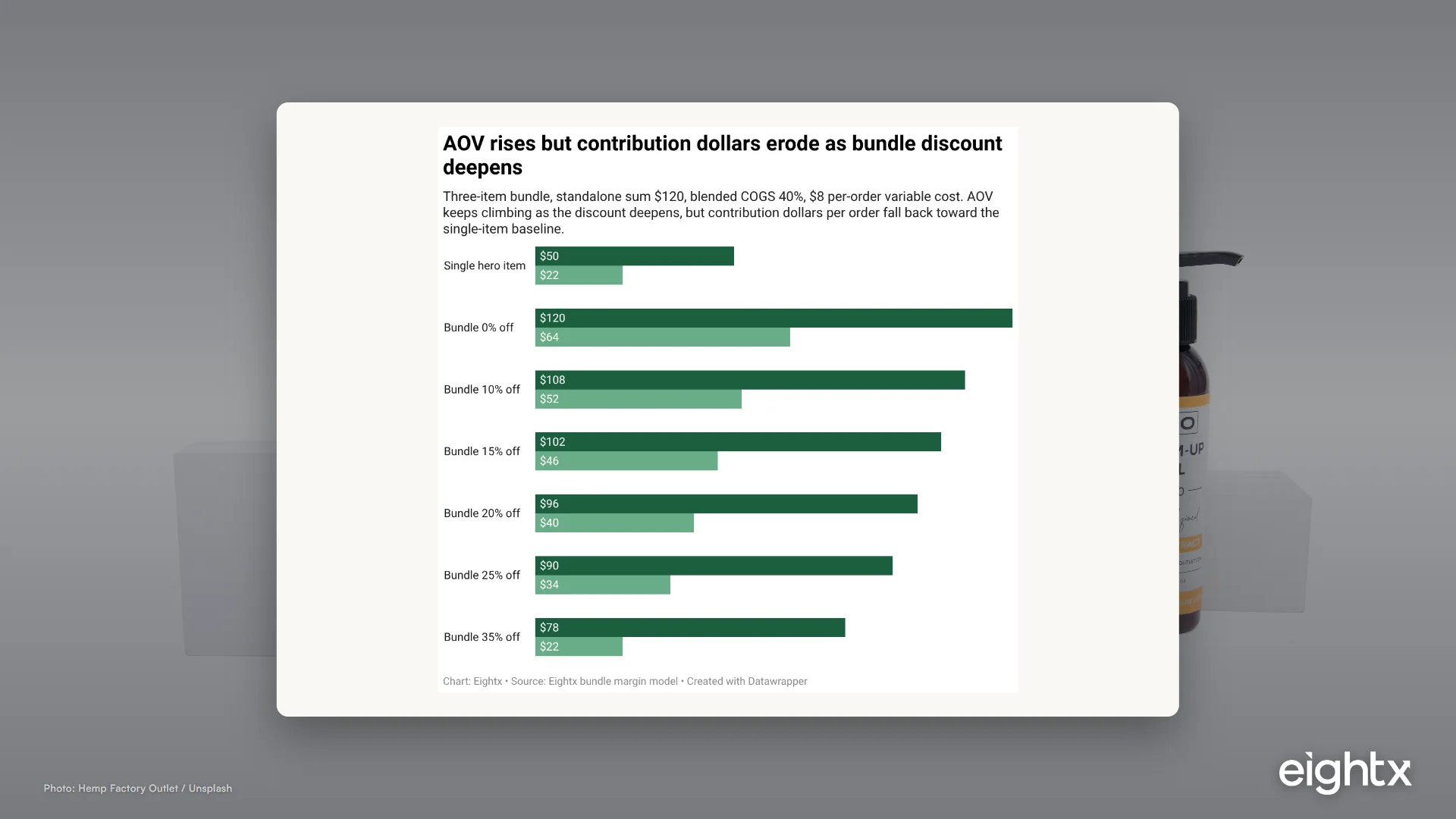
- On a 3-item bundle (standalone sum $120, 40% COGS, $8 order cost), a 10% discount delivers $52 of contribution per order versus $22 for a single item. A 35% discount lifts AOV to $78 but drops contribution back to $22, same as one item.
- Keep bundle discounts in the 10 to 20% range. Typical DTC bundle discounts run 10 to 20%, and below 50% gross margin you should stay nearer 5 to 10%.
- The lever bundles pull is order-cost leverage: you spread the same fulfillment and payment cost over 3 units instead of 1, so contribution per order can rise faster than AOV even after a discount.
- Attach rate beats discount depth. A bundle taken on 8% of orders at a 12% discount usually beats a bundle taken on 4% of orders at a 25% discount, on total contribution dollars.
Bundles are the most over-claimed lever in DTC pricing. Every Shopify app deck promises a 20 to 30% lift in average order value, and the lift is usually real. The problem is that AOV is the wrong scorecard. A bundle can push your AOV up and your profit per order nowhere, because the discount you used to trigger the bigger basket gave back exactly the margin the bigger basket created.
The right question is not "did AOV go up." It is "did contribution dollars per order go up." That is the number that pays for your ads and your overhead. Get the discount depth right and a bundle is one of the cleanest margin wins in ecommerce. Get it wrong and you are doing more work, shipping more units, and making the same money. Here is the math and the design rules.
The four bundle types and what each does to margin
Not all bundles behave the same way on a P&L. Four common structures, ranked roughly by how kind they are to contribution margin:
- Pure (fixed) bundle. A set group of SKUs sold as one unit at one price, like a starter kit. Simple to merchandise, but the value prop is almost entirely the price cut, so it tends to need a deeper discount to convert.
- Mixed (mix-and-match) bundle. The customer picks a qualifying combination ("any 3 for X"). Choice adds perceived value beyond price, so it can carry a shallower discount. Strong for beauty, supplements, food, and beverage.
- BOGO. Buy one get one free or half off. A blunt, high-converting mechanic, but a true BOGO is a 25 to 50% effective discount on the pair, which is brutal on margin unless the second unit is a low-cost add.
- Build-a-box. The customer assembles a fixed-count box from a menu. Maximum choice, often the strongest AOV lift, and the convenience framing lets you hold the discount down. The most margin-friendly structure when merchandised well.
Vendor and agency estimates put DTC bundle AOV uplift at roughly 15 to 30%, with mix-and-match and build-a-box offers cited at the top of the range (22 to 35%) and disciplined fashion programs nearer 5 to 15% (Zipchat, Convertibles, 2026). Treat those as directional vendor numbers, not measured panel data. The structure matters less than the discount you attach to it.
The worked example: AOV up, contribution sometimes flat
Here is the model that should govern every bundle decision. Take a hero item priced at $50 with a $20 product cost (a 60% gross margin, a representative DTC assumption that sits inside the apparel band our markup vs margin guide puts at 50 to 62%; pick the margin that matches your own category). Add $8 of per-order variable cost: fulfillment, pick and pack, and payment fees. A single-item order looks like this:
- Revenue $50, COGS $20, gross profit $30, minus $8 order cost = $22 contribution per order.
Now build a 3-item bundle. Standalone the three items sum to $120 with $48 of blended COGS, which holds the same 40% product-cost ratio as the hero (this assumes you are not padding the box with lower-margin filler SKUs, which would change the blended COGS and lower contribution at every depth). The model also assumes the bundle ships as a single parcel: the whole engine is that the $8 order cost barely moves whether you ship one unit or three, and that only holds if the three items go in one box. A bundle that splits into two shipments or trips dim-weight surcharges carries a higher and rising order cost, which eats into the contribution numbers below. With those two assumptions stated, walk the discount ladder:
| Order type | Discount | AOV | COGS | Gross profit | Order cost | Contribution $ |
|---|---|---|---|---|---|---|
| Single hero item | n/a | $50 | $20 | $30 | $8 | $22 |
| 3-item bundle | 0% off | $120 | $48 | $72 | $8 | $64 |
| 3-item bundle | 10% off | $108 | $48 | $60 | $8 | $52 |
| 3-item bundle | 15% off | $102 | $48 | $54 | $8 | $46 |
| 3-item bundle | 20% off | $96 | $48 | $48 | $8 | $40 |
| 3-item bundle | 25% off | $90 | $48 | $42 | $8 | $34 |
| 3-item bundle | 35% off | $78 | $48 | $30 | $8 | $22 |
Read the last row carefully. At 35% off, your AOV is $78, still 56% above the single-item order. Anyone reporting on AOV would call it a win. But contribution per order is $22, identical to selling one item. You shipped three units, carried more COGS, and made the same money. The deep discount handed back the entire benefit of the bigger basket.
A 10% bundle discount is the sweet spot here: $52 of contribution per order, more than double the single item, with a modest enough markdown that the customer still feels the deal. The lesson is not "never discount." It is that the first 10 to 15 points of discount are cheap relative to the contribution the extra units create, and everything past 20 points is where you start giving the win back.
The discount-depth vs attach-rate tradeoff
The instinct when a bundle is not converting is to discount harder. Usually the better lever is attach rate, the share of orders that include the bundle. Total bundle contribution is attach rate times contribution per bundle, and the two move against each other: a deeper discount tends to lift attach rate, but it also cuts contribution per order. The deeper you cut, the harder the attach rate has to work just to stand still.
Run the tradeoff on the table above. Take a 10%-off bundle that earns $52 of contribution per order and gets taken on 8% of orders, versus a 25%-off bundle that earns $34 and gets taken on 4% of orders. Both contribution figures are real rows in the ladder, so there is nothing interpolated here. Per 1,000 orders, the shallow offer generates 80 x $52 = $4,160 of bundle contribution; the deep offer generates 40 x $34 = $1,360. The shallow, higher-attach bundle wins by roughly 3x. Even a middle case, a 15%-off bundle at $46 contribution taken on 7% of orders, lands at 70 x $46 = $3,220, still more than double the deep-discount scenario. You almost always raise total contribution faster by improving placement, merchandising, and bundle logic than by cutting price.
That 3x gap is the whole argument for chasing attach over depth, and it shows up in real programs. A supplements brand we worked with ran a pure fixed starter kit at a 25% discount and was getting it on about 4% of orders. We rebuilt it as a build-a-box at 12% off and leaned on merchandising rather than price: a clearer "pick any 3" module on the PDP, the box surfaced in the cart drawer, and a one-click add at checkout. Attach climbed to roughly 9% of orders within two months and the contribution per box went up at the same time because the discount was shallower. On 1,000 orders that was the difference between about $1,400 and well over $4,000 of bundle contribution, with no extra ad spend. The blended COGS you feed into a bundle is itself a sourcing decision, and for supplement brands that often comes down to the co-packer versus in-house manufacturing trade.
A beauty brand showed the opposite failure mode. They ran a 35%-off "everything you need" set and were thrilled with a 30% AOV lift in the first month. When we put it through the model, CM3 was dead flat: the deep discount had handed back the entire benefit of the larger basket, exactly the 35%-off row in the table. They had bought revenue, not profit. Pulling the discount to 15% cost them a few points of attach but lifted contribution per box by more than half, and total bundle contribution rose even though the headline AOV came down. The AOV number got worse and the business got better, which is the entire point of scoring on contribution.
A third brand, in food and beverage, proved attach is mostly a merchandising problem, not a price problem. Their mix-and-match "build your variety pack" sat at a 20% discount and a thin attach rate. Instead of deepening to 30%, they held the discount and tested placement: moving the bundle module above the fold on the PDP and adding a post-purchase upsell. Attach roughly doubled off the placement changes alone. The price never moved. That is the lever most brands skip because cutting price feels faster than fixing merchandising, even though merchandising is where the durable contribution lives.
This discipline also keeps you off the discount treadmill. Our discount rate by vertical benchmark puts the 2026 median ecommerce discount at 15% and the average at 19.5% across 93,000 merchants, and notes that one added point of average discount depth at a 60% gross margin costs about 1.7 points of contribution. Bundles that lean on depth quietly push your blended discount rate up, train customers to wait for the deal, and compound into a structurally lower-margin business. A shallow bundle with strong attach does the opposite: it raises the basket without teaching anyone that your full price is negotiable.
Design a bundle that raises contribution dollars
- Score every bundle on contribution dollars per order, not AOV. Build the table above with your real COGS and your real per-order cost. If contribution per bundle is not clearly above your single-item contribution, the bundle is not working no matter what AOV says.
- Cap the discount at 10 to 20%, and at 5 to 10% if your gross margin is under 50%. Start shallow and only deepen if attach rate is genuinely stuck.
- Exploit order-cost leverage, but only when it is real. The bundle math works because fulfillment and payment costs are mostly fixed per order. That holds only if the bundle ships as a single parcel. Bundle items that fit in one box so you actually capture the leverage; if a configuration splits shipments or trips dim-weight surcharges, re-cost it before you trust the contribution number.
- Use mix-and-match or build-a-box before pure or BOGO. Choice and convenience let you hold the discount down while still lifting the basket. One supplements brand we worked with cut its bundle discount from 25% to 12% purely by switching from a pure fixed kit to a build-a-box, with no drop in attach, because the choice framing carried the value the price cut used to.
- Chase attach rate, not depth. Test placement (PDP, cart, post-purchase), the item mix, and the framing before you touch the price. A food and beverage brand we advised roughly doubled bundle attach by moving the module above the fold and adding a post-purchase upsell, while never changing the price.
- Watch CM3, not gross margin. After acquisition cost, your bundle still needs to clear the 20% CM3 scalable threshold from our contribution margin by vertical work. A bundle that lifts AOV but pushes CM3 below 20% is buying revenue, not profit.
For brands deciding between bundling and other AOV levers, a bundle is the entry-order tool: pair it with subscription pricing for repeat-order lifetime value and with free-shipping threshold math so the bundle clears your shipping-subsidy break-even. All three sit inside a broader ecommerce pricing strategy playbook, and if you also sell into retail, the same discipline has to hold up across your wholesale and DTC price lists so a bundle does not undercut a channel.
Methodology
The bundle margin model is identity arithmetic. The single-item baseline uses a $50 price and $20 COGS, a 60% gross margin chosen as a representative DTC assumption that sits inside the apparel band (50 to 62%) in the Eightx markup vs margin guide; other verticals in that guide run higher (beauty and personal care at 70 to 78%), so pick the margin for your own category rather than treating 60% as universal. Add $8 of per-order variable cost (fulfillment, pick and pack, payment fees), giving $22 contribution. The 3-item bundle uses a $120 standalone sum, $48 blended COGS held at the same 40% product-cost ratio as the hero (no lower-margin filler SKUs), and the same $8 order cost held flat across configurations; that flat order cost assumes single-parcel fulfillment. Contribution at each depth is discounted revenue minus COGS minus order cost. The $8 order cost is a representative assumption, not a benchmark, and will vary by category, weight, and processor. AOV uplift ranges (15 to 30%), discount-depth norms (10 to 20%, and 5 to 10% below 50% margin), and bundle-type behavior are vendor and agency estimates from 2026 sources (Zipchat, Convertibles), not measured panel data. The 2026 ecommerce discount median (15%), average (19.5%, across 93,000 merchants), and the 1.7-point contribution cost per added discount point are from the Eightx discount rate benchmark. The 20% CM3 scalable threshold is from the Eightx contribution margin benchmark. The attach-rate tradeoff figures and the operator examples are illustrative scenarios on the model with anonymized, representative figures, not measured client results. The contribution dollars a disciplined bundle protects are what fund the next decision up the chain, whether that is reinvesting in growth versus capex or how you keep more of the profit after choosing between an LLC and an S-corp. For brands that want this run against their own data, that is the kind of work we do as a fractional CFO for ecommerce brands.
Frequently Asked Questions
does bundle pricing actually increase average order value?
Yes. Well-built DTC bundles lift AOV by roughly 15 to 30%, with mix-and-match and build-a-box offers often at the top of that range. But AOV is a vanity metric. The real question is whether the bundle adds contribution dollars per order, which depends entirely on how deep you discount it.
how much should i discount a product bundle?
Keep most bundle discounts in the 10 to 20% range. If your gross margin is below 50%, stay nearer 5 to 10%, because there is less cushion to give away. The goal is to discount just enough to trigger the larger basket without handing back the extra margin the larger basket creates.
what is the difference between aov and contribution dollars per order?
AOV is just revenue per order. Contribution dollars per order is what is left after product cost, fulfillment, and payment fees, which is the money that actually pays for acquisition and overhead. A bundle can lift AOV while leaving contribution flat if the discount is too deep, so contribution is the metric to optimize.
which type of bundle is best for margin?
Mixed and build-a-box bundles usually protect margin best because the perceived value comes from convenience and choice, not just a price cut, so they can carry a shallower discount. Pure fixed bundles and BOGO offers tend to need deeper discounts to convert, which puts more pressure on contribution.
is a higher attach rate or a deeper discount better?
Attach rate, almost always. A shallow-discount bundle taken on more orders generates more total contribution dollars than a deep-discount bundle taken on a few. Improve placement, merchandising, and the bundle logic to raise attach rate before you reach for a deeper discount.
do bundles work better than subscriptions for raising order value?
They do different jobs. Bundles raise the value of a single order; subscriptions raise lifetime value across repeat orders. Many brands use bundles as the entry offer and convert the best buyers to subscriptions, so the two are complementary rather than competing levers.