
Insights
Subscription vs one-time AOV in ecommerce: what the public data actually says (2026)
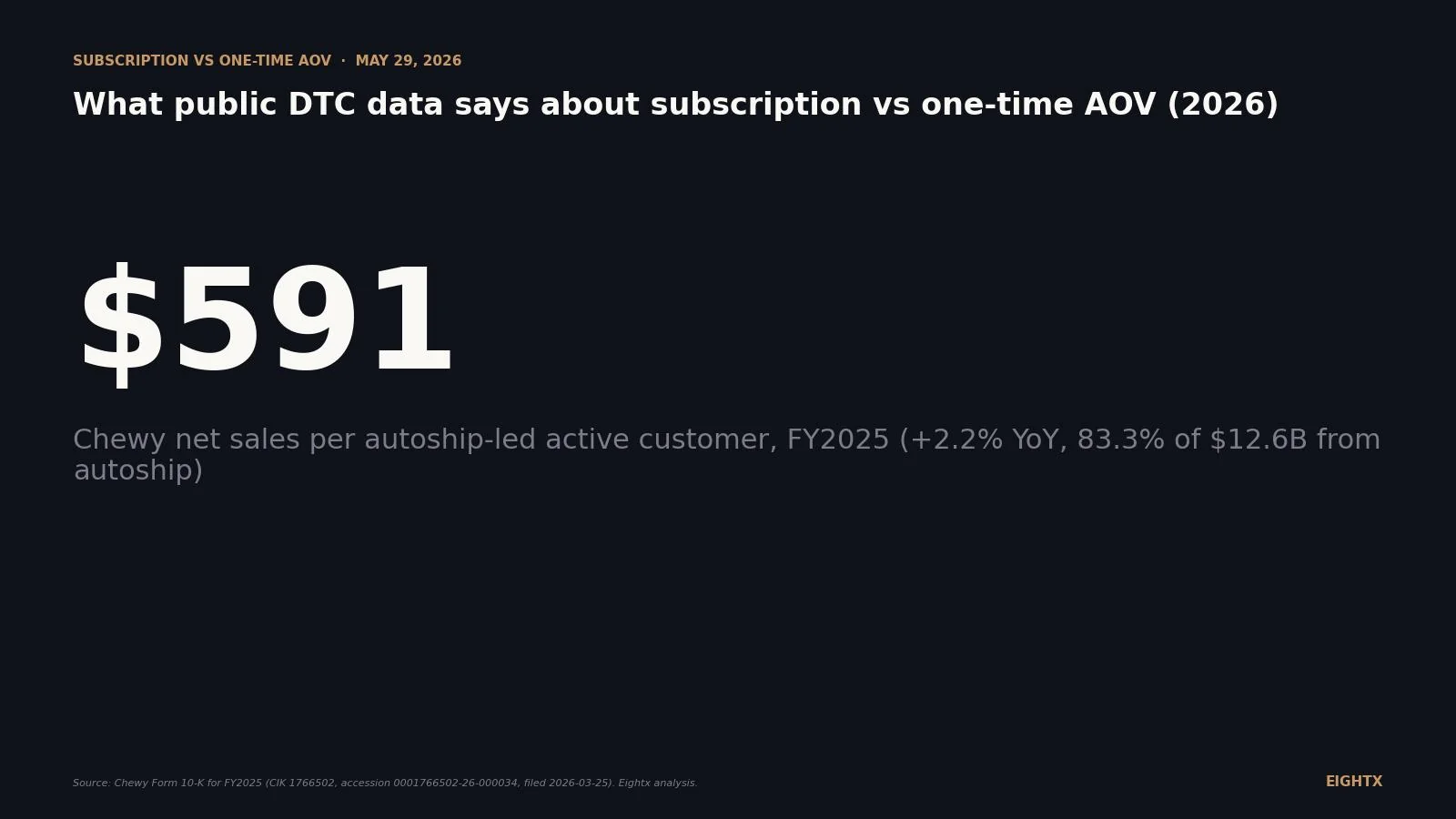
Subscription AOV uplift is real for consumables but does not hold for apparel, based on 2026 public data. Chewy autoship drives 83.3% of its $12.6 billion in net sales at $591 per active customer. For brands in pet, supplements, or repeat-use CPG, subscription programs expand AOV and LTV simultaneously. For fashion and hard goods, the subscription model frequently discounts without meaningfully lifting per-order value.
Key Takeaways
- Chewy FY2025: 83.3% of $12.6B in net sales came from autoship customers, and net sales per active customer reached $591 (+2.2% YoY). Autoship customer sales hit $10.5B, up 11.8% YoY. The win is frequency, not basket size.
- BARK Q3 FY2026 disclosed AOV: $31.41. A subscription-box brand running below the one-time pet ecommerce baseline of ~$61, because curated boxes have fixed price tiers. The play is recurring revenue, not basket.
- Subscription FIRST-ORDER AOV typically lands at 0.8 to 1.1x one-time AOV on the same store. Apparent uplift only shows up when the brand forces multi-pack or prepay structures inside the subscription flow. Pure subscribe-and-save almost always reduces per-order AOV.
- Median monthly churn rate is 7.02% (Recurly). Physical goods churn 10.54%, digital 6.63%. Amazon Subscribe and Save and pet autoship anchor the strongest disclosed retention at ~4.5%. Curated-box apparel sits 3x worse.
- Storeleads counts 10,478 Shopify stores with 10k+ monthly visits running a subscription app (Recharge, Bold, Skio, Loop, Appstle, Stay AI). That is your real addressable comp set for benchmarking subscription vs one-time AOV at the SMB and mid-market level.
Most operators we work with cite subscriptions as the AOV-uplift move. "Subscribe and save 15%, lift basket 20%, done." The public data tells a more nuanced story. The subscription win is frequency and retention, not basket size. Chewy FY2025 shows autoship customers driving 83.3% of $12.6B in net sales at $591 per active customer per year, which is roughly 10x the all-orders ecommerce AOV for pet (~$61). That 10x is annualized revenue per customer, not per-order AOV. This post collects what public DTCs (Chewy, Hims and Hers, BARK) and platform aggregators (Recurly, Recharge, Storeleads) actually disclose about subscription versus one-time AOV in 2026, and what to do with it.
What the public data actually says about subscription AOV
Start with the cleanest disclosed benchmark in the entire DTC universe: Chewy's autoship business.
Chewy's FY2025 10-K (CIK 1766502, accession 0001766502-26-000034, filed 2026-03-25) discloses three numbers across three fiscal years that let you triangulate the subscription effect cleanly. Autoship customer sales were $10.5B in FY2025, up 11.8% YoY. That's 83.3% of $12.6B in total net sales, up from 79.2% in FY2024 and 76.2% in FY2023. And net sales per active customer (NSPAC, the metric Chewy reports as a proxy for blended ARPU) reached $591 in FY2025, up from $578 and $555 in the prior two years.
Two things to notice. First, autoship as a share of net sales is growing about 3 percentage points per year. That's customers shifting onto autoship faster than the business is bringing in net-new active customers. Second, NSPAC is growing only 2 to 3% per year. The growth is autoship penetration (frequency, retention, share of wallet), not basket inflation.
For context, the all-orders ecommerce AOV in pet sits at roughly $61 per the average AOV by ecommerce vertical data (Dynamic Yield / ClickPost 2026 benchmarks). Chewy's autoship customer generates $591 of annualized revenue against a $61 category one-time baseline, which is roughly 10x the cumulative annual revenue per customer versus the category one-time baseline. Chewy doesn't disclose autoship per-order AOV, so the right read is annual revenue per customer, not order count: that ratio could be more orders at lower per-order AOV, fewer orders at higher per-order AOV (multi-bag bundles are common), or a mix. Either way it's the subscription model working: not bigger baskets, but multiples of cumulative revenue per customer per year. Anyone telling you the subscription play is a 20% AOV bump on a one-time customer is reading a vendor case study, not a 10-K.
Subscription AOV by vertical: the uplift is bundle-dependent, not subscription-dependent
The pattern across verticals is consistent: the "+15 to +25% subscription AOV uplift" claim only holds when the brand structures a multi-pack, prepay, or multi-SKU bundle into the subscription flow. Pure subscribe-and-save (same SKU, same quantity, minus 10%) lands subscription AOV at 0.8 to 1.1x one-time on the same store. The 0.8-1.1x figure is a practitioner-synthesis range from Recharge platform data summarized by subscription consultants and operator-survey responses (the underlying Recharge numeric tables are gated); we treat it as the working range, not a primary statistic.
The chart above is the bundle-structured case. Consumables (food, beauty, pet, supplements) show 16 to 23% uplift because subscription tiers are typically multi-pack or multi-SKU. Apparel sits at ~5% uplift, and that's only for replenishment-style apparel subscriptions (basics, undergarments, socks). Curated-box apparel (StitchFix-style) typically runs BELOW one-time apparel AOV because the box price is fixed.
Here is the working table operators should anchor planning to:
Vertical One-time AOV baseline (USD) Typical subscribe-and-save discount Typical bundle size Subscription AOV range (USD) Net uplift % Food and Beverage (CPG) 60 to 100 10 to 15% 2-3 pack 70 to 120 +15 to +20% Beauty / Personal Care 70 to 120 10 to 20% Multi-SKU or box 80 to 150 +15 to +30% Pet (autoship) 40 to 80 5 to 10% Multi-bag or multi-SKU 50 to 100 +15 to +25% Supplements 70 to 130 10 to 20% 2-3 bottle 85 to 170 +20 to +30% Apparel (replenishment) 50 to 120 10 to 15% Multi-pack basics 60 to 130 +10 to +20% Apparel (curated box) N/A Per-box pricing 1 box 60 to 120 Flat or below one-time
A $5-10M brand operator we work with put it cleanly on a call earlier this year. "Why are we having an AOV of $64? Because most people buy two or three sections with a discount. So they have like a stock for two months." The discount plus the multi-pack mechanic is the entire reason their AOV sits where it does. Strip the multi-pack and the subscription AOV collapses below one-time.
The churn ceiling: why subscription AOV math collapses without retention
You can run all the AOV uplift you want, but if monthly churn is above 10% the LTV math breaks. Subscription is fundamentally a retention game where AOV is a second-order lever.
The Recurly State of Subscriptions data (via Shopify Enterprise) puts median monthly churn at 7.02% across all subscription ecommerce. Physical goods run higher at 10.54% (because shipping friction, delivery cadence mismatches, and product expiration all kick in). Digital subscriptions run lower at 6.63%. For deeper category breakdowns see our average subscription churn rate by category piece. The two cleanest top-end anchors come from disclosed retention: Amazon Subscribe and Save runs 3 to 6% monthly churn based on operator coverage and BBC reporting, and Chewy autoship is in the same range based on backed-out 10-K disclosures.
A worked example for why this matters. Take a beauty subscription with a $90 subscription AOV and a $40 contribution margin per order.
- At 5% monthly churn, average customer life is 20 months. Cumulative contribution per customer is roughly $800. Strong unit economics.
- At 10% monthly churn, average customer life is 10 months. Cumulative contribution drops to roughly $400. Marginal.
- At 15% monthly churn (curated-box-apparel territory), average customer life is 6.7 months. Cumulative contribution is roughly $268. You're underwater on most paid acquisition channels.
Involuntary churn (failed payment cards, expired cards) is 30 to 40% of total churn and as high as 50% for sub-$10 AOV subscriptions. Sub-$10 AOV brands lose ~14% to failed payments alone vs ~4% for $1,000+ AOV. That's a structural argument for pushing subscription AOV up to a $30+ floor: card-update workflows recover better dollars per percentage point of churn at higher AOVs.
What Chewy, Hims, and BARK disclose, and what they hide
Three public DTCs anchor the disclosed end of the benchmark range. None of them publish a clean "subscription AOV vs one-time AOV" table, but the metrics they do publish triangulate the picture.
Company Fiscal year end Revenue (USD) Subscription / autoship metric Disclosed AOV Gross margin Chewy (CHWY) 2026-02-01 $12.6B Autoship 83.3% of net sales; NSPAC $591 Not disclosed (NSPAC $591 annualized) 29.8% Hims and Hers (HIMS) 2025-12-31 $2.35B Online revenue per avg subscriber ~$80-85/mo (Eightx estimate) Not directly disclosed 73.8% BARK (BARK) 2025-03-31 $484M Subscription box ARPU model; DTC dominant $31.41 (Q3 FY2026 investor materials) 62.4%
BARK is the most useful data point for box-subscription operators. AOV of $31.41 against a one-time pet ecommerce baseline of ~$61 confirms what curated-box operators already know: the box price point IS the AOV ceiling. The business model doesn't run on AOV uplift; it runs on recurring revenue at thin per-order margin (BARK gross margin 62.4% but operating loss of $35.1M, because acquisition and retention costs sit above gross margin).
Hims and Hers is the highest-quality subscription business in the comparable set: $2.35B revenue (+59% YoY) at 73.8% gross margin. The catch is they don't report AOV at all. They report subscribers (~2.4M ending) and revenue, which means you can back out an ARPU number (~$80 to $85 per subscriber per month) but you can't separate it into AOV times frequency. ARPU is the right metric for prescription-refill-plus-bundled-product models because one subscriber's monthly line item can carry multiple SKUs.
For the SMB and mid-market layer below the public DTCs, Storeleads is the best available comp set. A search for Shopify stores with 10k+ monthly visits running a subscription app (Recharge, Bold, Skio, Loop, Appstle, Stay AI) returns 10,478 stores. That's the addressable benchmark population. Recharge has the largest install base in this cohort per Storeleads; Skio is the newer challenger; Loop and Bold are credible alternates. We've broken down the trade-offs in our Recharge vs Bold vs Loop subscription app comparison.
The operator decision tree: discount, bundle, churn
Three calls every operator launching or refining a subscription has to make. Here's how we think about each one with the data above as the floor.
Call 1: discount. Set subscribe-and-save by margin profile. If your contribution margin (revenue minus COGS, shipping, payment fees) is above 40%, a 15% discount is sustainable. Between 30 and 40%, push to 10%. Below 30%, run free shipping as the perk instead of a percentage off. The instinct to match a competitor's 20% discount usually fails the cohort math.
Call 2: bundle. This is where the AOV uplift actually lives. A 2-pack at 10% off lifts subscription AOV by ~80% over a single-unit subscribe-and-save. A 3-pack at 12% off lifts AOV by 150% over single-unit. Operators we work with consistently underestimate how operationally hard the bundle is, but it IS the AOV-uplift mechanic. A European supplement operator on a recent call put it directly: "If we sell a subscription, we won't be able to sell them on an AOV of €68. Then the AOV will be what's costing subscription." Bundling is the only mechanic that flips that math.
Call 3: churn. If your subscription AOV is LOWER than your one-time AOV, that's not a failure mode, that's a signal of cannibalization. People who would have bought one-time at higher basket sizes are subscribing at lower basket sizes for the discount. Three ways to fix: raise the subscription minimum order ($75 floor on a $60 one-time AOV brand is reasonable), force a bundle at the subscription tier (no single-unit subscriptions), or shorten the cadence so frequency makes up for basket (monthly versus quarterly). On cadence specifically, the practitioner-data pattern is bimonthly and quarterly retain better than monthly, with annual prepay the exception that may or may not work depending on category.
The subscription win is not bigger baskets. It's recurring revenue from customers you already paid to acquire. Chewy at $591 per active customer per year on a $61 category baseline is the cleanest evidence in DTC. If your subscription is delivering basket uplift instead of frequency uplift, you've optimized the wrong variable.
Sources and methodology
SEC EDGAR 10-K filings. Three filings anchor the public-DTC data points. Chewy, Inc. (CIK 1766502) 10-K for FY2025, accession 0001766502-26-000034, filed 2026-03-25. The "Key Financial and Operating Data" table provides FY2023-FY2025 net sales per active customer ($555, $578, $591), autoship customer sales ($8.49B, $9.39B, $10.5B), and autoship share of net sales (76.2%, 79.2%, 83.3%). Hims and Hers Health (CIK 1773751) 10-K for FY2025, filed 2026-02-23, providing FY2025 revenue $2.35B, gross margin 73.8%, and operating cash flow $300.0M. BARK, Inc. (CIK 1819574) 10-K for FY2025 (March 2025 fiscal year end), filed 2025-06-04, providing $484M revenue and 62.4% gross margin. BARK's Q3 FY2026 disclosed AOV of $31.41 appears in the company's Q3 FY2026 earnings release and accompanying quarterly investor deck, filed as an 8-K exhibit (CIK 1819574). The earnings release and supplemental materials are linked from the investor relations site at https://investors.bark.co/news-events/press-releases and https://investors.bark.co/financials/sec-filings (filter: 8-K, period Q3 FY2026); the specific accession is on EDGAR under CIK 1819574 for the quarter ended December 31, 2025.
Recurly State of Subscriptions (cited via Shopify Enterprise and Oberlo). Median monthly subscription churn of 7.02% across all subscription ecommerce, physical-goods churn 10.54%, digital 6.63%. Amazon Subscribe and Save 3 to 6% target retention is from Amazon's public disclosures and the BBC's operator coverage; pet autoship 3 to 6% is backed out from Chewy 10-K disclosures on customer retention.
Dynamic Yield and ClickPost 2026 ecommerce AOV by industry (https://www.clickpost.ai/blog/average-order-value-by-industry). All-orders ecommerce AOV: Food and Beverage $89, Beauty $87, Pet $61, Apparel $281. These are blended one-time benchmarks across the long tail of stores; individual brands will vary based on price point and SKU mix.
Recharge State of Subscription Commerce (https://getrecharge.com/blog/state-of-subscription-commerce/) plus Kissmetrics on subscribe-and-save discount norms. Numeric vertical AOV tables are gated; we cite the qualitative claims plus public-DTC disclosures as the verifiable floor. The "0.8 to 1.1x one-time AOV for same-store first-order subscription AOV" finding is synthesized from Recharge platform data via subscription consultants and operator-survey responses.
Storeleads platform pull, 2026-05-29. Filter: platform=Shopify, min_monthly_visits=10,000, app_name matches (Recharge, Bold Subscriptions, Skio, Appstle, Loop, Stay AI). Result: 10,478 stores. This is the closest available proxy for the addressable mid-market subscription-app comp set.
Limitations. No public DTC discloses "subscription AOV" and "one-time AOV" as separate line items, so we triangulate via NSPAC (Chewy), ARPU (Hims), and disclosed AOV (BARK) plus operator-survey benchmarks. Recurly's churn data is 2025-vintage carried into Shopify Enterprise's 2026 article, not labeled 2026 in primary. Subscription discount norms (10 to 15%) are widely cited but not statistically representative across the long tail of stores. We refresh this index quarterly when public DTCs report; the next refresh anchor is Chewy's Q1 FY2026 10-Q in late May 2026.
Frequently asked questions
is subscription aov actually higher than one-time aov on the same store?
Usually no, not on the first order. Practitioner data across Recharge stores puts subscription first-order AOV at 0.8 to 1.1x one-time on the same SKU. The uplift you've read about (+15 to +25%) only shows up when the brand structures a multi-pack or prepay into the subscription flow. Pure subscribe-and-save (same SKU, same quantity, minus 10%) almost always lowers per-order AOV.
what's the typical subscribe and save discount in 2026 and does it kill my margin?
10 to 15% is the norm across CPG, pet, and food and beverage. Beauty and supplements push to 15 to 20%. The discount itself rarely kills the deal because subscription customers convert without paid acquisition after the first order, so your blended CAC drops. Where it kills margin is when you stack the discount on a bundle discount on a sitewide promo. Pick one.
what is chewy's net sales per active customer and how much of it is autoship?
FY2025 net sales per active customer was $591, up from $578 in FY2024 and $555 in FY2023. Autoship customer sales were 83.3% of $12.6B in net sales, up from 79.2% in FY2024 and 76.2% in FY2023. Autoship sales grew 11.8% YoY versus 2.2% on the per-customer metric, so the autoship penetration is doing more of the work than basket inflation.
how do i calculate the right subscription discount without destroying ltv:cac?
Start from gross margin after shipping and payment fees, not headline gross margin. If you make 40 points after variable costs, a 15% subscribe-and-save discount eats 15 of those 40 points (38% of your margin) on every recurring order. If retention payback hits inside 3 orders you're fine. If it takes 5+ orders the math breaks. Model it on your actual cohort, not on a vendor's case study.
what monthly churn rate is acceptable for a dtc subscription box in 2026?
Under 8% monthly is healthy. 8 to 12% is the practitioner median for physical goods (Recurly puts it at 10.54%). Over 12% means you're acquiring people who don't fit the offer; the fix is targeting and onboarding, not retention emails. Curated-box apparel sits at 12 to 15% as a structural ceiling, which is why box brands lean hard on annual prepay.
is subscription aov higher in pet, beauty, supplements, or cpg food?
Supplements and beauty pull the highest absolute subscription AOV because the SKUs are higher-priced and bundle naturally (2-bottle, 3-pack, multi-SKU regimens). Pet autoship runs the lowest absolute AOV (~$70 midpoint) but the highest retention. CPG food sits in the middle. Apparel curated boxes are the outlier: they typically run below one-time apparel AOV because box price points are fixed.
how does hims and hers report aov for their subscription model?
Hims and Hers doesn't disclose AOV directly. They disclose subscribers (~2.4M ending in FY2025) and online revenue ($2.35B FY2025, +59% YoY). Implied monthly revenue per subscriber is roughly $80 to $85. That's an ARPU number, not an AOV. The distinction matters: ARPU includes prescription refills, bundled products, and personalized plans where one subscription line item can mean multiple SKUs per month.
should i launch subscriptions on shopify with recharge, bold, skio, or loop?
All four work. Recharge is the default and has the deepest integrations (10,478 mid-market Shopify stores run a subscription app, mostly Recharge). Skio is the newer challenger with better mobile UX. Loop and Bold are alternates worth quoting. The decision is rarely the platform, it's whether you can set up bundles or prepay (the AOV-uplift mechanic) without rebuilding your product taxonomy.