
Financial Strategy
BoC cut to 2.25% but your DTC cost of capital didn't drop: what Canadian operators actually pay in 2026
The Bank of Canada cut its policy rate from 5.00% to 2.25% by October 2025, but Canadian DTC operators did not feel it. Bank prime still sits at 4.45% on a wider-than-normal spread, and Shopify Capital, Wayflyer and Clearco price 15-30% APR-equivalent. Here is what Canadian brands actually pay for capital in 2026.
Key Takeaways
- The Bank of Canada cut from 5.00% to 2.25% between June 2024 and October 2025, then held through the April 29, 2026 decision. Five straight holds (Dec 2025, Jan, Mar, Apr 2026, and the May reaffirmation). If you've been waiting for cheaper capital, this is the level.
- Canadian chartered bank prime is 4.45% as of May 2026. The spread of prime over the overnight rate is 2.20 percentage points, versus a 50-year average of 1.69pp. Banks are pricing 51 bps more above policy than the long-run average (a benchmark that spans multiple funding regimes; the post-2022 era has structurally higher bank funding costs).
- Shopify Capital Canada translates to roughly 15-30% APR-equivalent in 2026 (10-20% fee on 6-12 month tenor). Wayflyer lands at 16-25%, Clearco at 18-30%, MCAs at 35-80%. The BoC cut did not flow through to any of these.
- The cost-of-capital gap between BoC policy (2.25%) and typical DTC working capital (15-30% APR) is 13-28 percentage points. It did not narrow when the BoC cut. It will not narrow when the BoC cuts again.
- BDC term loans (estimated 7-9%) and bank LOCs (prime + 1-3%, so 5.45-7.45%) are the only Canadian sources that meaningfully reprice with BoC. Everything else is fee-based and decoupled from policy, and in our operator interviews the majority of a DTC brand's working capital sits in that decoupled bucket.
The Bank of Canada cut its overnight policy rate from a peak of 5.00% in mid-2024 to 2.25% by October 2025 and has held there through five straight decisions, including the April 29, 2026 hold. On paper, that should mean cheaper capital for Canadian DTC operators because every borrowing cost should compress. In practice, the spreads on most non-bank capital have not narrowed: chartered bank prime is still 4.45% (a 2.20 percentage-point spread over the overnight rate, versus a 50-year average of 1.69pp), Shopify Capital Canada fees translate to roughly 15-30% APR-equivalent, and MCAs sit at 35-80%. This page tracks the gap quarterly so you stop assuming a BoC cut means a cheaper next inventory order. Here's what to watch, what changed, and what to do this week.
What the Bank of Canada did from 2024 to 2026
The BoC's easing cycle started in June 2024 and ran for roughly 16 months. The first cut took the overnight rate from 5.00% to 4.75%. Five more cuts followed through December 2024 (4.25%, 3.75%, 3.25%), and three more through October 2025 took the rate to its current 2.25% level. Since then: holds in December 2025, January 2026, March 2026, and April 2026. The April 29, 2026 decision was the fourth straight hold.
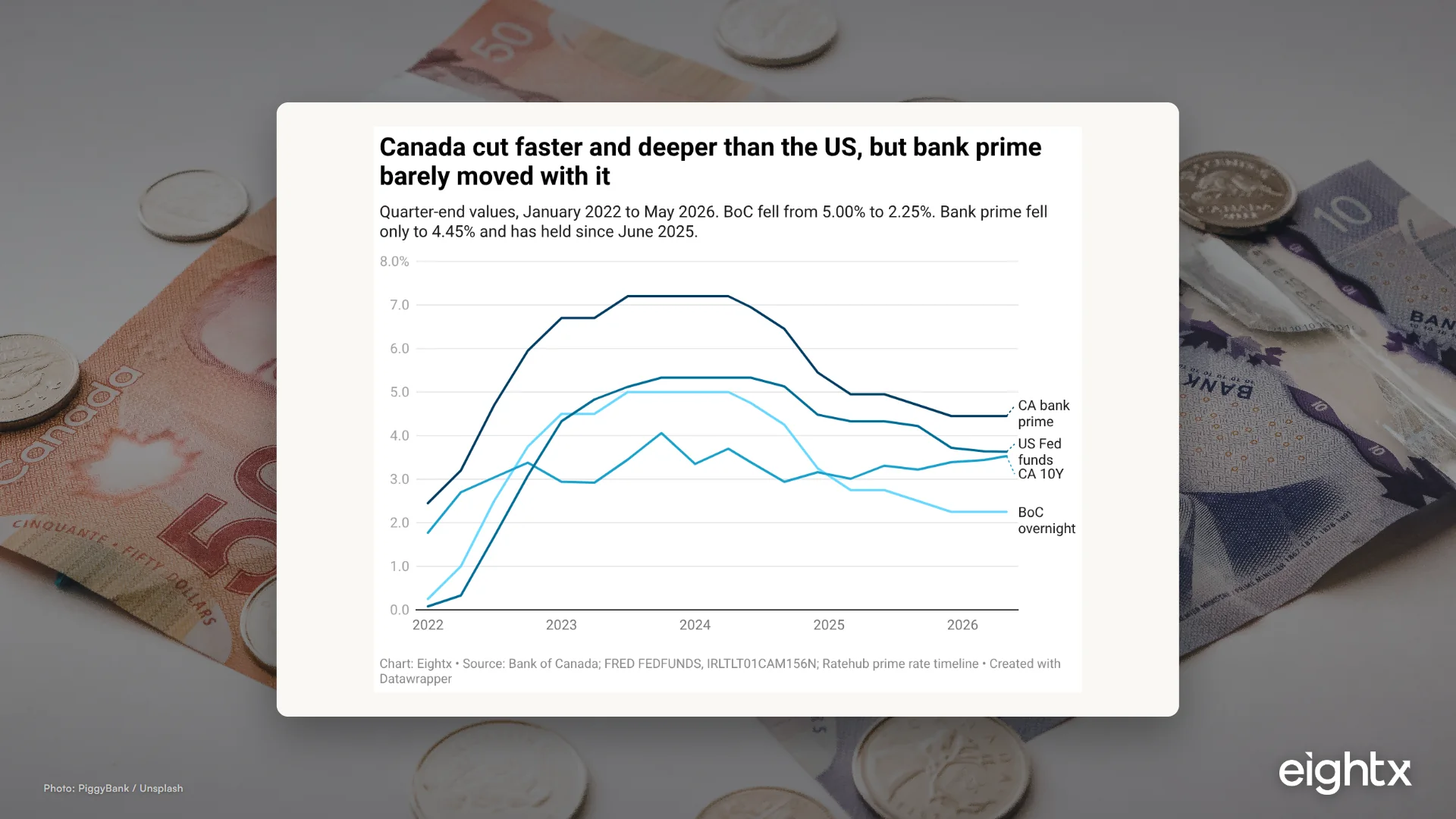
For context, the US Fed funds rate fell from a 5.33% peak to 3.63% over the same window. Canada cut earlier and further, opening a 138 basis point gap between Canadian and US policy rates by May 2026. That's the widest negative spread (BoC minus Fed funds) since 2022.
The bank-prime line is the one most Canadian operators notice. It moved with BoC most of the way down, but it stopped at 4.45% in June 2025 and has held there ever since (across all five Big-5 banks). The Big-5 are now charging 2.20 percentage points above the overnight rate, versus a 50-year average prime-to-overnight spread of 1.69pp. The 50-year average covers several different funding regimes and post-2022 bank funding has stayed structurally more expensive than the policy rate implies, so the spread is not pure margin. Even with that caveat, the extra 51 bps is not a small number for any business borrowing on a prime-linked LOC.
The gap between policy rate and what you actually pay
The reason most operators feel zero benefit from BoC cuts is that the working capital they actually use sits 13 to 28 percentage points above the policy rate. That gap did not narrow on the way down and will not narrow on the way up.
The reference rates (BoC, CA 10-year, bank prime) sit at the cheap end of the ladder, but no Canadian DTC operator actually borrows at those numbers. The cheapest real-world source is a bank LOC at prime + 1-3% (so 5.45 to 7.45% APR). Above that: BDC term loans at roughly 7-9% (their posted rates are not public, this is inferred from operator interviews and BDC's pricing convention of policy plus a risk spread), Wayflyer at 16-25% APR-equivalent, Shopify Capital Canada at 15-30%, Clearco at 18-30%, and merchant cash advances at 35-80%.
The reason the high end of that ladder is decoupled from BoC is product structure. Shopify Capital, Wayflyer, and Clearco are flat-fee products: a brand agrees to a 5-20% fee on an advance, repaid as a percentage of daily sales. The fee is priced off the lender's view of your sales volatility, not the BoC overnight rate. When BoC cuts 25 bps, the spread the lender earns gets wider. Your fee does not move.
Why chartered bank prime didn't follow the BoC all the way down
The 2.20 percentage-point spread of prime over the overnight rate (vs the 50-year average of 1.69pp) is one of the cleanest "extra margin" stories in Canadian banking right now. Three things changed in 2024-2025 that made it stick.
First, the Big-5 raised their assessment of credit risk during the 2022-2023 hike cycle and never fully reset it. That extra risk premium has shown up as a wider prime-to-policy spread rather than as a one-time provision.
Second, prime is administratively set by each bank, not formulaic. The banks moved prime in lockstep with the early BoC cuts, then slowed the pass-through over 2025; the last move was the June 2025 step down to 4.45%, and prime has held there even though BoC kept cutting.
Third, the funding mix matters. Banks fund prime-linked loans partly through deposits and partly through wholesale rates. Wholesale funding has stayed elevated even as the BoC overnight has fallen, so the cost of capital for the banks themselves is higher than the overnight rate implies.
The operator read: if you're on a prime + N LOC, the next BoC cut will drop your rate. If you're shopping for new credit, the price you'll be quoted is set off prime + a risk spread that is permanently wider than it was in 2021. Don't anchor to a pre-2022 LOC rate as your benchmark; the floor has reset.
The Canadian DTC financing menu in 2026
We pulled current pricing across the nine sources a typical $5-50M Canadian DTC brand actually has access to. The table below ranks them by APR-equivalent (top of the band, where we have ranges) so you can compare apples to apples.
| Source | Typical APR range (2026) | Best for | Notes |
|---|---|---|---|
| BoC overnight (reference) | 2.25% | Reference rate | Set by Bank of Canada; floor for chartered bank pricing |
| Canada 10Y govt bond (reference) | 3.53% | Reference rate | FRED IRLTLT01CAM156N, May 2026 |
| Chartered bank prime | 4.45% | Reference rate | All Big-5 banks since June 2025 |
| Bank LOC (prime + 1-3%) | 5.45-7.45% | Revolving working capital for profitable brands | Requires personal guarantee, covenants, 1+ year history |
| BDC term/equipment loan | ~7-9% | 2-8 year fixed-asset financing | Inferred from operator interviews; BDC posted rates not public |
| Wayflyer revenue-based | 16-25% APR-equiv | Inventory and ad-spend (3-9 month tenor) | 5-10% fee per advance; $5K-$20M facilities |
| Shopify Capital Canada | 15-30% APR-equiv | Speed and ease for Shopify-native brands | 10-20% fee; daily revenue-share repayment |
| Clearco revenue-based | 18-30% APR-equiv | Inventory and ad-spend | Toronto-headquartered; refocused product mix post-2022 |
| Merchant cash advance (MCA) | 35-80% APR-equiv | Emergency or very short tenor only | Factor rates 1.10-1.50; very expensive |
If you're at $5-20M revenue, the practical hierarchy looks like this. A bank LOC is the cheapest revolving capital you can get, but it's the slowest to obtain (4-12 weeks) and the most covenant-heavy. BDC is your bridge for equipment, build-outs, or any fixed-asset purchase with a 2-8 year payback. Shopify Capital, Wayflyer, and Clearco are the speed-and-convenience layer when you need cash in 48 hours and you're willing to pay 15-30% APR for it. MCA is emergency-only.
How Canada's policy gap with the US shapes your decisions
Canada's overnight rate is 2.25%; the US Fed funds rate is 3.63%. That 138 bps gap is the widest negative spread since 2022 and matters for two reasons.
First, if you sell into the US in USD, the CAD-USD spot has weakened to roughly 1.38 in 2026 (FRED EXCAUS, April 2026 = 1.3754). That gives you a margin tailwind on US revenue translated back to CAD, but it also means any USD-denominated debt you carry costs more in CAD terms. If your inventory is bought in USD and your sales are in CAD, the spread between policy rates compounds the FX exposure.
Second, if you're comparing a Canadian Shopify Capital advance to a US-based RBF facility, the floor under each pricing decision is different. A US lender benchmarks off Fed funds at 3.63%. A Canadian lender benchmarks off BoC at 2.25%. The Canadian product should be cheaper on a pure rate basis. In practice the fee structures don't reflect that gap because the specialty-lender market in Canada is smaller and less competitive. The 138 bps policy gap delivers maybe 25-50 bps of consumer benefit, not the full spread.
What changes (and what doesn't) when BoC cuts again
The June 4, 2026 BoC decision is the next checkpoint, with a hold at 2.25% or a 25 bps cut to 2.00% both on the table. Either way, here's what moves and what doesn't.
Moves with the BoC cut (within 48 hours): your bank LOC if it's priced as prime + N, your variable-rate mortgage, any prime-linked credit card. Each 25 bps BoC cut drops your borrowing rate by exactly 25 bps, assuming the banks pass through the full cut to prime (they have on the way down so far in this cycle, but as the prime-to-policy spread shows, that pass-through is at the banks' discretion). If you carry $1M on a prime + 2% LOC at 6.45% and the cut flows through, you save $2,500 per year. Real money but not life-changing.
Does not move: any Shopify Capital advance you've already taken, any Wayflyer or Clearco facility, any MCA, your fixed-rate term loan, your fixed-fee inventory financing. These are all priced off the lender's view of your risk, not the BoC overnight rate.
Does not move (but should): the fee you'd be quoted on a NEW Shopify Capital advance after the cut. In a competitive lending market, repeated BoC cuts should compress specialty-lender fees over time. In Canada, that compression has not happened across 275 bps of cuts. Don't model in fee compression for your 2026 capital plan.
The BoC cut 275 basis points across 16 months and your effective cost of capital didn't move because most of what you actually use isn't tied to the overnight rate. The play in 2026 is not to wait for cheaper capital. It's to refinance whatever sits in the fixed-fee bucket into the bank-prime bucket as fast as your underwriting profile lets you.
What to do this week
Three actions if you run a $5-50M Canadian DTC brand.
Audit your weighted average cost of capital. List every facility (LOC, term loan, Shopify Capital, Wayflyer, MCA, credit card balance) with the outstanding balance and the effective APR. Multiply each by its share of total outstanding and sum. If the answer is above 12%, you have a refinancing problem the next BoC cut won't fix.
Get a bank LOC application moving if you don't already have one. Even if you don't need the capital today, the time-to-approval is 4-12 weeks and the rate you get in June 2026 is the rate that will move down with every future BoC cut. The cheapest dollar of capital you'll borrow in 2027 is the one you set up in 2026.
Stop rolling Shopify Capital advances on autopilot. Every renewal is a new flat-fee transaction priced off your current sales trend, not the BoC overnight rate. If your sales have stabilized or grown since the last advance, you can negotiate the fee down (Shopify rarely volunteers this). If the math doesn't work, BDC + bank LOC is the answer; expensive convenience compounds. While you're tightening the capital stack, tighten payables too: the right AP automation tool for your ecommerce stack captures early-pay discounts that beat what any cut to your LOC rate will save you.
For more on how the same dynamics play out in the US, see our Fed funds vs DTC cost of capital benchmark, the UK cost-of-capital reality for Shopify brands, and the global DTC cost-of-capital map.
Sources and methodology
Bank of Canada overnight rate. Current rate of 2.25% confirmed from the April 29, 2026 rate decision press release and the BoC policy-rate page. The historical path was reconstructed from the BoC's published rate-decision schedule (six meetings per year). Each decision date and rate change was cross-referenced against Ratehub's prime-rate timeline, which lags each BoC move by 24-48 hours.
Canadian chartered bank prime rate. 4.45% across all Big-5 banks (RBC, TD, BMO, Scotiabank, CIBC) as of May 2026. Last change was the June 2025 cut to 4.45%. The 50-year average spread of prime over the BoC overnight rate (1.69pp) was calculated from Bank of Canada and Ratehub historical series; the current 2.20pp spread is the May 2026 snapshot.
Bond yields. Canada 10-year government bond yield of 3.53% (May 2026) sourced from FRED series IRLTLT01CAM156N (Long-Term Government Bond Yields: 10-Year for Canada). US 10-year yield of 4.48% from FRED DGS10. US Fed funds rate of 3.63% from FRED FEDFUNDS.
Specialty lender pricing. Shopify Capital Canada fee ranges (10-20%) from Shopify's Canadian merchant documentation and operator interviews. Wayflyer pricing (5-10% per advance, 3-9 month tenor, $5K-$20M facilities) from Finder's 2026 Wayflyer review. Clearco pricing from public marketing and operator interviews. MCA APR ranges (35-80%) from Shopify's Canadian MCA guidance and the nautixcapital.com 2026 Shopify Capital review. BDC term loan pricing is inferred (7-9%) because BDC does not publish rate sheets; the inference is based on BDC's standard practice of policy + 4-7pp for term loans plus operator interviews. We flag this as inferred in the table above.
APR-equivalent methodology. Flat-fee products were converted to APR-equivalent assuming the typical tenor for each product (6-12 months for Shopify Capital, 3-9 months for Wayflyer, 4-9 months for typical MCAs). The math assumes daily revenue-share repayment on a declining balance. Actual APR for any specific brand depends on margin, sales volatility, and structure; treat the ranges as benchmark bands, not quotes.
Limitations. The FRED OECD Canadian central bank rate series (IRSTCB01CAM156N) ends in December 2023. We used the Bank of Canada's own key-interest-rate page for current values. BDC posted rates are not publicly available and the 7-9% band is our best inference. Specialty-lender APR ranges are derived from typical fee structures times typical tenors; individual quotes will vary based on underwriting.
Audience scope. The "$5-50M Canadian DTC brand" framing across this post is the operator profile Eightx works with most often: Shopify-native, mid-market, mix of bank and specialty-lender capital. Sub-$5M brands typically rely more heavily on Shopify Capital and credit cards; $50M+ brands access syndicated facilities and asset-based lending that aren't covered here.
Chart 1 caveat. The CA bank prime values plotted in Chart 1 are quarter-end approximations reconstructed from the BoC and Ratehub timelines, not a continuous daily series. Use the chart for the directional story (prime stopped tracking BoC after June 2025); use the rate-decision table in the body for exact dates and levels.
Update cadence. This tracker refreshes after each BoC rate decision (six per year) and on any prime-rate move from the Big-5. Next scheduled update: June 4, 2026 BoC decision.
Frequently asked questions
the boc just cut to 2.25%. why isn't my shopify capital fee any cheaper?
Shopify Capital is a fixed-fee product, not an interest-rate product. You agree to a flat 10-20% fee per advance, and that fee is priced off Shopify's underwriting view of your sales volatility, not the BoC overnight rate. When BoC cuts 25 bps, the spread Shopify earns gets wider; the fee you pay does not move. The only thing that changes your Shopify Capital rate is your own merchant profile (sales trend, daily volume, return rate).
what is the canadian bank prime rate right now and how often does it change?
Canadian chartered bank prime is 4.45% as of May 2026 across all Big-5 banks (RBC, TD, BMO, Scotiabank, CIBC). It last changed in June 2025. Prime moves when the BoC moves, but with two caveats: the banks decide whether to pass on the full cut (in this cycle they did, but not always), and they decide when to lift prime if BoC hikes (also usually within a few days). If BoC cuts again at the June 4, 2026 meeting, expect prime to drop to 4.20% within 48 hours.
should i refinance my mca into a bank line of credit in 2026?
Yes, if you can qualify. A bank LOC at prime + 1-3% (so 5.45-7.45% APR) versus a 35-80% APR MCA is the single biggest cost-of-capital swing available to a Canadian DTC operator right now. The catch is qualifying. Banks want 12-24 months of profitable history, a personal guarantee, and clean tax filings. If you're MCA-stacked or behind on CRA, BDC is usually the bridge: their term loans are cheaper than MCA and they have a higher tolerance for sub-prime profiles.
is bdc actually cheaper than rbc or td for a dtc brand?
BDC is more expensive than a Big-5 LOC if you qualify for one, and meaningfully cheaper than every non-bank alternative if you don't. RBC or TD will price a working capital LOC at prime + 1-3% (5.45-7.45% in 2026). BDC term loans land at an estimated 7-9% because they take longer tenors (2-8 years) and lend to riskier profiles. The play we've seen work for $5-20M brands: BDC for the fixed-asset purchase (equipment, build-out) on a long tenor, with an RBC or BMO LOC sitting on top for working capital.
what apr should i expect on a shopify capital canada advance in 2026?
Plan for 15-30% APR-equivalent on a typical 6-12 month tenor with a 10-20% flat fee. The exact number depends on your fee percentage and how fast Shopify sweeps it out of your daily sales. A 12% fee paid back over 6 months is roughly 23% APR. A 10% fee paid back over 12 months is closer to 18%. Operators we work with frequently see 20-40% effective APR on actual Shopify Capital advances, and we've seen one priced at 45%. Always ask for the implied APR before you click accept.
does wayflyer still operate in canada and how do their rates compare to clearco?
Yes. Wayflyer's Canadian program offers $5K to $20M facilities over 3-9 month terms with a 5-10% fixed fee per advance, which annualizes to roughly 16-25% APR-equivalent. Clearco (Toronto-headquartered) lands a bit higher at 18-30% on similar tenors. The differentiator is structure: Wayflyer is closer to a traditional revenue-based facility, Clearco's product mix has shifted toward inventory-specific advances post-2022. Both will be cheaper than Shopify Capital for most brands and meaningfully cheaper than any MCA.
why is the canadian 10-year bond yield lower than the us 10-year?
The CA 10-year is 3.53% versus the US 10-year at 4.48% (May 2026, FRED), a 95 bps gap and the widest since 2022. The driver is monetary policy divergence: BoC is at 2.25% versus US Fed funds at 3.63%, so the front end of the Canadian curve sits lower and pulls the whole curve down. The practical implication for Canadian DTC brands is that capital should be cheaper here than in the US, but the spread between policy and DTC working capital is wider in Canada because fewer specialty lenders compete in this market.
if the boc cuts again in 2026, will my chartered bank loc rate drop with it?
Yes, if your LOC is priced as prime + N. That's how almost all Canadian bank LOCs work, so a 25 bps BoC cut becomes a 25 bps cut to your borrowing rate within 24-48 hours. What does NOT move with a BoC cut: any fixed-fee product (Shopify Capital, Wayflyer, Clearco), any MCA, any fixed-rate term loan you've already signed, and your credit card interest rate. In the brands we work with, the majority of working capital sits in that non-policy-sensitive bucket.