
Margins
Slotting Fees: What They Cost and How to Model Them in 2026
Slotting fees are what retailers charge to stock a new SKU, typically 250 to 1,000 dollars per item per store, or planning ranges of roughly 5,000 to 75,000 dollars per SKU for a chain authorization. The FTC's early-2000s grocery study found an average of 9,182 dollars per UPC per region-chain, a directional figure that is now dated, not a current quote. Model breakeven as slot cost divided by gross profit per case.
Key Takeaways
- The FTC's early-2000s grocery study (dated, directional figures) pegged slotting at 2,313 to 21,768 dollars per item per retailer per metro, averaging 9,182 dollars per UPC and a 69.20 dollar per store average.
- Practitioner benchmarks for 2026 run 250 to 1,000 dollars per item per store, or 5,000 to 75,000 dollars per SKU for a chain authorization.
- Frozen and refrigerated SKUs carry the highest fees; Walmart, Costco, BJ's, and many natural retailers charge little or no upfront cash slotting.
- Breakeven cases equals total slot cost divided by gross profit per case. At the FTC's dated 9,182 dollar figure and 10 dollars per case that is roughly 918 cases.
- Budget free fills, pay to stay, and trade spend alongside the slot. The slot is the entry fee, not the full cost of retail.
A buyer says yes. Then they hand you a deal sheet with a number on it: the slotting fee. That number is the price of shelf space, and for most founders stepping into retail for the first time, it is the single line item that decides whether the launch makes money or quietly bleeds it.
Slotting fees are not a scam and they are not optional in most conventional grocery. They are how retailers price the risk and the real estate of carrying an unproven SKU. The job is not to avoid them. The job is to know the range, budget for it, and model the velocity you need to earn the slot back before you sign. This post gives you the dollar ranges by retailer and category, the FTC's category-level data, and the breakeven math.
When I talk to founders chasing their first big retail account, the pattern we see again and again is that they fixate on the top-line revenue the chain could add and treat the slotting fee as a cost of doing business they will figure out later. Then the deal sheet lands, the number is 40,000 dollars across the chain, and there is no model that says whether it pays back. This is the model.
What a slotting fee actually is
A slotting fee is what a retailer charges to stock a new SKU. It compensates the retailer for giving scarce shelf space to a product with no sales history: the warehouse setup, the system entry, the planogram change, and the opportunity cost of bumping something that already sells.
The structure varies, and that is what trips founders up. Some retailers charge per store. Some charge a per UPC fee across a metro. Some charge a single chain authorization fee per SKU. So "what does slotting cost" has no single answer until you know the retailer and the structure.
The slot is also rarely the whole bill. As one operator put it to us, when you go into grocery there is a whole category of spend called trade spend, and the listing fee to get SKUs on the shelf is only the first piece, sometimes around 10,000 dollars per SKU just to get on shelf at a chain. On top of that come the promos where you drop the price and cost-share it with the retailer, plus the end caps you pay extra to sit on. That bundle is why the cash slotting line understates the true entry cost.
One accounting note that matters for your P&L: slotting fees are generally treated as a deduction against revenue, in the same family as trade spend, not as COGS. As our retail distribution margin breakdown lays out, retail deductions and trade spend are exactly the layers a standard bookkeeper misses. The slot hits your net revenue line, which is why your gross margin can look healthy while the launch loses money.
What slotting fees cost in 2026
Here are the ranges worth budgeting against. The most rigorous public dataset is still the FTC's staff study of grocery slotting allowances. It is dated (the staff report draws on early-2000s data), so treat its dollar figures as directional rather than current quotes, but it remains the most rigorous public benchmark on the structure of these fees. It found fees ranging from 2,313 to 21,768 dollars per item per retailer per metropolitan area, with an average of 9,182 dollars per UPC per region-chain (median 6,500 dollars). On a per store basis, the same FTC report found an average of 69.20 dollars per UPC per store. The DOJ summary of that study corroborates the structure, noting that slotting concentrates in higher-margin manufacturer categories, but it inherits the same vintage caveat.
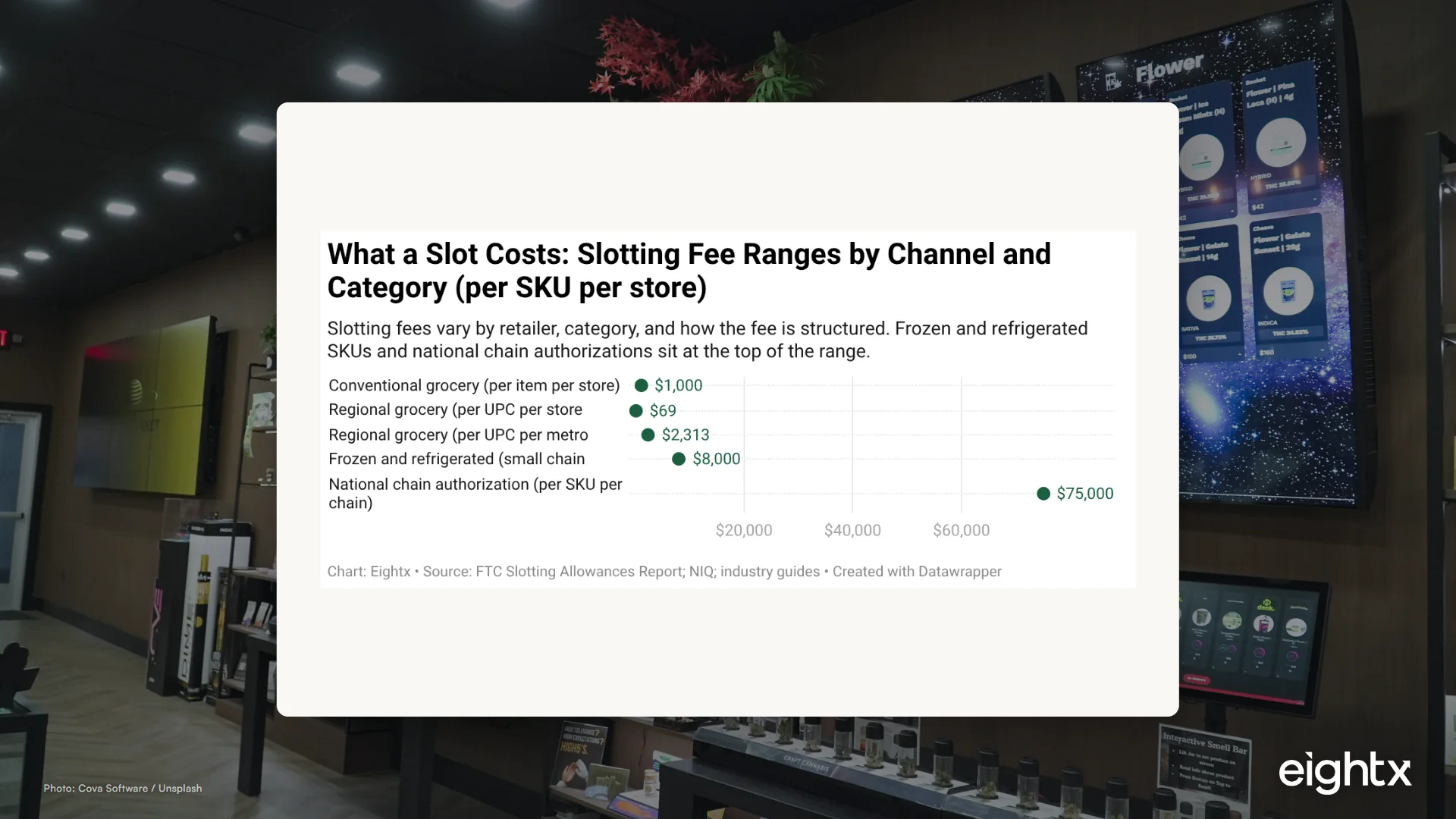
Current practitioner benchmarks (NIQ and industry guides) are the better headline numbers for planning. The chart below maps how the fee climbs depending on how it is charged.
The benchmark ranges, in plain terms:
- Conventional grocery: roughly 250 to 1,000 dollars per item per store for initial placement.
- Regional chains: often around 25,000 dollars per item for a small launch, with high-demand markets reaching far higher.
- Chain authorization: a planning band of roughly 5,000 to 75,000 dollars per SKU, spanning small regional chains through high-demand national authorizations.
- Frozen and refrigerated: the highest-fee categories. Small chains can charge 8,000 to 9,000 dollars for a single frozen SKU, and large chains 20,000 to 100,000 dollars per frozen SKU.
For a national rollout the per store math compounds fast. Three SKUs into 1,000 stores at 250 to 1,000 dollars per store is a 750,000 to 3,000,000 dollar slotting bill. The FTC report itself noted that going national with one product could run a little under 1 million to more than 2 million dollars in slotting. Do not multiply blindly, since many retailers use chain-level fees instead. But know that "going national" can carry a seven-figure entry price.
| How it's charged | Typical range | Source |
|---|---|---|
| Per item per store (conventional grocery) | $250 to $1,000 | NielsenIQ 2022 |
| Small regional launch (per item) | ~$25,000 | NielsenIQ 2022 |
| High-demand market (per item) | up to $250,000 | NielsenIQ 2022 |
| Chain authorization per SKU (planning band) | $5,000 to $75,000 | CFO Pro Analytics; ShelfFund 2026; NIQ |
| Frozen SKU, small chain | $8,000 to $9,000 | Vanderbilt 2024 |
| Frozen SKU, large chain | $20,000 to $100,000 | Vanderbilt 2024 |
| National rollout, one SKU | $1,000,000 to $2,000,000 | FTC staff study |
The FTC numbers, and why frozen costs the most
The FTC data is the only place you can see how the fee splits by category, and the pattern is consistent: refrigerated and frozen categories cost the most. Cold shelf space is scarcer, more expensive to run, and harder to reset, so retailers charge a premium for it.
On a per store basis, hot dogs (92.62 dollars) and ice cream (83.32 dollars) sit at the top, while pasta (33.99 dollars) and salad dressing (49.45 dollars) sit at the bottom. The same categories sit near the top at the per-region-chain level, where the combined average is the 9,182 dollar figure (pasta's per-region-chain figure runs higher than its per-store rank would suggest). The table below shows both views.
| Category | Per UPC per store | Per UPC per region-chain |
|---|---|---|
| Hot dogs | $92.62 | $10,950 |
| Ice cream | $83.32 | $10,625 |
| Bread | $65.37 | $8,551 |
| Salad dressing | $49.45 | $6,819 |
| Pasta | $33.99 | $9,667 |
| Combined average | $69.20 | $9,182 |
The takeaway is not to memorize these exact dollars, which are old, but to internalize the structure: where you sit in the store changes your entry cost by 2x to 3x. A shelf-stable pantry SKU and a frozen novelty are not in the same launch-budget conversation, even at the same retailer. Category structure drives the rest of the P&L too, the way footwear and apparel margins diverge is the same idea playing out on the gross-margin line.
Slotting is the entry fee, not the full cost
The slot is the visible number. The dangerous costs are the ones around it.
Free fills mean you supply the initial inventory at no charge to fill the shelf. That is product out the door with no cash back, so it belongs in your breakeven, not a footnote. Pay to stay fees are slotting fees on products that are already on the shelf, charged to keep your space. And trade spend (promotions, ad features, off-invoice discounts) typically runs far larger than the slot over a year.
When we have struggled with this alongside operators, what catches them out is almost never the headline slot. It is the free fills and the first-year trade spend that quietly double the real entry cost. The pattern we see again and again at this size is a founder who budgeted 40,000 dollars for the slot and spent closer to 110,000 dollars getting the SKU to stick on the shelf once fills, demos, and promo were in.
The cash strain is the other half of it. One operator who scaled a brand to roughly 80 million dollars, with about 30 million a year in wholesale grocery, described needing real processes just to manage the billbacks and off-invoice charges that come with the big retailers' trade-spend terms. Another got an offer for a 7 million dollar pipeline fill from a major chain, but on 180-day terms. Getting the authorization is one thing. Funding the float until you get paid is another, and it is where undercapitalized launches die.
How to model the breakeven velocity
This is the part most founders skip and the part that decides everything. The formula is simple:
Breakeven cases = (slotting + free fills + pay to stay + other launch costs) / gross profit per case
| Slot cost per SKU | Gross profit per case | Breakeven cases |
|---|---|---|
| $9,182 (FTC average) | $5 | 1,836 cases |
| $9,182 (FTC average) | $10 | 918 cases |
| $9,182 (FTC average) | $20 | 459 cases |
| $25,000 (regional chain) | $10 | 2,500 cases |
| $25,000 (regional chain) | $20 | 1,250 cases |
Then translate cases into the velocity you must hit. Take breakeven cases, divide by the number of stores, then divide by the weeks you have to prove the SKU. Using an illustrative 100-store, 26-week review window (plug in your own retailer's store count and review period), 918 breakeven cases works out to roughly 0.35 cases per store per week just to break even on the slot, before you make a dollar of profit. If that number is higher than your honest sell-through forecast, the deal does not work at that fee, and you negotiate or walk.
Two things make that velocity harder than the math suggests. First, authorization is not distribution. Brokers report brands paying 30,000 dollars for a 1,000-store chain authorization and then landing in only 120 actual stores, which wrecks the per-store math if you budgeted against the authorized count. Second, you need awareness for the SKU to move. As one operator told us, if people do not know you, they will not pick your package, and if they do not pick your package, you get booted out of retail. That is sell-through, and at the top retailers the number everyone watches is dollar velocity, which you can track from SPINS and Nielsen. There are brands under 10 million dollars doing very well in retail, so it is not about size, it is about rate of sale.
Who doesn't charge slotting, and what that means for sequencing
Not every door takes upfront cash. Walmart, Costco, BJ's Wholesale, and Whole Foods generally do not charge cash slotting fees. They recoup value other ways. Walmart historically insists on the single best net-net wholesale price instead, and the natural channel leans on free fills and promotional allowances. That changes your launch sequencing: if cash is tight, you can enter the slotting-free banners first, build velocity data, and use it as a stronger hand when you negotiate the chains that do charge.
It is worth saying plainly that retail can be a great channel despite all of this. The contribution margins through grocery are better than most founders expect. You can pull off 30 to 40 percent through a good grocery program even after the trade spend, and 30 percent is the lower bound I would work with in wholesale. Our channel margin map makes the same point: a roughly 35 percent DTC contribution margin has to fund 200 dollars or more of customer acquisition on every order, while a 30 percent wholesale contribution margin carries no per-order CAC at all, so wholesale frequently wins once you back out acquisition cost. The slot is just the first variable in that math.
When I talk to founders running a brand doing 5 to 30 million dollars, the ones who win in retail are the ones who priced the slot into a layered channel P&L before they signed, not the ones who tried to negotiate it away after. Our CPG brand acquirers and multiples work makes the same point: gross margin alone does not predict winners; the gross-to-operating gap does, and trade spend lives right in that gap.
What to do about it
- Get the fee structure in writing before you model anything. Per store, per UPC, or per chain authorization changes the budget by an order of magnitude.
- Build the full introduction cost, not the headline slot. Add free fills, pay to stay, and first-year trade spend.
- Calculate gross profit per case at the wholesale price the retailer will actually pay, not your DTC price.
- Budget against expected actual door count, not the authorized count. Ask the broker for a realistic first-year distribution estimate.
- Run the breakeven cases, then convert to cases per store per week and compare it to a conservative velocity forecast.
- Negotiate, or sequence around the fee. Offer free fills, a regional pilot, or marketing support, or start in the slotting-free banners first.
- Track the slot as a revenue deduction in a layered channel P&L so you can see true retail contribution, not just gross margin.
If you want a CFO to build the retail launch model with you, that is exactly the kind of work we do at Eightx.
Sources and methodology
Slotting fee ranges combine the U.S. FTC staff study "Slotting Allowances in the Retail Grocery Industry" (per UPC per metro, per store, and per region-chain figures), the DOJ summary of that study, NIQ's current per store and per chain benchmarks, and the 2024 Vanderbilt working paper on frozen-category fees. The FTC study is the most rigorous public dataset on the structure of these fees, but its underlying data is early-2000s vintage, so every FTC dollar figure here is flagged as directional rather than a current quote.
Practitioner ranges (250 to 1,000 dollars per store; 5,000 to 75,000 dollars per chain authorization) reflect 2025 to 2026 industry planning guidance, not brand-specific quotes. Structures differ (per store versus per DC versus flat per chain), so an apples-to-apples comparison requires normalizing to per-SKU-per-store or per-SKU-per-chain. The 5,000 to 75,000 dollar band spans small regional chains through high-demand national authorizations.
The wider band here reconciles with our cluster: the channel margin map uses a tighter 10,000 to 40,000 dollar per SKU per chain band as the typical midpoint for modeling amortized slotting, which sits inside this post's range. Slotting is treated throughout as a reduction of revenue (contra-revenue trade spend), consistent with how our trade-spend accounting work books it, not as COGS.
Breakeven and velocity figures are arithmetic illustrations, not survey data. Breakeven cases equals total slot cost divided by gross profit per case (verified: 9,182/5 = 1,836; 9,182/10 = 918; 9,182/20 = 459; 25,000/10 = 2,500; 25,000/20 = 1,250). The 100-store, 26-week velocity window is an explicit assumption you should replace with your own retailer's store count and review period. The "no upfront cash slotting" status of Walmart, Costco, BJ's, and Whole Foods reflects widely reported practice; those retailers recoup value through net-net pricing, free fills, or promotional allowances rather than a cash slot. Internal margin and channel benchmarks are from Eightx published analyses linked above.
Frequently Asked Questions
what is a slotting fee in cpg?
A slotting fee is what a retailer charges a brand to stock a new SKU, paid for shelf space. It can be a per store fee, a per UPC fee, or a one-time chain authorization fee, and it offsets the retailer's risk and handling cost of carrying an unproven product.
how much do slotting fees cost per sku per store?
Current practitioner benchmarks run 250 to 1,000 dollars per item per store. The FTC's early-2000s study (dated, directional figures rather than current quotes) found a per store average of 69.20 dollars per UPC and a per metro range of 2,313 to 21,768 dollars per item per retailer, averaging 9,182 dollars per UPC per region-chain.
why are frozen and refrigerated slotting fees so much higher?
Cold shelf space is scarce, expensive to run, and harder to reset, so retailers price it higher. The FTC found ice cream and hot dogs near the top per store, and industry analyses put large-chain frozen slotting at 20,000 to 100,000 dollars per SKU. Budget a premium if your product needs a freezer or cooler door.
which retailers don't charge slotting fees?
Walmart, Costco, BJ's Wholesale, and Whole Foods generally do not take upfront cash slotting. They recoup value other ways: Walmart historically insists on the single best net-net wholesale price, while the natural channel leans on free fills and promotional allowances. If cash is tight, these banners can be a better first door.
how do you calculate breakeven on a slotting fee?
Divide total launch cost (slotting plus free fills plus pay to stay) by your gross profit per case. At a 9,182 dollar slot and 10 dollars gross profit per case, breakeven is about 918 cases. Then divide by stores and weeks on shelf to get the velocity you need to hit.
does paying for authorization guarantee i'm in every store?
No. Authorization is permission to be carried, not guaranteed distribution. Brokers report brands paying 30,000 dollars for a 1,000-store chain authorization and landing in only 120 stores. Budget against your expected actual door count, not the authorized count, or your breakeven math will be badly off.
are slotting fees negotiable?
Often yes. Brands trade slotting down by offering free fills, deeper introductory promotions, marketing support, or a regional pilot before a national rollout. Some retailers waive cash slotting in exchange for trade spend commitments, so model the total introduction cost, not just the headline slot.
do slotting fees count as cogs or trade spend?
Slotting fees are generally treated as a reduction of revenue (a deduction) under retailer agreements, alongside trade spend, rather than as COGS. That is why a layered channel P&L matters: the slot hits your net revenue line, not your gross margin line.