
Financial Strategy
Cash Management Guardrails: 7 rules for ecommerce brands
You don't manage cash by watching the bank balance. You set guardrails: a reserve floor of 2-3 months of fixed costs, self-fund no more than 60-70% of inventory buys, hold cash equal to your full CAC payback before scaling spend, run a 13-week forward model, and keep inventory turning at least 4x a year.
Key Takeaways
- You don't manage cash by watching the bank balance. The median US small business holds just 27 cash buffer days (JPMorgan Chase Institute). You manage cash by setting guardrails against cash itself and the parts of the business that move it.
- Set your reserve floor against fixed costs, not total expenses. Keep 2-3 months of payroll, rent, software, and debt service in cash. Variable costs (inventory, ad spend) can be dialed down in a crunch. Fixed costs can't.
- Self-fund no more than 60-70% of any inventory buy. Inventory financing advances run 50-90% of cost, so the market funds the rest. Supplier terms are the cheapest first layer at roughly 0% explicit interest.
- 4x inventory turns a year is the floor. 2x is a crisis. The median ecommerce brand turns inventory just 2.8x; top-quartile DTC runs 7-12x. Below 4x, cash is trapped in the warehouse, not the bank.
- Hold cash equal to your full CAC payback period before you scale spend. A 90-day payback means 90 days of ad spend in the bank first. Slow payback quietly traps a fund-raise's worth of working capital.
The question every founder eventually asks me is some version of "how much cash should we keep in the bank?" It's the wrong question, or at least an unanswerable one on its own. There is no single right number, because the right amount of cash changes the moment you place a purchase order, scale ad spend, or take a raise. So you don't manage cash by watching the balance. You set guardrails: hard rules against cash itself, and against the parts of the business that move cash. This is the framework I use with ecommerce and DTC operators. Seven guardrails, each a specific threshold with a trigger you can act on.
The data backs the instinct. The median US small business holds just 27 cash buffer days, per the JPMorgan Chase Institute (cash buffer days = average daily cash balance divided by average daily cash outflows). Half of small businesses are running on less than a month of runway while advisors casually quote a "3 to 6 months" rule. When I talk to founders running a brand at this stage, the gap between what they think they have and what they actually have is almost always inventory and CAC. The cash isn't in the bank because it's in the warehouse and in last month's ad spend. Guardrails make that visible before it becomes a crisis.
Why you don't manage cash by watching the bank balance
A bank balance is a snapshot. It tells you what happened, not what's about to. A business can look healthy today and be insolvent in eight weeks because the balance doesn't show you the PO that clears next Tuesday or the payroll run that doesn't care how slow last month's cohort is paying back.
Guardrails fix this by converting soft advice into hard thresholds. Instead of "keep a healthy reserve," you get "never let cash fall below 2-3 months of fixed costs." Each guardrail is a boundary plus a trigger: the rule tells you where the line is, the trigger tells you what to do when you approach it. The pattern I see again and again is that the brands which get this right aren't the ones with the most cash. They're the ones who decided their numbers in advance, so nobody has to improvise under pressure.
Here are the seven, at a glance, before we go through each.
| Guardrail | Threshold | Act when... |
|---|---|---|
| Minimum Cash Reserve | 2-3 months of FIXED costs | Cash approaches the floor |
| Inventory Cash Coverage | Self-fund 60-70% of any inventory buy | Own-cash share of a PO exceeds ~70% |
| CAC Payback Gate | Hold cash = full CAC payback period | You want to accelerate spend but lack the payback cushion |
| 13-Week Forward Cash Model | Model cash in/out weekly for 13 weeks | Any week projects below the minimum reserve |
| Inventory Turn Minimum | 4x/year floor (2x = crisis) | Turns fall below 4x |
| Raise Proceeds Lockbox | Deploy in tranches tied to milestones | Tranche 1 milestones unmet (hold tranche 2) |
| Inventory Liquidation Triggers | Per-SKU safety-stock + weeks-on-hand targets (A/B/C) | A SKU violates its weeks-on-hand guideline |
Guardrail 1: Minimum Cash Reserve
Set a floor you never let cash fall below. The rule everyone repeats is "keep 3 to 6 months of expenses" (9 to 12 for seasonal or inventory-heavy DTC), and Relay, Wells Fargo, Capital One, and others all land there. Even credit-backed firms get told to "always keep 2 to 3 months' worth of expenses in cash" (TGG Accounting). That's directionally right but usually mis-applied, because it's measured against total expenses.
The sharper version: measure the floor against fixed costs only. Payroll, rent, software, and debt service continue regardless of revenue, so they're your true survival number. Inventory and ad spend are variable. In a downturn you can pause a PO and pull ad spend within days, but you cannot pause payroll. Two to three months of fixed costs is a floor you can actually defend.
Treat the reserve as a boundary, not a piggy bank. Approaching it is the signal to act (cut variable spend, accelerate collections, delay a PO), not a cushion you dip into. When we work with founders this size, the reframe that lands is: the reserve isn't money you're allowed to spend down to zero in a bad month. It's the line that, when you get near it, forces a decision a week earlier than you'd otherwise make it. That one week is often the difference between a managed slowdown and a fire drill.
Guardrail 2: Inventory Cash Coverage
Inventory is the highest-risk asset on your balance sheet. You've already paid for it, it's sitting in a warehouse, and it hasn't earned you a dollar. So cover no more than 60-70% of any inventory purchase with your own cash. Fund the rest with supplier terms, purchase-order financing, or an inventory line of credit.
This isn't aggressive. It's squarely inside what the market already funds. PO financing advances 70-90% of supplier cost, inventory-backed and asset-based lines advance 50-90%, and supplier terms (net 30/60/90) are the cheapest first layer at roughly 0% explicit interest. Stack them in that order: exhaust supplier terms first, then PO financing for the gap, then a line of credit as backstop. The point of capping your own-cash share is that it keeps cash free for the things financing won't easily cover, like ad spend, people, and the opportunistic buy when a supplier offers 30% off to clear their own stock.
The founders who get burned here self-fund 100% of a big seasonal buy because terms felt like a hassle to set up. Then peak underperforms, the cash is locked in unsold units, and there's nothing left to fund the recovery. Financing the inventory isn't weakness. It's keeping your most flexible asset (cash) flexible.
Guardrail 3: CAC Payback Gate
Before you scale ad spend, hold enough liquid cash to cover the full CAC payback period. If it takes you 90 days to earn back what you spent acquiring a customer, you need 90 days of ad spend in the bank before you accelerate. Scale without that cushion and you grow your way into a crunch: revenue climbs, but the cash to fund the next cohort hasn't come back yet.
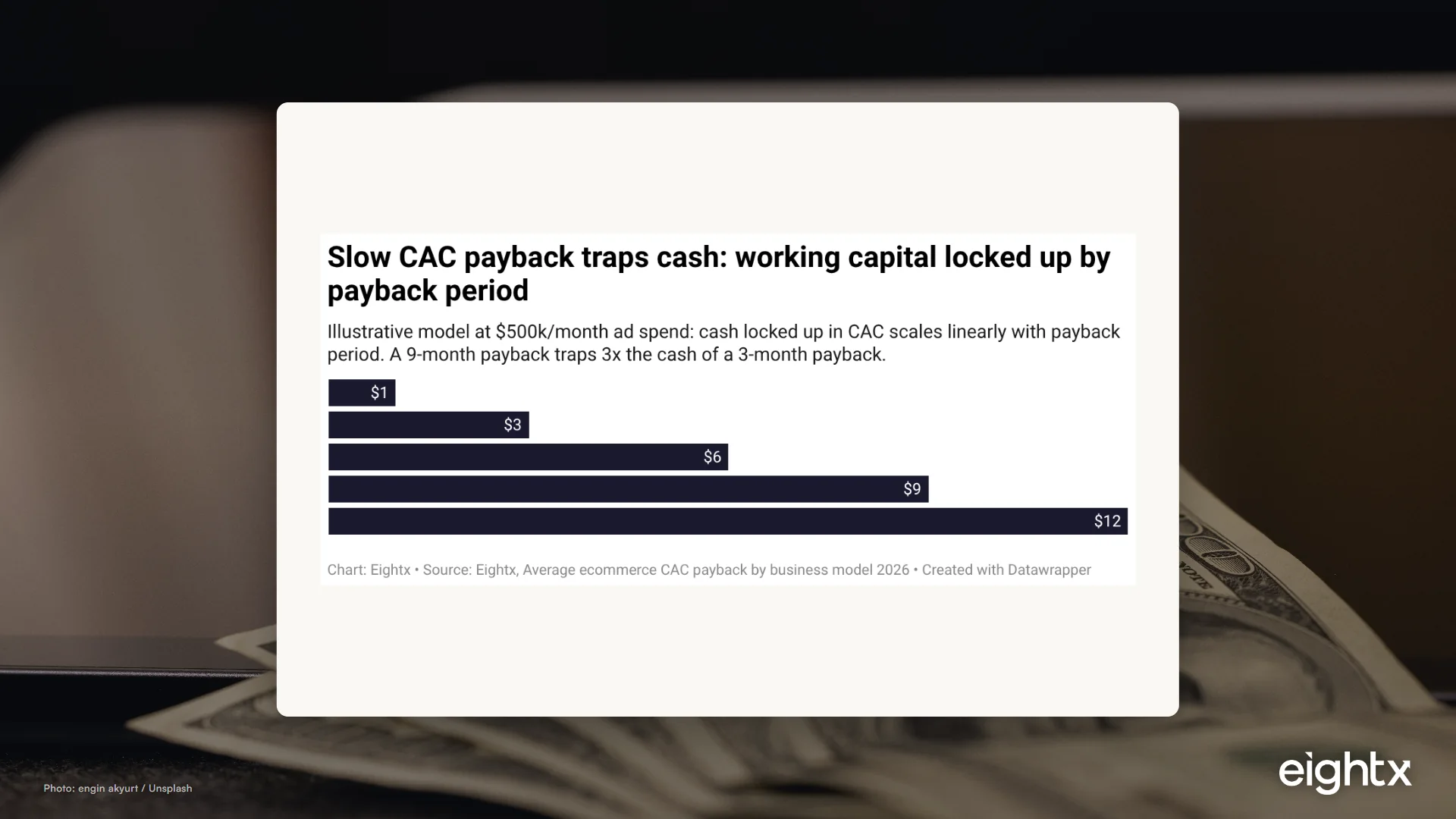
A good DTC CAC payback is 3-6 months, the practical scaling target is 90-120 days, and anything past 9-12 months is broken for most brands absent subscription-grade retention. The relationship every operator eventually internalizes: working capital trapped in CAC is roughly monthly ad spend times payback months. A brand spending 25% of revenue on acquisition at a 9-month payback has about 3x more cash locked up than the same brand at 3 months. That delta is the funding round you didn't have to raise.
The chart models it at $500k a month in spend. It's illustrative, not measured, but the shape is the lesson: the cash you tie up scales linearly with how slowly you get paid back. The cleanest way to widen this gate is to be first-purchase profitable. When the first order covers its own acquisition cost, the payback math stops fighting you and scaling stops being a cash bet.
Guardrail 4: 13-Week Forward Cash Model
A bank balance is rear-view. The 13-week cash flow forecast is the windshield. Model actual cash in and cash out, weekly, for the next 13 weeks. Not revenue projections off your P&L, the direct method: real dollars moving in and out. Thirteen weeks is about one quarter, which is the accepted sweet spot, long enough to see a problem coming, short enough that you can still do something about it. It's the standard CFOs and turnaround firms run (PKF O'Connor Davies, Alvarez & Marsal), and lenders treat it as table stakes.
The rule that makes it operational: any week that projects below your minimum reserve is a fix-it-now signal, not a note for next month. The reason the horizon matters is the control it gives you over your own decisions. An unplaced PO is easy to delay. A payroll you've already run is not. The 13-week model surfaces the squeeze while the controllable levers (a PO you haven't placed, a campaign you haven't launched) are still in your hands. When we've struggled with a tight stretch ourselves, the 13-week model is what turned "are we okay?" into "we're $40k short in week 9, so we delay the reorder two weeks and we're fine." That's the whole value: it replaces anxiety with a dated, specific action.
Guardrail 5: Inventory Turn Minimum
4x a year is the floor for a healthy DTC brand. Below that, cash is trapped. At 2x or below, you're in crisis territory, carrying roughly six months of inventory when three would do, and the difference is sitting in the warehouse instead of the bank.
The benchmark backs the threshold hard. The median ecommerce brand turns inventory just 2.8x a year (about 129 days on hand), while top-quartile DTC runs 7-12x. Finaloop's healthy rule of thumb is 4-8 turns. So the bands are clean: above 4x is green, 2-4x is a watch, below 2x is red.
| Band | Turns per year | Read |
|---|---|---|
| Red / crisis | <2x | Cash trapped; large share of stock likely aging past 180 days |
| Yellow / watch | 2x-4x | Below median peers; working capital tied up |
| Green / healthy | >4x (4-8x typical) | Efficient; in line with healthy DTC norms |
| Top-quartile DTC | 7x-12x | Top performers; fast-moving categories (beauty, fast fashion) |
The fix when you're below the floor is unglamorous: mark down and clear the slow SKUs. Don't hold at full margin hoping. The pattern I see again and again is a founder protecting the headline margin on a SKU that hasn't moved in four months, while that frozen cash could be reordering the product that's actually selling. Recovered cash goes back into what's moving. A lower margin on units that sell beats a beautiful margin on units that don't.
Guardrail 6: Raise Proceeds Lockbox, and Guardrail 7: Inventory Liquidation Triggers
The last two guardrails are operator logic more than benchmark data, but they're where discipline either holds or breaks.
Guardrail 6, Raise Proceeds Lockbox. When you take a raise, ring-fence the proceeds and deploy them in tranches tied to sell-through milestones. Tranche 2 releases only when tranche 1 hits its targets. The reason is human, not financial: a fat bank balance after a raise quietly resets everyone's spending instincts, and the discipline that got you the raise evaporates. Tranching forces the capital to earn its next release. The founders who keep proceeds in a separate account with milestone gates are the ones still holding runway eighteen months later.
Guardrail 7, Inventory Liquidation Triggers. Set safety-stock and weeks-on-hand (WOH) targets per SKU, then group your SKUs A/B/C by sales contribution. Weeks-on-hand is how many weeks your current stock will last at the current sales rate (units on hand divided by weekly sales velocity). ABC grouping concentrates attention: A items are your top sellers and earn tight management, C items are the long tail. When any SKU violates its WOH guideline, put it on promo and liquidate aggressively. A common aging rule is to mark down past 90 days on hand and clear hard past 180. The trigger does the deciding, so you don't relitigate every slow SKU emotionally each quarter.
You don't manage cash by staring at the bank balance. You set guardrails against cash and against the things that move it: a fixed-cost reserve floor, a cap on self-funded inventory, a CAC payback gate, a 13-week forward model, an inventory-turn minimum, a raise lockbox, and per-SKU liquidation triggers. Each one is a number with a trigger, decided in advance, so nobody has to improvise when the pressure is on.
How to set your own thresholds
The thresholds in this post are starting points grounded in real benchmarks, not laws. Your category, margin profile, and seasonality move the right number. A beauty brand turning 10x lives in a different world than a furniture brand turning 3x, and a subscription brand can carry a longer CAC payback than a one-and-done purchase brand.
So calibrate. Pull your own numbers: fixed-cost burn for the reserve floor, blended CAC payback for the gate, trailing inventory turns by SKU group. Set each guardrail against your reality, write the threshold and its trigger down, and make them visible to whoever touches cash decisions. Then review quarterly, and at any major inflection: a raise, a new channel, a big swing in velocity. The guardrails aren't there to make you cautious. They exist so growth decisions get made against a number you set on a calm day, not a balance you're staring at on a stressful one.
Sources and methodology
Cash buffer benchmark. The 27-day median cash buffer is from the JPMorgan Chase Institute small-business report, which defines cash buffer days as average daily cash balance divided by average daily cash outflows. The distribution it reports: 25th percentile at 13 days, median at 27 days, 75th percentile at 62 days. We use it as the stakes-setting anchor for the Minimum Cash Reserve guardrail.
Cash reserve norms. The "3 to 6 months" reserve rule (9 to 12 for seasonal or DTC) is consistent across Relay, Wells Fargo, Capital One, and TGG Accounting, with TGG's "2 to 3 months even with credit" framing used as the floor. The fixed-costs-not-total-expenses refinement is the Eightx framework's deliberate counter-take. Most public sources measure against total expenses; we measure the survival floor against fixed costs (payroll, rent, software, debt service) because variable costs can be cut quickly in a downturn.
Inventory turnover. The 2.8x median, 4-8x healthy range, and 7-12x top-quartile bands come from 2026 DTC vendor benchmarks (citing Finaloop). These are vendor and advisory benchmarks, not government statistics, but they're consistent across multiple independent sources, which is why we use them. Treat them as estimates.
CAC payback. The 3-6 month healthy range, 90-120 day scaling target, and 9-12 month "broken" threshold synthesize Saras Analytics, Retainful, and StoreHero (with a 4-month ecommerce target against a 12-month SaaS norm). The working-capital-trapped chart is an illustrative model (monthly ad spend times payback months) at $500k a month, drawn from our own published CAC analysis. It is a model, not measured data, and is labeled as such.
Inventory financing. Advance rates of 50-90% synthesize 8fig, Dripcapital, Settle, and Finaloop: PO financing advances 70-90% of supplier cost, inventory-backed and asset-based lines advance 50-90%, and supplier terms are the cheapest first layer at roughly 0% explicit interest.
13-week forecast. The 13-week direct-method cash flow forecast as the CFO and turnaround standard is documented by PKF O'Connor Davies, Alvarez & Marsal, Atlar, and Intuit. The operator-voice lines throughout are anonymized house patterns from our work with ecommerce founders; no client, brand, or individual is named or identifiable.
Frequently asked questions
how much cash should an ecommerce business keep in the bank?
Enough to cover 2-3 months of fixed costs as a hard floor, plus the cash your CAC payback period and inventory buys actually require. There's no single dollar figure, which is the point: you set it against fixed costs and the parts of the business that move cash, not a vibe about the balance. Most brands run thin. The median US small business holds only 27 days of cash buffer.
how many months of expenses should a business have in reserve?
The common advice is 3-6 months (9-12 for seasonal or inventory-heavy DTC). The sharper version: hold 2-3 months of fixed costs (payroll, rent, software, debt service) as an untouchable floor. Variable costs like inventory and ad spend can be cut fast in a crunch, so they don't belong in your survival number.
should i use fixed costs or total expenses to set my cash reserve?
Fixed costs. Most sources quote a reserve against total expenses, but that overstates your true survival number. In a downturn you can pause inventory buys and pull ad spend within days. You cannot pause payroll, rent, software, or debt service. The reserve that keeps the lights on is measured against the costs you can't switch off.
how much of my inventory should i pay for in cash?
No more than 60-70% of any inventory purchase. Fund the rest with supplier terms, PO financing, or an inventory line of credit. Inventory financing advances 50-90% of cost, so the market is happy to fund the gap. Start with supplier terms (net 30/60/90), they're the cheapest layer at roughly 0% explicit interest.
what is a healthy inventory turnover for a dtc brand?
4x a year is the floor for a healthy DTC brand, and 4-8x is the typical healthy range. Top-quartile DTC runs 7-12x. The median ecommerce brand only turns 2.8x, so most brands have room. Below 2x is a crisis: you're carrying six months of stock when three would do, and the difference sits in the warehouse, not the bank.
what is a good cac payback period for ecommerce?
Under 3 months is excellent, 3-6 months is healthy with solid margins and retention, and past 9-12 months is broken for most DTC unless you have subscription-grade retention. The practical scaling target is 90-120 days. The shorter your payback, the less working capital gets trapped funding the gap between spend and recovery.
how much cash do i need before i scale ad spend?
Hold cash equal to your full CAC payback period before you accelerate. A 90-day payback means 90 days of ad spend in the bank before you push harder. Scaling spend without the payback cushion is how brands grow their way into a cash crunch: revenue climbs, but the cash to fund the next cohort isn't back yet.
what is a 13 week cash flow forecast?
A weekly, 90-day model of actual cash in and cash out (the direct method), not revenue projections off your P&L. 13 weeks is about one quarter: long enough to see a problem coming, short enough to still act. It's the CFO and turnaround standard, and lenders treat it as table stakes. Any week that projects below your reserve floor is a fix-it-now signal. More on building this in our guide to seasonal cash flow forecasting.
when should i mark down and liquidate slow-moving inventory?
When a SKU breaks its weeks-on-hand target. Set safety-stock and weeks-on-hand thresholds per SKU, grouped A/B/C by sales contribution, and when a SKU violates its guideline, put it on promo and clear it. A common aging rule is to mark down past 90 days and liquidate aggressively past 180. Don't hold slow stock at full margin hoping it moves. More on clearing dead stock.
For the full picture on how cash discipline fits into the rest of your finance function, see our interim CFO services, and the deeper dives on the minimum cash reserve and runway and inventory financing options compared.