
eCommerce
UK fulfilment cost index 2026: the £4.95 to £7.45 per-order band every Shopify brand should be modelling
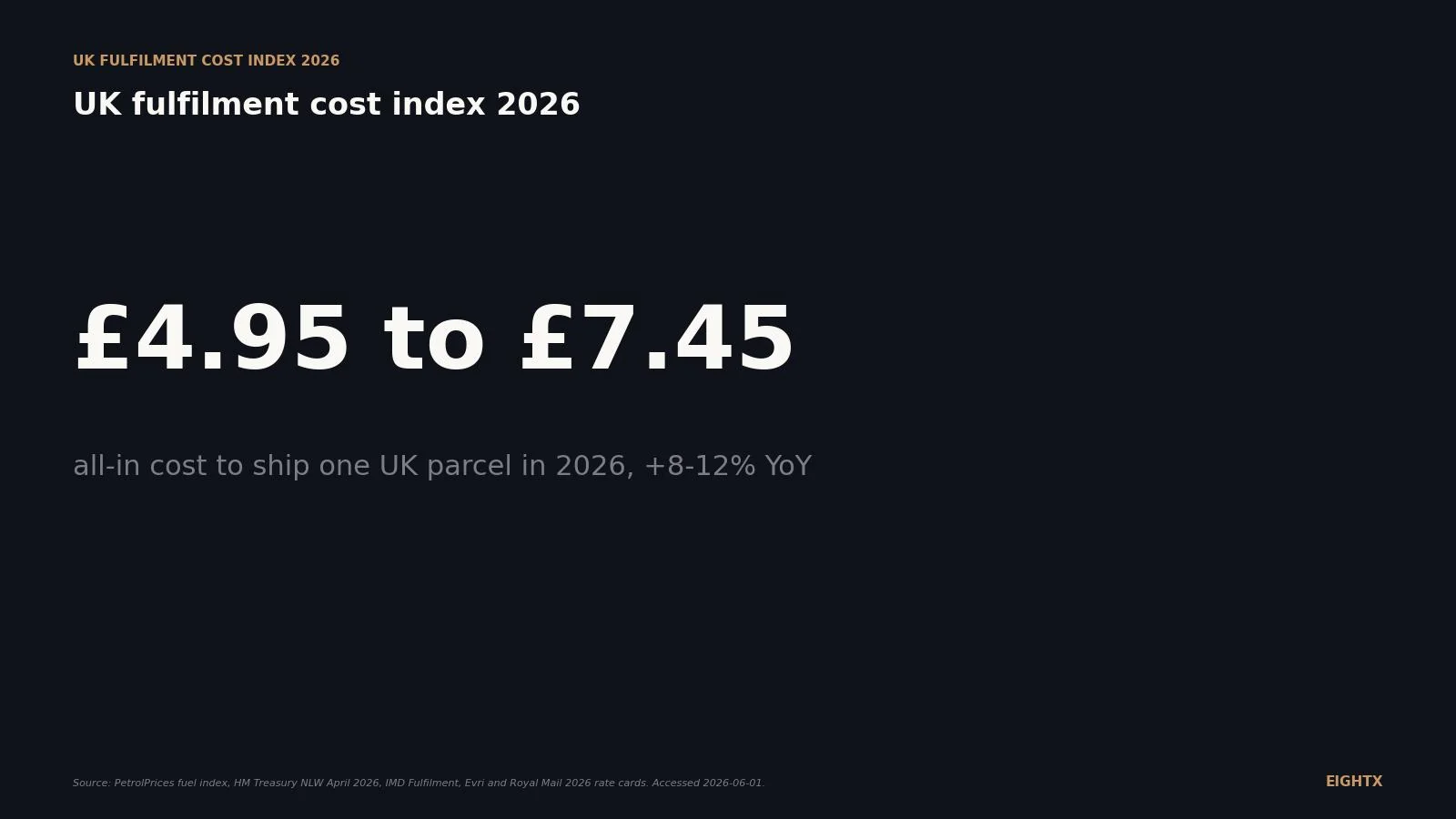
UK fulfilment cost per economy order sits at 4.95 to 5.60 pounds for mid-volume DTC brands in 2026, and 5.75 to 7.45 pounds for premium next-day, both up 8 to 12 percent year-over-year. The National Living Wage rose to 12.71 pounds per hour on 1 April 2026, adding 3 to 6 percent to pick-and-pack rates.
Key Takeaways
- All-in UK fulfilment cost per economy order in 2026 sits at £4.95 to £5.60 for mid-volume DTC brands on Evri or Royal Mail Tracked 48, and £5.75 to £7.45 for premium next-day. Both bands are up 8 to 12% year-on-year.
- UK diesel hit 185.07p per litre in the week ending 25 May 2026 (UK Government weekly fuel index via PetrolPrices), up roughly 18% year-on-year. Diesel is the single biggest variable in carrier line-haul cost.
- The National Living Wage rose to £12.71/hour on 1 April 2026, a 4.1% lift confirmed in the November 2025 Autumn Budget. Around 50 to 70% of UK 3PL pick and pack cost is labour, so the NLW move alone justifies a 3 to 6% pick and pack rate rise.
- Push your 2026 3PL renewal against the National Living Wage clock, not the calendar year. Q3 timing gives you visibility on the April wage lift plus pre-peak volume forecasts, which is where the negotiating power actually sits.
- Ask your 3PL to break out the rate card per component: pick and pack, carrier pass-through, storage. A blended per-order number hides which line item is moving and stops you challenging the right driver.
UK ecommerce fulfilment cost per order in 2026 is being squeezed from three directions at once. Diesel hit 185.07p per litre in the week ending 25 May 2026 (UK Government weekly fuel index via PetrolPrices), up roughly 18% year-on-year. The National Living Wage (NLW) rose to £12.71/hour on 1 April 2026, a 4.1% lift that flows almost one-for-one into warehouse picker, packer and goods-in payroll. And the major UK carriers (Royal Mail, Evri, Yodel, DPD) have layered 5 to 12% effective rate increases on top of fuel and labour.
The net result: total UK 3PL fulfilment cost per domestic order in 2026 sits at £4.95 to £5.60 for economy mid-volume Shopify merchants, and £5.75 to £7.45 for premium next-day, both up roughly 8 to 12% year-on-year. The operator decision this post supports is straightforward. Re-cost your UK fulfilment line before peak, push Q3 renewals against the NLW clock rather than the calendar year, and benchmark your 3PL against per-component bands (pick and pack versus carrier versus storage) rather than a single all-in number.
This is a living index, refreshed quarterly. Last refreshed: 1 June 2026.
What UK fulfilment actually costs per order in 2026
A useful 2026 starting frame: most mid-volume DTC brands shipping in the UK should be modelling £4.95 to £5.60 per order on economy service and £5.75 to £7.45 on premium next-day. That is the all-in number, which is pick and pack plus carrier plus storage and overhead. The carrier component is the dominant line item in every tier.
Pick and pack lands at £1.75 to £2.25 per order at mid-volume (1k to 10k orders a month). Carrier sits at £2.62 (Evri ParcelShop drop-off) on the low end and pushes north of £4.55 on Royal Mail Tracked 48 small parcel. Storage and overhead, allocated per order at typical mid-volume DTC SKU profiles, is £0.10 to £0.25.
Why this matters for your business. If your 2026 quote is materially outside this band on the all-in number, the gap is almost always in one of two places. Either your pick and pack rate has not been repriced down for your volume tier, or your carrier mix is leaning on a premium service when an economy tier would do the job. Both are fixable in 60 to 90 days without changing 3PL.
The three pressures squeezing UK fulfilment in 2026
The £4.95 to £7.45 number is the symptom. The cost driver story is what you actually have to model against your 2026 plan. Three pressures are doing the work, and they compound rather than offset.
Diesel is up about 18% year-on-year, which feeds straight into carrier fuel surcharges (typically 3 to 4% on tariff per +£0.25 per litre move). The National Living Wage move on 1 April was 4.1%, which translates to a 2 to 3% pick and pack cost rise once you account for the labour share of pick and pack. Carrier list rates are up 5 to 10% across Royal Mail, Evri and DPD. Sum the three and you get the 8 to 12% blended fulfilment cost rise we are seeing in operator quotes.
What to do this week. Ask your 3PL for the percentage breakdown of their pick and pack cost between labour, consumables and overhead. If labour is less than 50% in their answer, push back. The UK industry average sits at 50 to 70%, and a low labour share usually means they are under-disclosing wage exposure to make a renewal look more palatable.
Diesel, the line-haul cost driver
UK retail diesel ran sideways through 2024 and most of 2025 in the 148p to 158p band. It broke out in Q1 2026 and pushed through 185p per litre by late May. That is roughly an 18% lift on the year-earlier number, and it is the single biggest variable in carrier line-haul cost.
Carriers absorb the first few pence of any diesel move through their existing surcharge buffer, but a 25 to 30 pence move (which is what we have had since January) blows through the buffer and resets the surcharge formula. Royal Mail, Evri and DPD all use slightly different formulae, but the rule of thumb is consistent. A +£0.25 per litre move on retail diesel pushes 3 to 4% onto your carrier tariff within one to two reset cycles.
The implication for your model. If you priced your 2026 carrier line in late 2025 against a diesel benchmark in the 155p to 160p range, you are 3 to 4% under-baked already. Build in a quarterly review of the PetrolPrices weekly index and re-cost the carrier line item against the most recent eight-week average, not the rate-card snapshot you signed against.
The National Living Wage clock: April hits pick and pack one-for-one
The National Living Wage rose to £12.71/hour on 1 April 2026 for workers aged 21 and over, a 4.1% lift confirmed in the November 2025 Autumn Budget. Around 2.4 million low-paid workers benefit. A full-time worker gains roughly £900 gross per year.
Most UK warehouse pickers, packers and goods-in staff sit at or just above the NLW. So the lift flows almost one-for-one into 3PL pick and pack costs. The labour share of UK pick and pack is 50 to 70% (depending on how much consumables and overhead the 3PL allocates), so the 4.1% NLW lift on its own justifies a 3 to 6% pick and pack price rise. That is before any carrier or fuel pass-through.
This is why the contract-renewal timing implication matters. If you renew in January or February, you are agreeing a 2026 rate before the April NLW move actually lands in payroll. The 3PL knows this and will either pad the renewal to cover the unknown, or come back to you in May with a mid-year reset. Push the renewal to Q3 instead. By July you have one full quarter of post-NLW pick and pack data, you have your H2 volume forecast for peak, and the 3PL has run one quarter of the new wage line through their P&L. Both sides are negotiating against real numbers, not guesses.
Evri's GMB courier pay deal sits underneath this story. Evri Plus couriers are guaranteed at least £14.00/hour (£14.80 in London) through at least April 2027. That is meaningfully above NLW and signals a hard floor under last-mile labour cost across the network. The point is structural: wage pressure on UK fulfilment is not a one-year cyclical move, it is a multi-year reset.
What to push your 3PL on in the 2026 renewal
Three asks for the renewal conversation. They are the difference between a renewal that holds your unit economics and one that quietly eats your gross margin.
Ask for a per-component rate card, not a blended per-order number. The blended number hides which line item is moving. Pick and pack, carrier pass-through and storage all behave differently. You need them broken out to know which one to challenge.
Ask for volume tier triggers in writing. If you forecast 8,000 orders a month in 2026 and you actually do 14,000, the rate should step down at a defined threshold. Put the threshold in the contract so you do not have to re-open the conversation mid-year.
Ask for a National Living Wage pass-through cap. Push the 3PL to commit that any future NLW lift above 4% will be passed through as a percentage uplift on pick and pack only, not on storage or overhead. This protects you from a 3PL absorbing all of their NLW exposure into the line items that are easier to obscure.
Monthly order volume Pick and pack per order, low end (£) Pick and pack per order, high end (£) Per-additional-item (£) Low volume / high touch (under 1k) 2.25 3.00 0.30 Mid volume (1k to 10k) 1.75 2.25 0.20 Mid-high volume (10k to 50k) 1.65 2.00 0.18 High volume (over 50k) 1.50 1.75 0.15
The carrier side of the renewal is harder to negotiate because list rates are set by the carrier, not the 3PL. But the 3PL chooses the carrier mix on your behalf, and that mix is a lever. Ask for the percentage of your volume routed through each carrier in the last quarter and compare it against the published rate cards. If you are running 80% of your volume through a premium service on a product that ships in protective mailers and is not time-sensitive, you have a carrier-mix cost leak the 3PL has no incentive to flag.
Carrier Service Weight band 2026 from price (£) Royal Mail Tracked 24 small parcel up to 2kg 5.85 Royal Mail Tracked 48 small parcel up to 2kg 4.55 Royal Mail 2nd Class small parcel up to 2kg 4.15 Royal Mail 1st Class small parcel up to 2kg 5.30 Evri Standard (ParcelShop drop-off / delivery) under 5kg 2.62 Evri Standard (home delivery) 1-2kg 4.79 Evri Next Day from price 3.20 Evri (in-branch via Post Office) Standard 1-2kg 5.89
How UK fulfilment cost compares to the US 3PL index
UK absolute is lower per order than the US. US 3PL fulfilment by vertical lands in the $7 to $11 band depending on category, which is roughly £5.50 to £8.50 at recent exchange rates. The UK economy band of £4.95 to £5.60 is meaningfully under that. UK premium at £5.75 to £7.45 is closer.
The YoY rate of increase is the other way around. The US 3PL index is running at about 6 to 8% YoY blended (US BLS PPI for couriers up 12.3% YoY in April 2026, warehousing PPI up 4.0%, blended against typical 3PL cost mix). The UK is running 8 to 12%. The driver mix is different: UK is more labour-weighted because the NLW move hits warehouse pay simultaneously with the carrier list-rate reset, while the US is more carrier-weighted.
For cross-border DTC operators serving both markets, the practical implication is that the UK leg of your unit economics is getting more expensive faster than the US leg, and the cost driver you can least manage (statutory wage policy) is doing more of the work. For the cross-reference number, see our US benchmark at average ecommerce fulfillment cost per order by vertical 2026.
UK fulfilment in 2026 is not getting more expensive because 3PLs are over-charging. It is getting more expensive because diesel, statutory wages and carrier list rates all moved in the same direction inside six months. The operator job is to model the components, time the renewal to Q3, and ask for per-component rate cards. The 3PL job is to recover the costs without absorbing margin they did not have to start with. Both sides have data on their side. The renewal that works is the one that uses all of it.
Sources and methodology
This is a living index. The numbers are triangulated from four primary source families: UK retail diesel via the PetrolPrices weekly fuel index (which is derived from official UK Government weekly fuel price statistics); HM Treasury for the April 2026 National Living Wage announcement; IMD Fulfilment for UK 3PL pick and pack and storage benchmarks; and the published 2026 rate cards from Evri and Royal Mail.
UK retail diesel was 185.07 pence per litre in the week ending 25 May 2026. The National Living Wage moved to £12.71 per hour on 1 April 2026 for workers aged 21 and over, a 4.1% lift from £12.21. The IMD Fulfilment 2026 ecommerce fulfilment guide reports UK 3PL pick and pack at £1.50 to £3.00 per order, pallet storage at £3 to £6 per pallet per week, and per-additional-item at £0.15 to £0.40. Evri's 2026 published online price is £2.62 from for Standard and £3.20 from for Next Day.
The Royal Mail 2026 small parcel figures in our table apply a modelled +6 to 10% YoY uplift to the October 2025 baseline (Tracked 24 £5.49 to £5.85; Tracked 48 £4.29 to £4.55). Royal Mail confirmed an April 2026 rate change but did not surface a consolidated rate-card PDF on the date this index was first built. We will replace the modelled figures with exact April 2026 values at the next quarterly refresh.
The blended 8 to 12% YoY fulfilment cost figure triangulates three drivers: diesel (+15 to 20% YoY) times a 15 to 20% line-haul cost share equals +2.5 to 4% from fuel; NLW (+4.1%) times a 50 to 70% labour share of pick and pack equals +2 to 3% from labour; carrier list-rate increases of +5 to 10% on tariff. Sum: +6.5 to 10% in fuel plus labour plus carrier, conservatively widened to +8 to 12% to reflect carrier surcharge resets and 3PL margin recovery.
Limitations. FRED has no usable live UK series for 2024 to 2026 warehouse wages, transport PPI or retail diesel; UK HICP series stop in 2020. UK primary data therefore comes from UK Government, ONS and vendor sources directly. ONS Average Weekly Earnings Transport and Storage (SIC 52) series is not yet published for the 2026 reference period as of 1 June 2026; we will replace the modelled warehouse wage growth assumption with actual ONS EARN03 figures at each quarterly refresh. DPD UK 2026 SME rate cards are contract-specific and not publicly indexed; the +8 to 12% YoY assumption for DPD next-day is a synthesised estimate, not a published source.
Update cadence. Quarterly. Next checkpoint targets diesel re-pull (PetrolPrices week-ending nearest 1 July 2026), the latest ONS AWE EARN03 release, and a fresh check of Royal Mail and Evri rate cards. Read more in our interim CFO services overview for how we use this index in client renewal conversations, and the related average ecommerce shipping cost by vertical 2026 for the % of GMV cut.
Frequently asked questions
what does it actually cost to ship one parcel in the uk in 2026?
For a mid-volume DTC brand running economy service on Evri or Royal Mail Tracked 48, all-in fulfilment lands at £4.95 to £5.60 per order. Premium next-day on DPD or Royal Mail Tracked 24 pushes that to £5.75 to £7.45. Both bands are up 8 to 12% on 2025 because diesel, the National Living Wage and carrier list rates all moved in the same direction.
how much have uk fulfilment costs gone up year over year in 2026?
Around 8 to 12% blended. Diesel is up about 18% year-on-year, the National Living Wage went up 4.1% on 1 April 2026, and carrier list rates are up roughly 8% on the published rate cards. That is steeper than the US 3PL index, which is running at around 6 to 8% on couriers PPI plus warehousing PPI.
is it cheaper to ship with evri, royal mail, or dpd in 2026?
Evri ParcelShop drop-off at £2.62 is the cheapest published 2026 rate for under-5kg parcels. Royal Mail Tracked 48 sits in the £4.15 to £4.55 band on small parcels and Tracked 24 sits around £5.85. DPD is mostly contract-priced so the answer depends on your volume tier. For most DTC under 2kg, Evri is the cheapest gross rate and Royal Mail is the cheapest premium rate.
how does the april 2026 national living wage hike change my 3pl quote?
Labour is 50 to 70% of pick and pack cost. A 4.1% NLW lift on its own justifies a 3 to 6% pick and pack price rise. If your 3PL is asking for 5 to 7% on pick and pack alone, that is in line with the data. Above that, ask them to show the labour ratio in their P&L and the carrier surcharge formula in writing.
should i be renegotiating my uk 3pl contract right now or waiting?
Renegotiate in Q3, not in January. The April National Living Wage move is the cost driver. By July you have one quarter of post-NLW pick and pack data, plus your H2 volume forecast for peak. That is when you have the most evidence on both sides of the table. Renegotiating in January or February gets you guesses on both fronts.
why is uk diesel so high in mid-2026 and how long does it stick?
Wholesale crude is up year-on-year on the back of mid-2025 Middle East tensions and ongoing global supply pressure. UK retail diesel was 185.07p per litre in the week ending 25 May 2026 versus around 155p a year earlier. Carrier fuel surcharges reset monthly or quarterly, so anything that stays above 175p per litre keeps getting passed through into your parcel quote for at least one more cycle.
how do uk fulfilment costs compare to us 3pl rates per order?
UK fulfilment is lower in absolute pounds but rising faster. UK all-in economy is around £4.95 to £5.60 per order versus a US figure that sits north of $7 to $11 depending on vertical. The UK YoY rate increase is steeper because diesel and the National Living Wage are both moving more than their US equivalents.
what's a healthy pick and pack rate for a £5m gmv uk shopify brand?
At roughly £5m GMV with mid-volume order counts (1k to 10k orders a month), you should expect £1.75 to £2.25 per order on pick and pack plus a per-additional-item charge of about £0.20. If you are paying above £2.50 on pick and pack as a base rate at that volume, you have either a high-touch product (fragile, kitted, custom inserts) or a 3PL that has not repriced you down on volume.