
M&A
Quality of Earnings: What Buyers Scrutinize
A Quality of Earnings analysis is the buyer's independent test of whether your reported EBITDA is real. It scrutinizes revenue recognition, true gross margin, add-back legitimacy, customer concentration, working-capital trends and one-time versus recurring items, then produces the Adjusted EBITDA the offer actually hangs on.
Key Takeaways
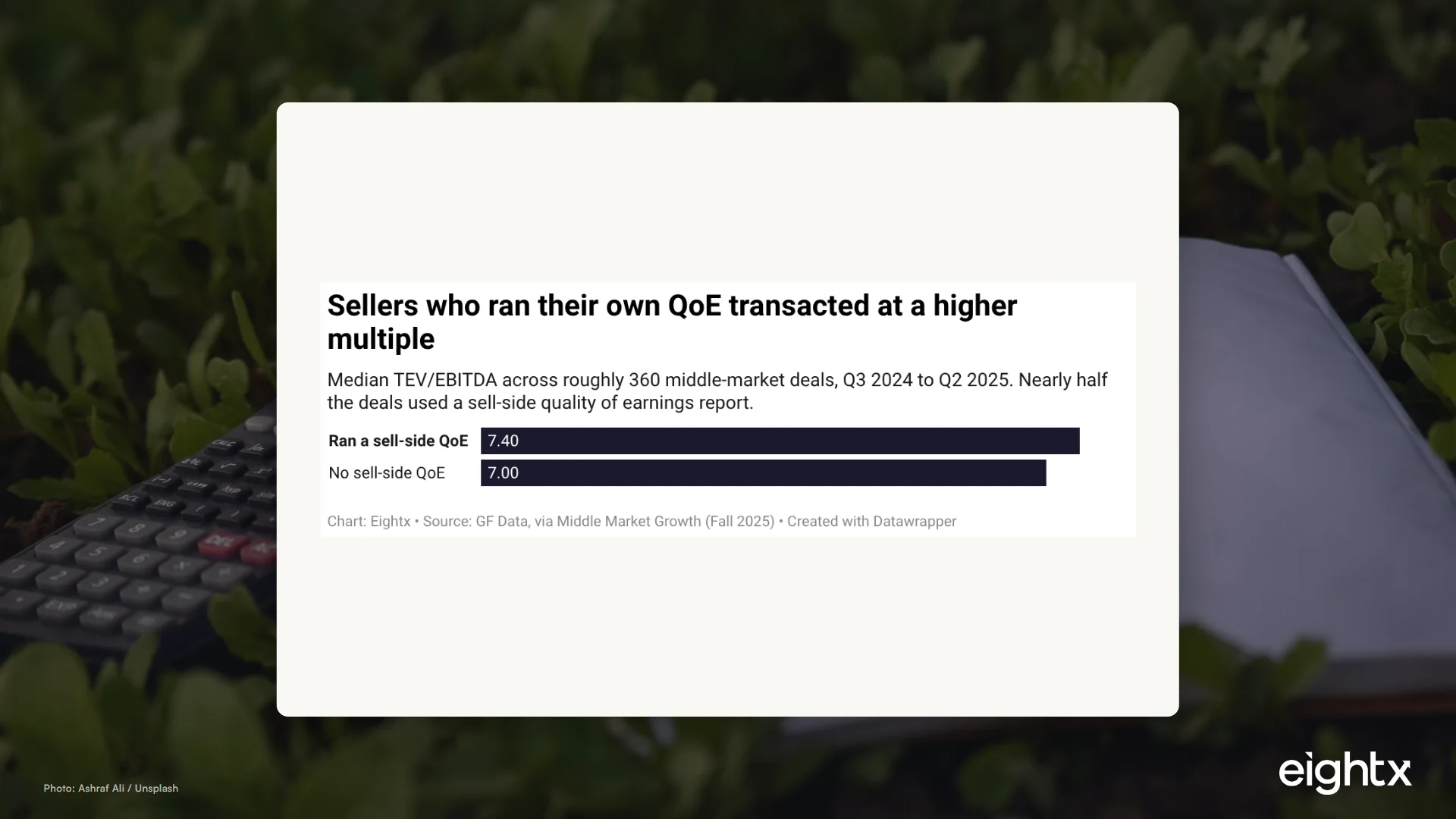
- Sellers who ran their own QoE transacted at 7.4x EBITDA versus 7.0x without one, a measured premium across about 360 middle-market deals (GF Data).
- Add-backs now average roughly 29% of adjusted EBITDA in sale processes, which is exactly the pile a buyer's QoE is built to contest.
- Owner compensation normalization is usually the largest single add-back, and it can move EBITDA up, not just down.
- The fastest way to lose value is an add-back that looks one-time but recurs in the 24 to 36 months of GL the buyer reviews.
- Concentration is priced as a multiple haircut, not an EBITDA line: buyers generally want under 10% from any one customer and under 20% from the top five.
Every founder who has been through a sale process remembers the same moment. The headline EBITDA you negotiated the letter of intent on goes into the buyer's Quality of Earnings analysis, and a few weeks later it comes out smaller. Not because anyone lied. Because reported EBITDA and the number a buyer will actually value off are rarely the same thing.
A Quality of Earnings (QoE) analysis is the independent accounting deep-dive a buyer commissions during diligence. Their team works through 24 to 36 months of your general ledger, normalizes EBITDA, and produces the Adjusted EBITDA the offer hangs on. This is not niche jargon: a full-text search of SEC filings returns more than 1,200 references to "quality of earnings" since the start of 2024, in loan agreements, 8-Ks and S-1s alike. It is standard diligence language now. When I talk to founders running a brand this size, the question is never whether a QoE happens. It is whether you pre-empt it or let the buyer find the issues and convert each one into a discount. This is what the buyer's team digs into, and how to be ready for each piece.
Revenue recognition: is the top line real
The QoE team starts at the top of the P&L because every error there compounds. For an ecommerce or CPG brand the recurring questions are simple to ask and easy to get wrong: when is revenue recognized, at order, shipment or delivery, and how are returns, refunds and chargebacks treated. I have seen brands recognize revenue at checkout and then bury a 15 percent return rate in a separate expense line. That is not a 15 percent expense, it is a 15 percent revenue adjustment, and a good QoE team will reclassify it.
This is more than a timing nuance. When I talk to founders running brands at this stage, one put it plainly about a heavy month: "for refunds it does affect the monthly P and L." If refunds are landing in your operating expenses instead of contra-revenue, your top line and your margin are both overstated, and the buyer's team will rebuild both. The other classics are deferred revenue treated as recognized, subscription revenue booked upfront instead of over the term, and gift-card breakage inflating the top line. None of these are exotic. They are the first things a buyer normalizes, and each one drags reported EBITDA down. Our ecommerce due diligence checklist walks through the channel-by-channel version of this in more depth.
True gross margin, not the blended one
A consolidated gross margin can hide a lot. A brand doing $20M can look healthy until you split it by channel and find Amazon running near breakeven, subsidized by DTC margin. The pattern we see again and again is that operators scaling on Amazon are quietly growing their least profitable channel. As one of our advisors says about it bluntly, Amazon "is way less profitable" than the blended number suggests, which is exactly why you have to look at margin by channel rather than in aggregate. The QoE rebuilds margin from the bottom up: landed COGS validated against POs and freight, fulfillment cost per order, and margin by channel and SKU.
If your gross margin has compressed over the trailing twelve months, say from 55 percent to 48 percent, expect that to be the single most-scrutinized trend in the report, because it signals something structural. The fix is not cosmetic. You want twelve-plus months of clean contribution-margin data by channel so the buyer can see which revenue is actually profitable. If you can produce that, you control the narrative. If you cannot, the buyer builds their own version, and it will be less generous than yours.
Add-back legitimacy: where deals get won or lost
Every seller arrives with a list of one-time expenses they want added back to EBITDA. This pile is bigger than most founders expect: across sale processes, add-backs average roughly 29 percent of adjusted EBITDA. That is the gap between your raw reported earnings and the number you want to be valued on, and the buyer's QoE is built to contest it line by line. Each add-back gets scored as accept, accept with reduction, or reject. The math is brutal in your favor or against you: at a 6x multiple, every $100K of accepted add-back is $600K of enterprise value, and every rejected one is $600K gone.
The important thing to understand is that a QoE is not a one-way haircut. It makes adjustments in both directions. The table further down shows the common adjustment categories and which way they typically move EBITDA. Owner-comp normalization, related-party rent, genuine one-time legal and transaction costs, and personal expenses run through the business push EBITDA up. Aggressive revenue recognition, under-accruals and rejected "one-time" items push it down.
There is one number that makes the case for doing this work yourself, and it is worth putting up front.
The chart above is the single hardest number in this whole topic, and it earns its place here because it is the strongest argument for doing the work. GF Data, reporting on roughly 360 middle-market deals between Q3 2024 and Q2 2025, found that sellers who commissioned their own sell-side QoE transacted at 7.4x EBITDA versus 7.0x for those who did not. Nearly half of those deals used a sell-side report. A few rules on what survives, drawn from how buyers actually score EBITDA add-backs:
| Adjustment | Direction | Survives when |
|---|---|---|
| Owner compensation normalization | Up or down | Documented with market-comp benchmarks |
| Related-party / below-market rent | Up or down | Trued to arm's-length market rent |
| One-time legal / M&A advisory / severance | Up | Genuinely non-operating and documented |
| Personal expenses run through the business | Up | Clearly discretionary and won't continue |
| "One-time" marketing tests / rebranding | Down (often rejected) | Rarely; the GL shows the pattern recurs |
| Aggressive / premature revenue recognition | Down | Buyer normalizes it regardless |
The deadliest mistake is an add-back that looks one-time but recurs. The QoE team has the GL detail to spot it, and once they catch one, they trust the rest of your bridge less. Conservative, well-documented monthly accounting beats sale-time cleanup every time. As one of our advisors puts it, accrual books are usually better than cash "because it's actually what happened in that period." If you spent the money, it shows up where and when it should, and there is nothing for the buyer to unwind.
Concentration and recurring versus one-time
Concentration rarely shows up as an EBITDA adjustment. It shows up as risk priced into the multiple. Buyers generally want to see under 10 percent of revenue from any single customer and under 20 percent from the top five. Cross those lines and the treatment escalates in tiers: above 10 percent draws diligence focus, above 20 percent tends to draw a multiple haircut, and 30 percent or more often forces earnouts, escrows or seller rollover before a deal can close. Channel counts too. A brand that is 60 percent Amazon gets discounted even without a single named customer, because you are partly a tenant on someone else's platform.
This is one of the few places where I will get ahead of a founder before the buyer does. When we see a brand leaning hard on one channel, we say so early: honestly, it is fairly risky, and it is worth fixing before you tell your growth story to an acquirer. The table below lays out how buyers typically treat each tier.
| Concentration from one customer or channel | How buyers typically treat it |
|---|---|
| Under 10% | Usually manageable; light diligence |
| 10% to 20% | Diligence focus; some discounting |
| 20% to 30% | Meaningful multiple haircut (often ~10% to 20%) |
| 30% or more | Major valuation pressure; often needs earnouts, escrows or seller rollover (discounts cited 20% to 35%) |
The recurring-versus-one-time distinction runs through the whole analysis, and it is worth understanding why. A multiple is really a derivative of a discounted-cash-flow view. A sophisticated buyer like a PE firm is underwriting the present value of your future cash flows and backing into a multiple from there. That is why earnings quality, not just earnings level, sets your price: they are paying for the cash they believe will repeat. The cleaner your separation of recurring operations from one-time noise, the less room there is to argue your number down. Which earnings base the multiple even attaches to depends on your size, and it is worth knowing whether buyers value you on SDE or EBITDA before you set an asking price.
Working-capital trends: the quiet adjustment
Working capital is usually handled as a separate purchase-price mechanism rather than an EBITDA line, but it can move closing economics as much as any add-back. The buyer sets a target, or peg, equal to a normalized trailing-twelve-month average of your working capital, chosen to absorb seasonal swings. If actual working capital at close is above the peg, the seller gets paid for it. If it is below, the purchase price drops dollar for dollar, with the final true-up usually settling 60 to 90 days after close.
For inventory-heavy brands the traps are seasonal inventory builds, aged stock carried at full value, and large prepaid PO deposits. We have seen normalized working capital come in $250K below the LOI figure because a seasonal build was not smoothed out. That was money the seller did not see coming, and it came straight off the price at close. The fix is to true your own working capital to a trailing-twelve-month average before you go to market, so the seasonality is your story to tell, not the buyer's surprise to spring.
What to do about it
Here is the work, in the order I run it with founders heading toward an exit.
- Keep conservative accrual books all year. Do not max out reported EBITDA in the twelve months before a sale. The QoE team finds aggressive accounting faster than you expect, and it poisons trust in everything else.
- Document every add-back as you incur it. A folder of invoices and a one-line rationale per item, built in real time, is worth more than a reconstruction done under deal pressure.
- Produce contribution margin by channel for twelve-plus months. Prove which revenue is profitable so the buyer values off your math, not theirs.
- True working capital to a trailing-twelve-month average yourself. Surface the seasonal swings before the buyer does, and have an answer ready.
- Reduce concentration before you tell the story. Diversify customers and channels where you can, and have a defensible explanation where you cannot.
- Commission your own sell-side QoE. At roughly $10M-plus, a report runs anywhere from about $15K for a streamlined review to $200K for a full-scope engagement with a working-capital analysis. It surfaces the findings months early and lets you fix them on your timeline. The GF Data premium, 7.4x versus 7.0x, is the measured payoff.
Pre-empting the QoE is exactly the kind of preparation our M&A team runs. It is the same discipline behind getting your books ready in prepare financials for due diligence and the value-creation work in increase your exit multiple. For the full picture on what drives the number, see how ecommerce brands are valued.
Sources and methodology
The headline benchmark, that sellers with their own QoE transacted at 7.4x versus 7.0x without, comes from GF Data analysis reported by Middle Market Growth (Fall 2025), covering roughly 360 middle-market deals between Q3 2024 and Q2 2025, nearly half of which used a sell-side QoE. The "quality of earnings is standard language" point is corroborated by an SEC EDGAR full-text search returning more than 1,200 filings referencing the term since January 2024.
The add-back magnitude, roughly 29 percent of adjusted EBITDA in sale processes, comes from advisory research aggregated through our triangulation pass. The adjustment categories and which way each moves EBITDA are drawn from CBIZ, Kreischer Miller, Warren Averett and Middle Market Growth; the categories are sourced, but any specific dollar or percent magnitude on a given deal varies and should be treated as directional.
There is no published universal figure for how much a QoE reduces EBITDA, because it is a private-deal practice with no public per-deal dataset. The 10 to 30 percent range used here is a practitioner estimate from our own experience, not a cited statistic, and we have framed it that way throughout.
Concentration thresholds, that buyers generally want under 10 percent from any one customer and under 20 percent from the top five, and the tiered discount treatment, are synthesized from M&A advisory guidance (Nuvera Partners, BMI Mergers, Morgan & Westfield, beancount.io and Metric HQ). The discount percentages are typical ranges, not formulas. Net working capital mechanics, a trailing-twelve-month normalized peg settled dollar-for-dollar with a 60 to 90 day post-close true-up, are drawn from Jah Law, Kreischer Miller, BDO, SRS Acquiom and Morgan & Westfield.
Sell-side QoE cost ranges disagree across sources, from about $15K for a streamlined "QoE Lite" review up to $200K or more for full-scope engagements; we present the spread and note that scope drives it. Operator-voice lines are anonymized observations from across the founder conversations our team runs, with no client identified.
Frequently Asked Questions
does being heavy on amazon hurt my multiple even without one big customer?
Yes. Channel concentration is priced the same way customer concentration is, as risk in the multiple rather than an EBITDA line. A brand that is 60 percent Amazon gets discounted even with no single named customer over the threshold, because you are partly a tenant on someone else's platform and that platform can change your economics overnight.
how much does a qoe reduce my ebitda?
There is no published universal figure, because QoE is a private-deal practice. In our experience reported EBITDA often moves 10 to 30 percent through the process. Owner comp and clean one-time items push it up; aggressive revenue recognition, under-accruals and rejected add-backs push it down. The net depends on how aggressive your reported number was.
which qoe adjustment is usually the biggest?
Owner compensation normalization. When a founder is paid well above or below market, the buyer trues the salary to market rate. It is often the single largest line and, unlike most adjustments, it frequently moves EBITDA up rather than down.
should i commission my own sell-side quality of earnings report?
If you are at roughly $10M of revenue or more and serious about a sale, usually yes. GF Data found sellers who ran their own QoE transacted at 7.4x versus 7.0x without one. It surfaces the issues a buyer would find anyway and gives you months to fix them before negotiations start.
how much does a sell-side quality of earnings report cost?
Scope drives it. A streamlined review runs around $15K to $40K, while a full-scope engagement with a working-capital analysis on a larger brand runs $100K to $200K or more. Most advisors frame it as self-funding because it protects more value than it costs.
how much revenue from one customer or channel is too much?
Buyers generally want under 10 percent from any single customer and under 20 percent from the top five. Above 10 percent draws diligence focus, above 20 percent tends to draw a multiple haircut, and 30 percent or more often forces earnouts, escrows or seller rollover to get the deal done.
how does the working capital adjustment change my price at close?
The buyer sets a target, or peg, equal to a normalized trailing-twelve-month average of your working capital. If working capital at close lands above the peg, the seller gets paid for it; below it, the price drops dollar for dollar. The final true-up usually settles 60 to 90 days after close.