
Financial Strategy
Wise vs Airwallex for ecommerce cross-border payments: the FX-spread math on $100K of monthly conversions
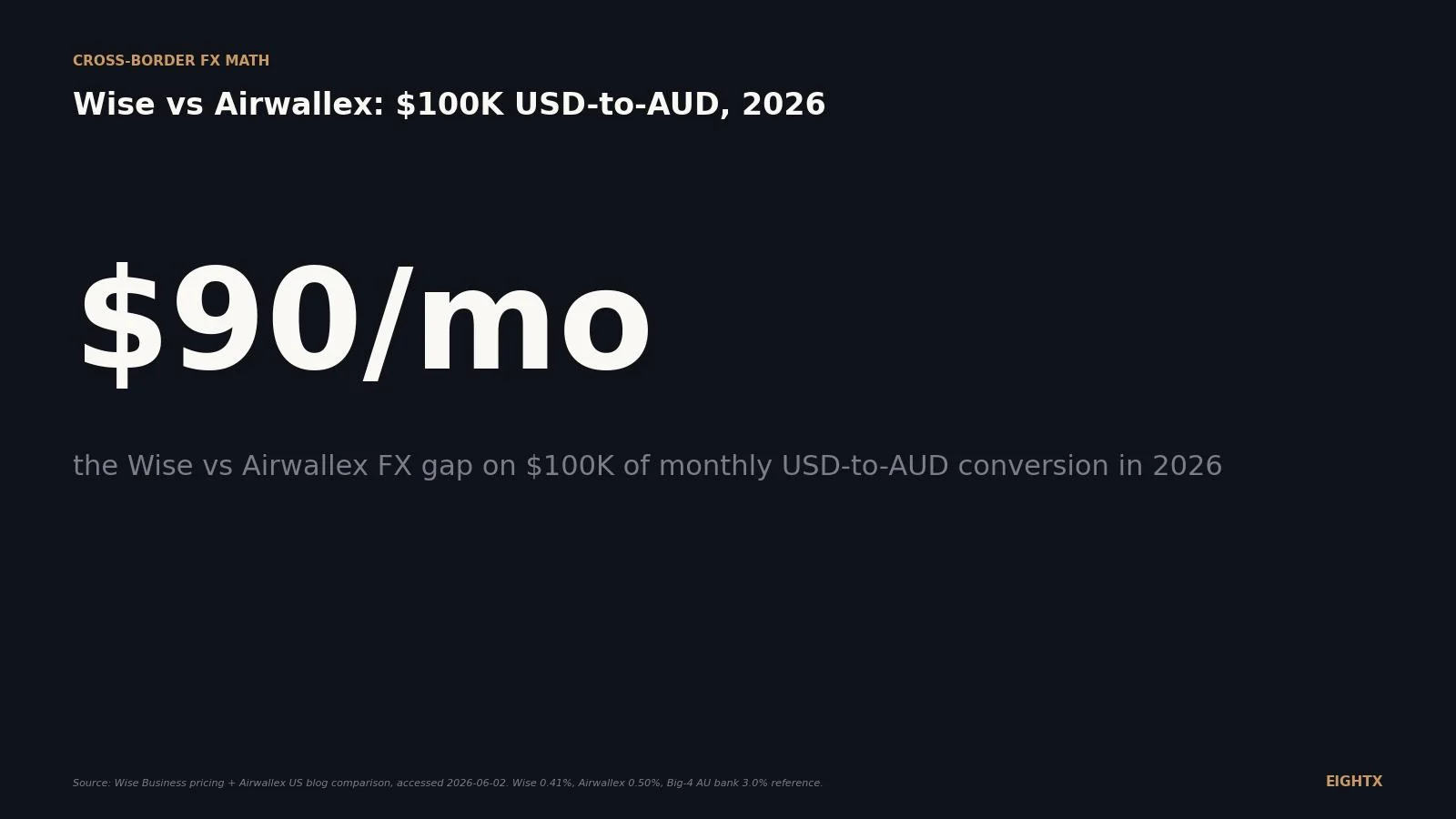
Wise Business charges 0.33 to 0.60 percent over mid-market on major corridors including USD to AUD. Airwallex charges a flat 0.50 percent on its 10 major currencies and 1.00 percent otherwise. On $100,000 per month of USD-to-AUD conversions, Wise saves roughly $90 per month. Airwallex wins on CNY supplier payments and bundle economics if you are replacing a PSP, but Wise is cheaper for pure FX conversion volume.
Key Takeaways
- Wise Business FX markup runs 0.33 to 0.60% on major corridors, up to about 1% on exotics. Mid-market reference rate, transparent percentage fee, no monthly account fee, one-time setup around $31 to $50 depending on region.
- Airwallex charges 0.50% on its 10 major currencies plus USD, and 1.00% on everything else. Mid-market reference rate but the markup is built into the rate, not a separate fee line. Tiered monthly plans (EU: €0 with a €10K balance, otherwise €19 to €999 per month).
- On $100K per month of USD to AUD, the Wise-Airwallex markup gap is $90 per month. The gap to a Big-4 AU bank at 3% is $2,590 per month. Choosing between Wise and Airwallex is a $1K per year decision at this volume; switching off a bank is a $30K per year decision.
- Under $250K per month in conversions with no acquiring need, Wise wins on pure cost. Above that, with marketplace payouts, corporate cards, and a built-in payment gateway in the mix, the Airwallex bundle math starts to dominate.
- Airwallex bundles payment acceptance, the gateway, corporate cards, and treasury. Wise does not. If you accept multi-currency cards at checkout, Airwallex is a PSP and Wise is not. For brands on Shopify Payments plus Stripe, that bundle is irrelevant.
For an ecommerce operator moving USD, AUD, EUR, and GBP between marketplaces, suppliers, and the home account, the picking-a-provider question reduces to two numbers: the FX markup over mid-market and the per-transfer fee on the corridors you actually use. On the public pricing, Wise Business lands at 0.33 to 0.60% over mid-market on major corridors with no monthly fee. Airwallex sits at 0.50% on its 10 major currencies plus USD, and 1.00% on everything else, with tiered monthly plans.
The honest CFO read: on pure FX cost, Wise wins. On the bundled ecommerce stack (acquiring plus corporate cards plus treasury plus a built-in payment gateway), Airwallex wins. The decision is volume-shaped. Under about $250K per month in conversions with no card acquiring need, Wise saves you 9 to 50 basis points of every dollar converted. Over that, with marketplace payouts and team cards in the mix, the Airwallex bundle math starts to dominate.
This post resolves the FX math first, then anchors the bundle question, then drops a calculator you can use to plug in your real corridors and volumes. Rates and plan fees verified on 2026-06-02.
The 0.50% question, where Wise and Airwallex actually differ on FX markup
Wise and Airwallex both price as a percentage over the mid-market rate. The structural difference is how the markup is presented and what corridors fall into which tier.
Wise discloses a percentage fee per corridor, ranging from 0.33% on the cleanest majors (USD to EUR or USD to CAD at large notional) up to about 0.60% on smaller majors and 0.85 to 1.00% on exotics like MXN or BRL. The percentage is shown explicitly in the calculator at wise.com/business/pricing and you pay it on top of the mid-market rate, not baked into the rate itself. There is no monthly account fee. A one-time setup of about $31 to $50 (region-dependent) is the only fixed cost to open the account.
Airwallex discloses a flat 0.50% markup on its 10 major currencies plus USD (AUD, CAD, CHF, CNY, EUR, GBP, HKD, JPY, NZD, SGD), and 1.00% on all other currencies. The markup is built into the rate you see, not a separate fee line. The plan layer sits on top: in the EU the Explore tier is fee-free if you maintain a €10K balance in the multi-currency wallet, otherwise about €19 per month. Grow is about €49 per month, Accelerate €999 per month. US, UK, and AU tier structures are similar with regional thresholds.
The chart picks out the structural point. On the six major corridors Wise either matches or undercuts Airwallex by 5 to 9 basis points. On USD to SGD, Airwallex actually undercuts Wise (0.50% versus 0.55%). On USD to JPY, the two providers are tied. On exotic pairs (MXN, BRL), the markup gap widens to 10 to 15 basis points in Wise's favor.
The data table behind the chart, plus a corner-case Wise advantage on exotics:
Corridor Wise FX markup Airwallex FX markup Gap (bps) USD to EUR 0.43% 0.50% +7 to Wise USD to GBP 0.45% 0.50% +5 to Wise USD to AUD 0.41% 0.50% +9 to Wise USD to CAD 0.41% 0.50% +9 to Wise USD to SGD 0.55% 0.50% +5 to Airwallex USD to JPY 0.50% 0.50% Tie USD to MXN (exotic) 0.85% 1.00% +15 to Wise USD to BRL (exotic) 0.90% 1.00% +10 to Wise
The chart is the headline but the table is the citation. Wise wins six of eight, Airwallex wins one, and one is a tie. The structural insight: if your top three corridors are USD to EUR, GBP, or AUD (which covers most US to international DTC brands), Wise is between 5 and 9 basis points cheaper per conversion.
What $100K of monthly conversions actually costs on each platform
Take a representative AU-based DTC brand doing $5M to $15M in annual revenue, selling primarily into the US via Shopify Payments, and converting $100,000 per month of inbound USD back to AUD to pay local AU expenses. That is a realistic conversion volume for the band, and it is the right notional to size the platform decision against.
The math is unforgiving. On $100K per month of USD to AUD:
Provider FX markup FX cost on $100K Monthly plan fee Total monthly cost Wise Business 0.41% $410 $0 $410 Airwallex Explore (with €10K balance held) 0.50% $500 €0 $500 Airwallex Explore (no balance held) 0.50% $500 €19 (~$20) $520 Airwallex Grow 0.50% $500 €49 (~$53) $553 Big-4 AU bank (reference) 3.00% $3,000 $0 $3,000
Annualized: Wise is $4,920, Airwallex (Explore with balance) is $6,000, Big-4 AU bank is $36,000. The Wise to Airwallex delta is $1,080 per year. The Wise to bank delta is $31,080 per year.
That number ordering is the strategic insight. Switching from Wise to Airwallex or vice versa is a roughly $1K per year decision at this notional. Switching from a bank to either Wise or Airwallex is a roughly $30K per year decision. If you are still using a Big-4 bank for FX, do not spend a single hour comparing Wise to Airwallex until you have switched off the bank. The bank decision is 30x bigger.
At higher volumes the math scales linearly. At $500K per month of USD to AUD, the Wise to Airwallex gap becomes $5,400 per year. At $2M per month it becomes $21,600 per year. Above $1M per month in conversion volume, the FX cost is large enough that you should at least price Airwallex Accelerate or negotiate enterprise rates with both providers in parallel.
Run the numbers on your actual corridor mix
The calculator below applies the same logic to your real inputs: monthly volume, primary corridor, SWIFT transfer count, Airwallex plan, and optional card spend in non-home currency.
Two worked examples to anchor the output.
A US-based DTC brand converting $100,000 per month USD to EUR (to pay European 3PL and Klaviyo invoices), with 4 SWIFT transfers per month and zero international card spend, on Airwallex Explore with a €10K balance: Wise costs $446 per month ($430 FX plus $16 SWIFT), Airwallex costs $580 per month ($500 FX plus $80 SWIFT, zero plan fee). Wise wins by $134 per month, or $1,608 per year.
An AU-based brand converting $300,000 per month USD to AUD (Shopify USD payouts converted to AUD), 2 SWIFT transfers per month, $30K per month in card spend on US SaaS, on Airwallex Grow: Wise costs $1,373 per month ($1,230 FX plus $8 SWIFT plus $135 card at 0.45%). Airwallex costs $1,893 per month ($1,500 FX plus $40 SWIFT plus $300 card at 1% plus the €49 (~$53) plan fee). Wise wins by $520 per month, $6,240 per year, mostly on the card-FX gap.
In both cases the gap is real but not transformational. Use the output to set the negotiating range with whichever provider you have less pricing pull on. If the gap is below $5K per year, the bundle decision (acquiring, cards, treasury) probably outranks the cost decision.
Where Airwallex earns its premium, the bundled stack
The 0.50% on FX is the price of the bundle, not the price of the FX in isolation. Three structural features sit inside Airwallex that Wise does not offer.
Payment acceptance and the embedded gateway. Airwallex is a PSP. It can accept multi-currency card payments at your checkout. Wise cannot. For brands building a custom checkout, B2B portal, or marketplace that needs to take card payments in 10 plus currencies without bolting on Stripe, Airwallex is in a different category. For brands running standard Shopify Payments or Stripe acquiring, this feature is irrelevant.
Corporate cards with global multi-currency limits. Airwallex issues physical and virtual cards in 30 plus countries with per-team budgets and approval workflows that compete with Brex and Ramp. Wise issues a business debit card but the management layer is thinner. If your team has 10 plus people spending across regions and you want one card stack instead of three (Brex US, Wise International, local AU corporate card), Airwallex is the consolidation play.
Marketplace payouts and treasury. Airwallex handles split payments, automated bulk transfers in 20 plus currencies, and treasury management features (yield on idle balances in some markets, automated FX hedging). Wise is built around the move-money primitive; the management layer above it is intentionally thin.
The operator translation: if you are running a treasury function (not just paying invoices), Airwallex is built for that workflow. If you are moving money on a quarterly cadence, Wise is the cleaner mechanic.
Where Wise wins, low-volume, low-complexity, pure-treasury operators
Wise's structural advantage is what it does not try to do. No gateway, no card stack ambition, no monthly fee, no balance threshold games. The pricing is one number per corridor. That is the right product for a specific operator profile.
Brands using Shopify Payments plus Stripe for acquiring and Mercury or Brex for banking do not need a PSP. They need to move money between accounts and convert when the FX is favorable. Wise does that with the lowest published markup on major corridors and the lowest friction (no monthly fee, no balance requirement, fastest sign-up).
The operator we see win on Wise most consistently: AU brand under $20M doing $50K to $250K per month of USD-to-AUD conversion, on Shopify Payments for US acquiring, using Brex or Airbase for cards, and Xero for accounting. The math says save the $1K to $5K per year on FX, do not pay for the bundle.
Brands moving up the size band hit a decision point at roughly $250K per month in conversion volume. Below that, the Airwallex bundle's monthly fees and balance requirements are leakage. Above that, the bundle features start to justify themselves, especially if you also need cards, gateway, or treasury.
For a deeper look at the financial-stack decisions that come up at the $10M to $50M revenue band, see our interim CFO services overview and the working capital drag calculator we use to pressure-test the underlying cash dynamics before any payment-stack conversation.
The decision framework, three operator profiles
Choosing between Wise and Airwallex at $100K per month of conversion is a $1K per year decision. Switching off a Big-4 bank at the same volume is a $30K per year decision. Sequence the moves accordingly: kill the bank first, then run the Wise vs Airwallex math against the bundle features you actually use.
Three profiles fall out cleanly.
Profile A: under $250K per month in conversions, no card acquiring need. Wise wins on pure cost. Save $1K to $5K per year on FX, accept that you do not get the bundle features. The right answer for most $5M to $20M DTC brands with one or two corridors.
Profile B: $250K to $2M per month, marketplace payouts or team cards in scope. Airwallex wins on bundle math. The 0.50% FX markup is the price of acquiring plus corporate cards plus treasury under one roof, which removes Brex and a separate gateway from the stack. Net cost is usually positive once you fold in the avoided line items.
Profile C: $2M plus per month, multi-entity, multi-currency treasury. Negotiate enterprise pricing on both. test it on one corridor first. Wise for the high-volume majors where the published markup is already tight. Airwallex for marketplace payouts, cards, and treasury. The decision is no longer either-or; it is portfolio.
Sources and methodology
Wise Business pricing. Pulled from the public fee calculator at wise.com/business/pricing on 2026-06-02. Percentage fees by corridor reflect a $10K transfer slice; route-specific exact rates vary by 1 to 3 basis points day-to-day. Wise's percentage fee is flat above small notionals, so we extrapolate linearly to $100K and $300K monthly examples. Account opening fees are region-dependent and one-time (US around $31, UK around 45 GBP, EU around 50 EUR).
Airwallex pricing. Pulled from the public pricing page at airwallex.com/us/pricing and Airwallex's own Wise comparison blog at airwallex.com/us/blog/comparison-wise-vs-airwallex, accessed 2026-06-02. The 0.50% flat markup applies to AUD, CAD, CHF, CNY, EUR, GBP, HKD, JPY, NZD, SGD, plus USD. The 1.00% markup applies to all other currencies. EU tier pricing was used for the worked examples because it is the most transparent public set; US, UK, and AU tier structures are similar with regional balance thresholds.
Third-party confirmation. RemitFinder (remitfinder.com/money-transfer-providers-Airwallex) and CorporateAlliance 2025 Airwallex fee breakdown independently confirm the 0.50% / 1.00% split and the specific currency list. wearefounders.uk Airwallex pricing 2026 and scribehow Airwallex pricing breakdown both independently flag that the $0 Explore plan is not actually free for operators below the balance threshold; both were used as triangulation, not source-of-truth.
Reference rates. The Big-4 AU bank reference of 3.0% blended markup synthesizes long-standing ANZ, NAB, CBA, and Westpac small-to-mid business FX disclosures, which publish 2.5 to 3.5% TT/conversion spreads. The Stripe Connect cross-border FX rate (used in Chart 2) is widely reported at 2.0% as of 2026, though Stripe varies this by route and we recommend re-confirming from Stripe Connect docs before publishing a specific cost number.
Methodology for cost examples. Notional of $100,000 per month of USD-to-AUD conversion was chosen because it is a realistic monthly conversion volume for an AU-based DTC brand at $5M to $15M annual revenue selling primarily into US Shopify Payments. No transfer fees were included in the $100K headline example because percentage-based costs dwarf any $5 to $25 fixed SWIFT fees at that notional. For brands doing 50 plus small transfers per month under $5K each, SWIFT fees become material and the calculator captures this explicitly.
Limitations. Airwallex's enterprise tier (Accelerate or Custom) can negotiate FX markup below 0.50%; we do not have public data on negotiated rates, so the comparison is rack-rate vs rack-rate. Wise's fee calculator returns route-specific micro-variations (Monday morning vs Friday afternoon can differ by 1 to 3 basis points). We use mid-of-range. Both providers update fees periodically; the worked example table will move if either provider shifts published rates by more than 5 basis points, so we date-stamp the pull.
Update cadence. This page is refreshed quarterly when both providers publish updated rate cards or when the Big-4 bank reference shifts materially. Next update target: September 2026.
Frequently asked questions
which one actually has cheaper fx, wise or airwallex, for usd to aud?
Wise, by about 9 basis points. Wise sits around 0.41% on USD to AUD from the 2026 fee calculator; Airwallex is a published flat 0.50% on AUD as one of its 10 major currencies. On $100K per month of conversion that is a $90 per month gap, or $1,080 per year. At higher volumes the gap scales linearly. At smaller volumes it is rounding error.
if i'm on shopify payments already do i even need airwallex's gateway?
Probably not. Shopify Payments and Stripe cover ecommerce card acquiring for most DTC brands. Airwallex's built-in payment gateway is its big structural advantage over Wise, but only if you are actually using a PSP. If your checkout flow already runs Shopify Payments or Stripe, you are not switching off either of them, and the Airwallex bundle math collapses to just FX plus cards plus transfers, where Wise is cheaper.
does the airwallex free plan stay free at $100k monthly conversion volume?
Yes, as long as you keep at least a €10K balance in the multi-currency wallet. The Explore tier is fee-free in the EU only with that balance held; without it you pay about €19 per month. In the US and AU the structure is similar with regional thresholds. wearefounders.uk and scribehow both flagged that the €0 plan is not actually free for most operators sitting below the balance threshold.
what is the real markup on wise when you account for the percentage fee plus the transfer fee?
For ecommerce-sized conversions ($10K plus per transfer), the percentage fee is the entire cost. Wise is currently 0.33 to 0.60% on majors with no separate per-transfer charge above the small-notional band. On small transfers (under about $2K), the fixed component is meaningful and the effective markup creeps higher. Re-pull the live calculator at wise.com/business/pricing on the exact amount and corridor to confirm.
can i hold usd, aud, eur, gbp in one account on either platform without converting?
Yes, both. Wise Business supports holding 40 plus currencies in one multi-currency account and gives you local bank details (sort codes, routing numbers, BSB) in 10 plus countries. Airwallex covers fewer currencies for holding (about 23 plus) but supports the same multi-currency wallet model with local virtual accounts in 60 plus countries. For an AU brand selling into US and EU, both let you hold inbound USD and EUR until you choose to convert.
which one is better for paying chinese suppliers via cny?
Airwallex, narrowly. CNY is one of Airwallex's 10 major currencies, so you pay the 0.50% rack rate on a fairly seamless local-rail payout. Wise also supports CNY but the rail mechanics and timing can be lumpier because Wise routes through SWIFT or local partners depending on the recipient bank. If suppliers are a frequent payee, Airwallex is the cleaner mechanic; the cost gap is small.
how does the airwallex card fx of 1% compare to a brex or ramp card on international saas?
Brex and Ramp also charge an FX fee on non-USD card transactions (Brex is currently around 1% on international, Ramp varies by tier). So Airwallex's 1% on its corporate card is in the same band, not noticeably worse. Wise's card at 0.33 to 0.60% is the cheapest option in the set if you spend $50K plus per month on international SaaS or ads. That is the gap to model if card-FX is a material line for you.
if my brand does $5m revenue but only $40k a month in cross-border conversion, which one wins on cost?
Wise. At $40K per month and zero acquiring need, your monthly FX cost on Wise is about $164 (0.41%) versus $200 on Airwallex (0.50%). Annualized, you save about $432. Not enough to make Airwallex stupid, but enough to make Wise the obvious pick if you do not need the gateway or corporate cards.
does wise integrate with xero and quickbooks the same way airwallex does?
Both have native Xero integrations and both push transactions in cleanly. Airwallex has the deeper integration set across QuickBooks, NetSuite, and a few other accounting platforms because it is positioning as a financial operations platform, not just a transfer rail. For an AU or NZ brand on Xero, the difference is small. For a US brand on QuickBooks looking at multi-entity, Airwallex has the edge.
what happens to the fx rate on weekends - does airwallex really add a hidden surcharge?
Yes. Airwallex's own help article confirms that when the interbank market is closed (weekends, holidays), an additional risk premium is applied to the FX rate. They do not publicly disclose the exact size of the surcharge. Wise's published percentage is corridor-fixed regardless of weekend. If you batch payouts on Friday afternoons or Sunday nights for Monday processing, the Airwallex weekend premium is a real but small line.
is there a scenario where keeping stripe plus a us bank actually beats both wise and airwallex?
Only at very low cross-border volumes. Stripe charges around 2.0% FX on cross-border charges, which is 4x to 5x worse than either Wise or Airwallex. Under about $10K per month in cross-border flow, the Stripe simplicity tax might be worth it. Above that, you are leaving thousands of dollars per year on the table by not adding Wise or Airwallex as the FX rail and using Stripe for acquiring only.