
Pricing
How to Price for Wholesale vs DTC: One Architecture That Works in Both Channels
Price from the outside in. Set MSRP first, wholesale at keystone (about 50% of MSRP), and protect DTC with a MAP policy near 0 to 15% off MSRP. The test is contribution margin, not gross margin: wholesale must still earn positive contribution after the retailer's cut, freight, and trade spend.
Key Takeaways
- Set MSRP first, then back into wholesale at keystone, about 50% of MSRP, so the retailer earns a 50% gross margin and you still clear contribution.
- Judge wholesale on contribution margin, not gross. A 50% wholesale haircut can still net 25 to 30% contribution because the channel skips CAC.
- A MAP policy near 0 to 15% off MSRP everyday, widening to 20 to 25% in named promo windows, keeps street price from collapsing your DTC price.
- Across 6 public consumer brands with cleanly disclosed splits the median wholesale share is about 49% (including two pure-DTC zeros), so a real wholesale channel is structural, not optional, in most categories.
- If your wholesale price does not cover landed cost plus inbound freight plus trade spend, you are buying revenue at a loss. Kill or reprice the SKU.
Founders get a wholesale term sheet, see their hero product priced at 50% off MSRP, and panic. "I am handing the retailer half my margin." That reaction is half right and half a trap. You are giving away gross margin. You are not necessarily giving away contribution margin, because wholesale does not make you pay for the most expensive line item in DTC: customer acquisition.
The job is to build one price architecture that works in both channels at the same time. That means setting MSRP deliberately, wholesaling at a margin the retailer can accept, protecting your DTC price with a published MAP policy, and proving the wholesale price still earns positive contribution after the retailer's cut. Get the sequence wrong and you end up with channel conflict, a wholesale channel that loses money on every unit, or both.
Price from the outside in: MSRP first
Set MSRP before you set anything else, then work backward. Start with the consumer price your DTC channel needs to hold to make its acquisition math work. That price becomes the anchor for the whole system, because the retailer is going to sell at or near it too. If you set MSRP too low to make DTC look competitive, you have just capped what the retailer can charge, which caps what you can wholesale at, which is how brands end up wholesaling below cost.
Then back into wholesale. The default is keystone: the retailer buys at wholesale and sells at 2x, a 100% markup on cost and a 50% gross margin on the sale. For you, that means your wholesale price is 50% of MSRP (keystone markup math). On a $40 MSRP serum, you ship it at $20 and the retailer sells it at $40. By industry convention, 40 to 50% off MSRP is the standard wholesale band, tightening or widening by category, brand strength, and order size.
The same SKU, two margin builds
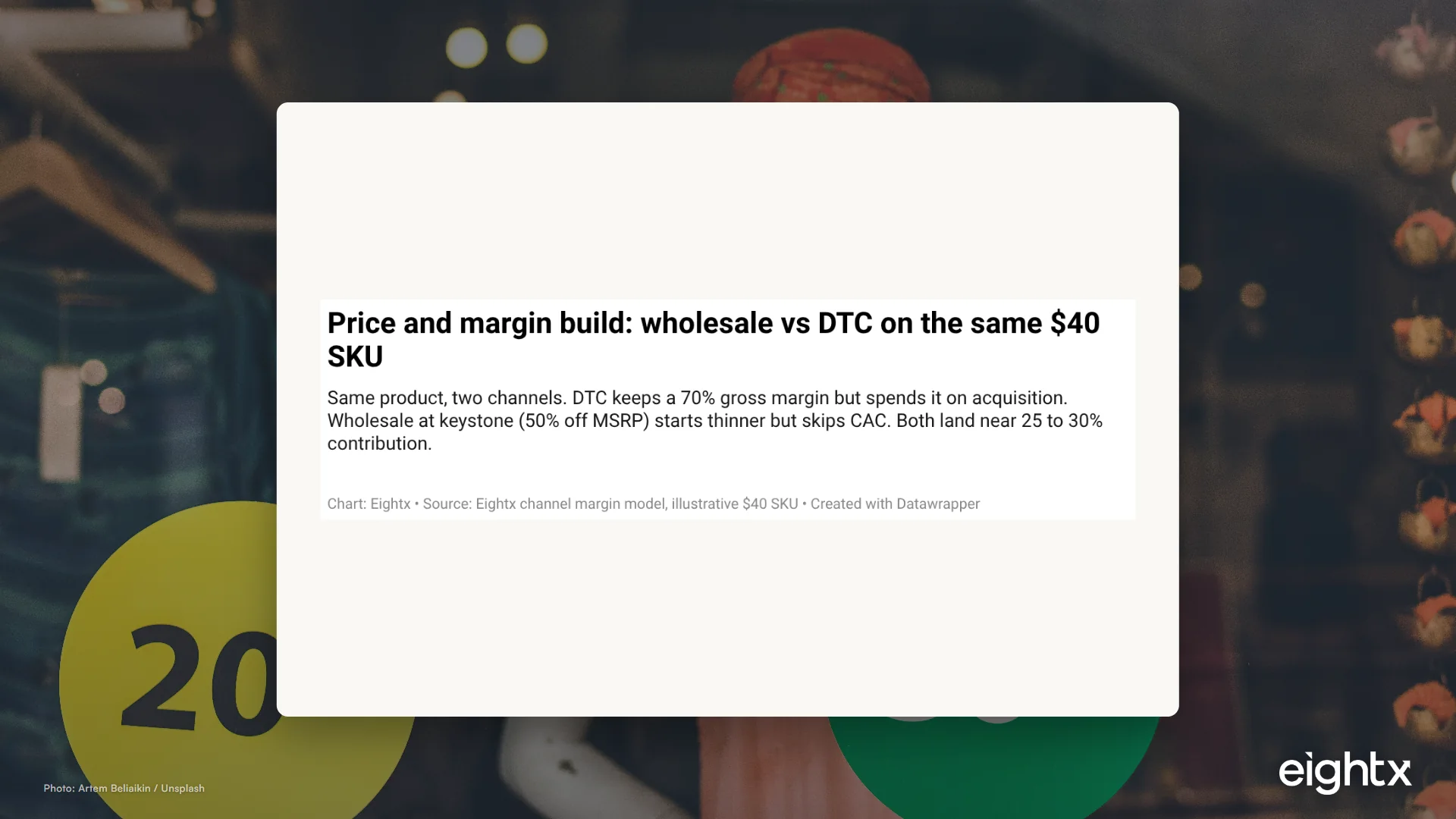
Here is the build that matters. Same $40 SKU, $12 landed cost, run through both channels per unit.
On gross margin, DTC wins easily: $28 of gross profit (70%) versus $8 (40%) on wholesale. But DTC then spends roughly 40% of revenue, about $16 here, on customer acquisition, fulfillment, and returns, leaving around $12 of contribution. Wholesale skips CAC entirely. After roughly 15% of wholesale revenue in trade spend and inbound freight, about $3, it clears around $5 of contribution. Per unit, DTC contributes more, but wholesale moves volume you would never reach directly. The channels converge on contribution, not on the headline gross margin number. This is the same dynamic we modelled in beauty retail vs DTC margins: both land near 25 to 30% contribution from completely different starting points.
The trap is judging wholesale by gross margin and either rejecting a profitable channel or, worse, accepting one that loses money. The only test that matters: does wholesale revenue cover landed cost plus inbound freight plus trade spend, with contribution left over? If yes, the channel pays. If no, you are buying revenue at a loss.
The pattern we see again and again is a founder who looks at the 50% gross margin on wholesale, panics, and tries to claw it back by raising the wholesale price 10 points. One beauty brand doing about $6M in DTC tried exactly this with a regional chain; the buyer walked, and they lost a channel the per-unit build showed would have cleared positive contribution. When we work through that build with operators, the number that changes the conversation is contribution after CAC, not the gross-margin headline they fixated on.
Protect DTC with a MAP policy
A keystone wholesale price is worthless if retailers race each other to the bottom on the advertised price. The first reseller who undercuts starts a cascade: automated repricers chase the low price down within hours, and channel margin collapses before you notice. That collapse drags your DTC price and brand perception with it.
The fix is a minimum advertised price (MAP) policy. MAP is the lowest price a reseller may advertise, not the lowest they may sell at (MAP pricing explained). Everyday bands run 0 to 15% off MSRP, widening to 20 to 25% in named promo windows like Black Friday and Prime Day. Premium brands run tighter at 0 to 10%. In the US, MAP is legal when structured as a unilateral policy under the Colgate doctrine (United States v. Colgate & Co., 250 U.S. 300, 1919): you publish the policy, distribute it, and refuse to deal with violators, with no signature and no negotiation. The moment you negotiate it into a signed agreement, you break the doctrine and create a vertical price-fixing problem reviewed under the rule of reason after Leegin (2007). One caveat: MAP is generally prohibited in the EU and UK, so global brands run region-specific policies.
The margin stakes are concrete. On a $100 MSRP item wholesaled at $50, MAP enforced at $90 leaves the retailer a 44.4% gross margin. If street price slips to $70, that margin collapses to 28.6%, which most specialty stores treat as too thin to keep stocking you, and they either demand a cost concession or drop you. (This is operating guidance on pricing structure, not legal advice; run any MAP or distribution policy past counsel before you enforce it.)
Wholesale is structural, so plan for it
This is not an edge case you can avoid forever. Across the 6 public consumer brands with cleanly disclosed splits, the median wholesale share of net revenue is about 49%, with the two pure-DTC brands included as zeros (wholesale revenue share by vertical). Drop the two zeros and the four channel-having brands median about 60%. Either way the read is the same. On Holding runs 58.2% wholesale, Birkenstock 62%, e.l.f. Beauty sells 83% through retailers. Only pure-DTC models like FIGS and Warby Parker report zero wholesale, and both have structural reasons (repeat scrubs, prescription eyewear). For footwear, beverage, and beauty, wholesale becomes the channel where new-customer trial happens. Build the price architecture before the buyer calls, not after.
| Brand | Category | Wholesale share of FY2025 net revenue |
|---|---|---|
| e.l.f. Beauty | Beauty | 83% |
| Birkenstock | Footwear | 62% |
| On Holding | Footwear | 58.2% |
| YETI | Drinkware / outdoor | 40% |
| Warby Parker | Eyewear | 0% (pure DTC) |
| FIGS | Apparel (scrubs) | 0% (pure DTC) |
| Median (all 6, zeros included) | ~49% |
When I talk to founders running a brand at this size, the reaction is almost always the same: they assumed they could stay direct forever, then a buyer from a national retailer emails and they realise they have no wholesale price that actually clears contribution. One founder doing about $8M in DTC took the call cold, agreed to a number live, and only afterward worked out the per-unit build was running roughly $2 to $3 underwater on every case shipped. The brands that handle that call well already had the architecture built. The ones that scramble end up agreeing to a number on the call and reverse-engineering the loss later.
What to do about it
- Set MSRP from the DTC price your acquisition economics require. That is your anchor for both channels.
- Wholesale at keystone, about 50% of MSRP, then run the per-unit build: landed cost, inbound freight, trade spend. Confirm contribution is positive before you sign.
- Reject any wholesale SKU that does not clear positive contribution. Raise MSRP, cut COGS, or build a channel-specific pack instead of wholesaling at a loss.
- Publish a MAP policy at 0 to 15% off MSRP everyday, 20 to 25% in named promo windows. Keep it unilateral: publish, distribute, refuse to deal, never sign or negotiate it.
- Enforce MAP consistently across every reseller. One exception creates the inference of an agreement and breaks your Colgate safe harbor.
- Use channel-specific SKUs, pack sizes, or bundles so DTC customers cannot find the identical item cheaper at retail. This is your main lever against channel conflict.
- Review channel contribution quarterly. If wholesale contribution drifts negative as trade spend creeps up, reprice or exit the account.
For the full picture of how channel pricing fits your overall margin plan, start with our ecommerce pricing strategy guide, and if a wholesale line is already underwater, work through how to fix an unprofitable product line.
Methodology
The price and margin build is an illustrative per-unit model on a $40 MSRP SKU with $12 landed cost, using a keystone (50% of MSRP) wholesale price. The 40% DTC cost ratio and 15% wholesale cost ratio are illustrative typical values, not measured benchmarks; your channel will differ. Keystone and MAP figures are drawn from Eightx reference guides. Wholesale revenue shares are the 6 public consumer brands with cleanly disclosed channel splits in their latest FY2025 SEC EDGAR 10-K and 20-F filings; the shares are wholesale (or "B2B" / retailer) revenue as a percentage of net revenue. Each is computed from the issuer's own channel disclosure: e.l.f. reports retailers 83% vs e-commerce 17% (FYE March 2025); Birkenstock B2B EUR 1,297.9M of EUR 2,092.7M = 62% (FYE September 2025); On Holding wholesale CHF 1,753.4M of CHF 3,014.0M = 58.2% (FYE December 2025, reported in CHF under IFRS); YETI wholesale 40% vs DTC 60% (FYE January 2026); FIGS and Warby Parker run pure-DTC models at 0% wholesale. Because the issuers' fiscal years end in different months, this is a cross-section of each brand's latest annual filing, not a single calendar window. The median includes the two pure-DTC brands as zeros, which pulls the all-6 median to about 49%; the four channel-having brands median about 60%. The 40 to 50% off-MSRP wholesale band reflects standard industry convention. Your real numbers will differ by category and order size; model your own.
Frequently Asked Questions
what wholesale discount off msrp is standard?
Keystone, about 50% off MSRP, is the cleanest starting point. It gives the retailer a 50% gross margin at full price and is what premium retailers expect. Many brands run a 40 to 50% off range and adjust by category, brand strength, and order size.
how do i set msrp so both channels work?
Price from the outside in. Start with the DTC consumer price that protects your acquisition economics, then back into wholesale at keystone (about 50% of MSRP), and confirm your landed cost still leaves positive contribution in the wholesale channel. If it does not, the MSRP is too low or the COGS is too high.
why judge wholesale on contribution margin instead of gross margin?
Because gross margin overstates the haircut. Wholesale drops gross margin from roughly 70% to 50% on a beauty SKU, but it skips the 25 to 30% of revenue DTC spends on customer acquisition. After you net out CAC on DTC and trade spend on wholesale, the two channels often land within a few points on contribution, near 25 to 30%.
how does a map policy protect my dtc price?
MAP sets the lowest price a reseller may advertise, usually 0 to 15% off MSRP everyday and 20 to 25% in named promo windows. It stops the race to the bottom where one retailer undercuts and every repricer chases it down within hours, which would otherwise drag your DTC price and brand perception down with it.
what if my wholesale price loses money?
Then you are buying revenue at a loss and the channel is a cash drain disguised as growth. Rework it: raise MSRP so keystone leaves room, cut landed cost, build a channel-specific SKU or pack, or walk away from the retailer. Never wholesale a SKU whose price does not cover landed cost plus inbound freight plus trade spend.
how do i avoid channel conflict between wholesale and dtc?
Hold MSRP as the shared consumer price, enforce MAP consistently across every reseller, and use channel-specific SKUs, pack sizes, or bundles so customers cannot find the identical item cheaper at retail. Treat wholesale as a distribution and awareness channel, not a discount channel, so it does not cannibalize your direct price.