
Insights
DTC subscription churn index 2026: what six public subscription disclosers tell us about retention right now
DTC consumer-goods subscription churn averages 6.5% monthly, according to Recurly benchmarks, and 7.1% from Recharge's consumer panel. Insights from public 10-K disclosures indicate that replenishment-based subscriptions exhibit higher retention, while curated box services are experiencing shrinkage.
Key Takeaways
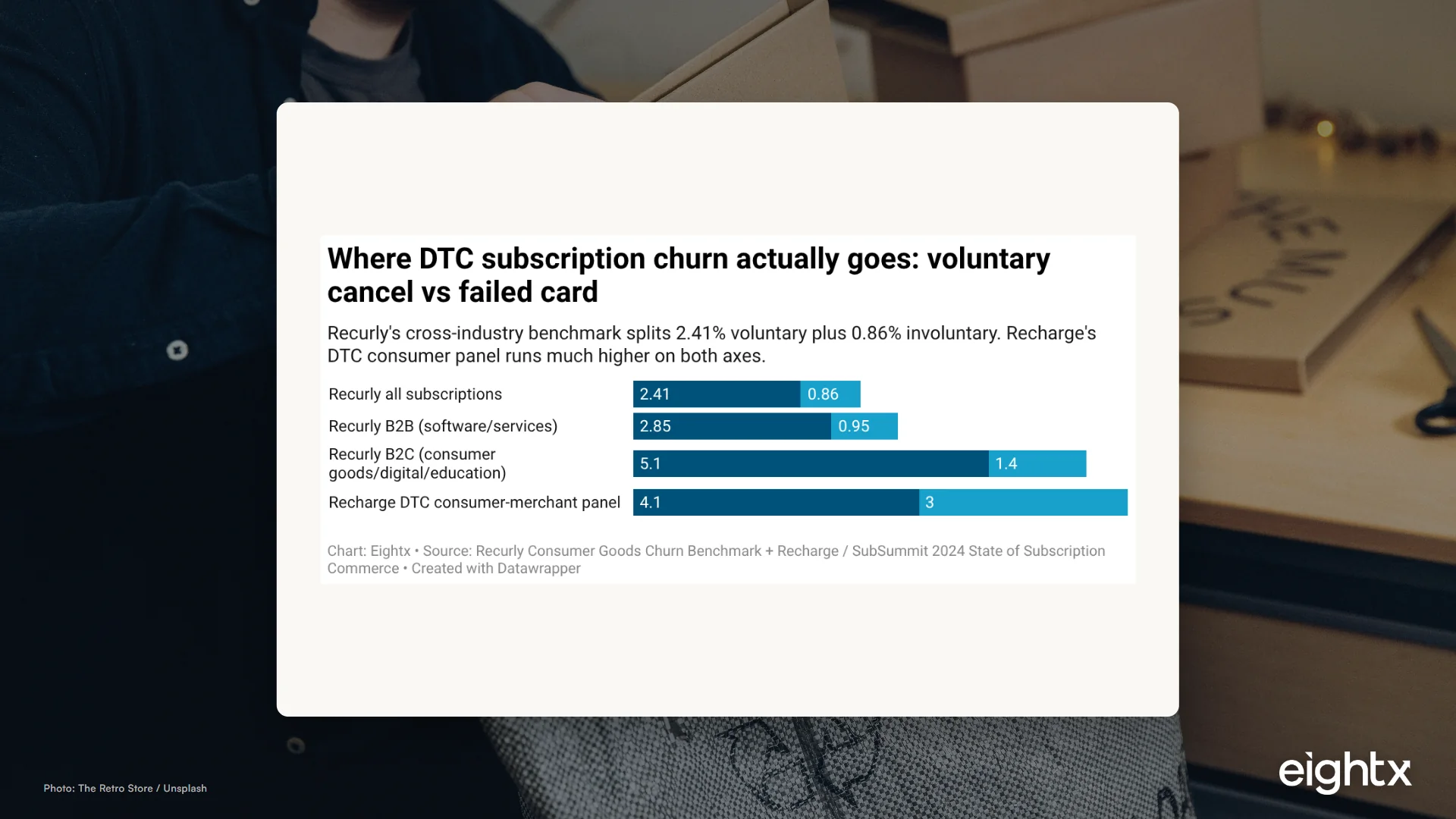
- Consumer-goods subscription churn averages 6.5% monthly per Recurly's 2024 benchmark (B2C aggregate covering consumer goods, digital media, and education). Recharge's DTC consumer-merchant panel runs higher at 7.1% (4.1% voluntary plus 3.0% involuntary).
- Both curated-box subscriptions in our public stack are shrinking (BARK -20.5% DTC revenue, Stitch Fix -7.9% active clients). Peloton's connected-fitness subscriptions also fell -5.9%, a separate archetype with hardware lock-in. The two that grew were Rent the Runway (+20.1%, rental) and Hims (+12.7%, telehealth replenishment).
- Only Peloton publishes a hard monthly churn rate. 1.6% on Connected Fitness (hardware-locked) and 7.0% on App. Every other public DTC subscription company discloses subscriber counts but defers from publishing the churn number, which is why platform data from Recurly and Recharge is needed to fill the gap.
- Involuntary churn is 12-42% of total subscription churn. If your monthly churn is 8%, somewhere between 1 and 3 of those points is fixable purely via dunning and card retry, before you touch the save flow.
- If your replenishment brand is over 7%/mo or your curated box is over 12%/mo, the fix is product or onboarding, not the cancel flow. Above-band churn is structural; below-band churn is competitive advantage.
Every DTC operator on a CFO call asks the same retention question. Is my churn high, low, or about average? There's no clean answer in any single public report, and the platform vendors (Recharge, Recurly) only publish aggregates. So we built the index from two complementary data layers: six public subscription companies that disclose subscriber counts or churn in 10-K and 10-Q filings, and the published platform benchmarks from Recurly and Recharge that aggregate thousands of private merchants. The headline read: consumer-goods subscription churn averages 6.5% monthly per Recurly, 7.1% per Recharge's DTC consumer panel. Public DTC filings triangulate the same story. Replenishment models retain. Curated boxes don't. Rental is the standout exception.
The benchmark in one number, and why one number is misleading
The Recurly Consumer Goods Churn Benchmark Report puts B2C subscription monthly churn at 6.5%. That groups consumer goods, digital media, and education on the same line. Recurly's broader cross-industry benchmark is lower at 3.27% (2.41% voluntary plus 0.86% involuntary), but that figure is weighted heavily by B2B software subscriptions, which churn at roughly half the rate of consumer subscriptions. For comparison, Recurly's B2B benchmark is 3.8% monthly.
Recharge's data sample is DTC-only and runs higher. The 2024 State of Subscription Commerce Industry Outlook puts the consumer-merchant panel at 7.1% combined (4.1% voluntary plus 3.0% involuntary). The gap between Recurly's 6.5% and Recharge's 7.1% is the difference between a benchmark that includes large digital-media subscriptions (Recurly) and one that's pure DTC physical-goods commerce (Recharge).
Why "one number" is misleading: subscription model matters more than industry vertical. A replenishment supplement brand at 5%/mo churn is performing better than a curated beauty box at 9%/mo, but they're both at the average for their respective models. Compare against the right band, not the headline.
What six public DTC subscription companies told the SEC
We pulled the most recent 10-K and 10-Q filings from six companies that publish subscriber-count or churn data: Rent the Runway, Hims and Hers, Stitch Fix, Black Rifle Coffee, Peloton, and BARK. Beachbody is in the public DTC subscription space but its 2026 10-K (accession 0001193125-26-100284) was not retrievable at research time; FIGS does not classify itself as a subscription business and was excluded.
The pattern is clean. Replenishment and rental models grew subscribers in 2025. Curated boxes shrank. Connected fitness (Peloton) is shrinking but at the lowest rate in the index because the hardware lock holds the base.
| Company | Ticker | Subscription model | Subscriber metric | Latest value | YoY change | Period end | Filing |
|---|---|---|---|---|---|---|---|
| Rent the Runway | RENT | Curated apparel rental | Active Subscribers | 143,796 | +20.1% | Jan 31 2026 | 10-K 0001468327-26-000020 |
| Hims & Hers | HIMS | Telehealth replenishment | Subscribers | 2,511,000 | +12.7% | Dec 31 2025 | 10-K 0001773751-26-000022 |
| Black Rifle Coffee | BRCC | Coffee replenishment | Coffee Club Active Subscribers | 159,900 | ~flat | Dec 31 2025 | 10-K 0001891101-26-000022 |
| Peloton | PTON | Connected fitness | Paid Connected Fitness Subs | 2,799,943 | -5.9% | Jun 30 2025 | 10-K 0001639825-25-000138 |
| Stitch Fix | SFIX | Curated apparel box | Active Clients | 2,309,000 | -7.9% | Aug 2 2025 | 10-K 0001628280-25-042782 |
| BARK | BARK | Curated pet box | DTC segment revenue (9mo proxy) | $250.9M | -20.5% | Dec 31 2025 | 10-Q 0001628280-26-005799 |
Why Peloton's 1.6% Connected Fitness churn is the gold standard nobody else can hit
Peloton is the only company in the public sample that publishes a monthly churn rate as a key operating metric in its 10-K. For FY2025, Average Net Monthly Paid Connected Fitness Subscription Churn was 1.6% (up from 1.4% the prior year). App Subscription Churn was 7.0% monthly.
The 1.6% number is structurally low because the customer bought a $1,500 to $2,500 piece of hardware that requires the subscription to function. That's the strongest possible switching cost in subscription. Cancel the subscription and the bike or treadmill becomes a coat rack. Hims and Hers gets some of this dynamic from the prescription-tied refill cycle (canceling means restarting a telehealth consult), but nowhere near as hard a lock.
The takeaway for non-hardware operators: do not benchmark against 1.6%. It is not reachable without a switching-cost mechanic embedded in the product. The relevant Peloton comparison for app and content subscriptions is the 7.0% App churn, which sits at the same level as average curated-box churn.
Replenishment vs curated box vs rental: where each model should land
Three retention archetypes show up in the data, each with a structurally different band.
Replenishment (CPG, coffee, pet food, supplements): 4-7% monthly churn. The product solves a recurring need the customer already has. Black Rifle Coffee's Coffee Club holding 159,900 subscribers flat in a soft coffee category is exactly the expected outcome. Above 7% in replenishment usually means the product-to-cadence fit is wrong (monthly when bi-monthly would land better) or onboarding is not teaching the customer how to use the subscription.
Curated box (beauty, food, pet toys, apparel): 8-12% monthly churn. Curation is structurally weaker retention because it's discovery, which is a discretionary need that pauses easily. BARK at -20.5% DTC segment revenue and Stitch Fix at -7.9% active clients sit at the structural ceiling of this model. The fix is rarely the save flow; it is product (better matching, fresher rotation) and pricing (lower commitment or pause mechanics).
Curated rental (apparel): 6-10% monthly churn. Rent the Runway is the standout exception in the public stack, growing 20.1% YoY. Rental sidesteps style fatigue because the customer expects the rotation by design, and the paused-subscriber mechanic captures cost-conscious churners who would otherwise cancel. RTR is the only DTC subscription model where pause is a core retention lever.
Telehealth replenishment: 5-8% monthly churn. Hims and Hers grew subscribers 12.7% YoY (from a +45% prior-year base, so the deceleration is real). The prescription-tied refill cycle and physician-network switching cost keeps the band tighter than pure CPG replenishment.
Connected fitness (hardware-locked): 1-3% monthly churn. Peloton-style. Not reachable without hardware lock-in.
Digital app subscription: 7-10% monthly churn. Peloton App 7.0% is the public benchmark. Behaves like a curated box on retention.
The 12-42% of your churn that's actually a payments problem
Across the platform aggregates, involuntary churn (failed cards, expired payment methods) is 12-42% of total subscription churn. Recurly's overall sample puts it at 26% (0.86% of the 3.27% total). Recharge's DTC consumer panel puts it at 42% (3.0% of 7.1%). The gap reflects merchant sophistication: more mature subscription merchants have invested in account updaters and retry optimization; Recharge's DTC sample skews newer.
The opportunity is large and consistently under-invested. Recurly publishes a 49% baseline dunning recovery rate, with optimized merchants reaching 71%. If your monthly churn is 8% and 30% of that is involuntary (2.4 points), pulling involuntary recovery from 49% to 71% gets you from 2.4 to 1.5 points of involuntary churn (a 0.9-point improvement on the headline number for what is usually a one-quarter engineering project).
The lever set is well-defined. Pre-dunning notifications 3-5 days before charge attempt. Account Updater services (Visa, Mastercard, Amex). Smart retry timing (don't retry on day 1 if the decline was insufficient-funds; retry day 4 or 6). Customer-facing card-on-file update prompts in transactional emails. None of these are exotic; the discipline is simply prioritizing them as engineering work, not waiting for "the marketing team" to fix retention.
We see this miss on operator calls regularly. The default operator assumption is that high churn is a product or cancel-flow problem; the cancellation-reason data almost never gets segmented by voluntary vs involuntary, so the billing-system fix never gets prioritized. Recurly's 49% baseline-to-71% optimized recovery delta is the headline opportunity here.
What to do this quarter if you run a $5M to $50M DTC subscription brand
Three actions, in order of speed-to-impact.
Audit your involuntary churn first. Pull last quarter's cancellation reasons and segment by voluntary vs involuntary (failed payment, expired card, declined). If involuntary is more than 25% of total, you have a billing-system fix that is faster and cheaper than any save-flow project. Push your billing stack toward Recurly-baseline retry logic, Account Updater integration, and pre-dunning notifications. None of this segmentation is reliable without clean books underneath it, which is the whole reason we keep comparing ecommerce bookkeeping providers for subscription brands.
Benchmark your churn against the right band, not the headline. Replenishment 4-7%, curated box 8-12%, telehealth replenishment 5-8%, curated rental 6-10%, app subscription 7-10%. If you're in-band, the lever is product depth (more SKUs, better matching) and lifecycle marketing (month-3 retention is the highest-churn moment for most subscriptions). If you're above-band, the fix is structural (product, pricing, or onboarding), not save-flow optimization. Price the subscription against your real channel economics too, since contribution margin differs sharply between Amazon and Shopify and the discount you can afford on each is not the same.
For curated boxes specifically, consider a pause mechanic before a save flow. Rent the Runway's data point is real. Letting a price-sensitive customer pause for two months instead of canceling outright captures 30-50% of would-be churners, based on operator anecdotes from our last twelve months of CFO calls. The implementation is two or three weeks of work in Recharge or your subscription system. The retention impact compounds quarterly.
A $5M to $50M DTC subscription brand at 6%/mo churn loses 70% of its subscribers in a year if the rate holds. Pull churn to 4% and that drops to 56%, an extra 14 points of base retention without acquiring a single new customer. That's the math operators don't internalize until they see it on the page. Every monthly churn point you save is the equivalent of three to five months of paid-acquisition effort.
A few operator notes from the last twelve months of CFO calls
A handful of patterns recur across the founder calls in our library. Worth flagging because they don't show up cleanly in either platform data or 10-K disclosures.
A mid-7-figure beverage operator we work with kept hitting this wall: "If we sell a subscription, we won't be able to sell them on an AOV of €68. Then the AOV will be what's costing subscription." Translation: the subscription discount cannibalizes a high-ticket one-off AOV, so retention has to be exceptional or the subscription is dilutive. The AOV math gets harder still once you factor in how much lower mobile AOV runs than desktop, since most subscription sign-ups now happen on a phone. This is the curated-box paradox in operator language and it's why subscription pricing has to come out of the gross-margin math, not the marketing budget.
A supplements operator at $8M GMV found a clean lever in billing cadence: "Bi-monthly retention is so much better than monthly, quarterly even better. Acquisition cost didn't change when we offered bi-monthly subscription. So the retention was that much better." The Recharge data backs this up: longer billing cadence reduces apparent monthly churn substantially, because the customer makes a stick-or-cancel decision less often.
A skincare operator put twelve-month LTV at $195 across the cohort. For an early-stage replenishment brand, that's a usable target. The pattern we see most: replenishment LTV scales with the number of products in the subscription, not the price per product. Adding a second SKU to the subscription lifts twelve-month LTV more than raising the price of the first.
The Fenty pause-flow conversation comes up in roughly one CFO call a month. A founder's spouse signs up, struggles to cancel, and the operator realizes the FTC click-to-cancel rule has teeth. If your save flow uses pattern-matching tricks (multi-step cancel, surprise pause-by-default), the regulatory risk is now larger than the retention upside. Make the cancel flow as easy as the sign-up flow and put the retention lift somewhere else.
Sources and methodology
We pulled subscriber and churn data from three layers. The first layer is SEC EDGAR full-text search, run against form types 10-K and 10-Q for "active subscribers" and "subscribers AND churn" in the window January 1 2025 through June 1 2026. The DTC-relevant filings retrieved are Rent the Runway 10-K accession 0001468327-26-000020 (FY2025 ending January 31 2026), Hims and Hers 10-K accession 0001773751-26-000022 (FY2025 ending December 31 2025), Stitch Fix 10-K accession 0001628280-25-042782 (FY2025 ending August 2 2025), Black Rifle Coffee 10-K accession 0001891101-26-000022 (FY2025 ending December 31 2025), Peloton 10-K accession 0001639825-25-000138 (FY2025 ending June 30 2025), BARK 10-K accession 0001819574-25-000024 plus 10-Q accession 0001628280-26-005799.
The second layer is platform churn benchmarks. The Recurly Consumer Goods Churn Benchmark Report is the source for the 3.27% cross-industry, 6.5% B2C, 3.8% B2B aggregate monthly churn figures. The SubSummit 2024 State of Subscription Commerce Industry Outlook is the source for the Recharge DTC consumer-merchant panel split of 4.1% voluntary plus 3.0% involuntary. Both reports aggregate thousands of subscription merchants on their respective platforms, but neither publishes vertical-by-vertical breakdowns publicly.
The third layer is the model-by-model band synthesis in Chart 3 and Table 2. We assembled it by triangulating the Recurly and Recharge aggregates against the public subscriber trajectories from the 10-K layer (Rent the Runway growing in rental, Black Rifle Coffee flat in coffee replenishment, BARK and Stitch Fix shrinking in curated boxes, Peloton publishing the only hard monthly churn rate). The bands are Eightx synthesis, not a single published series, and should be read as directional benchmarks rather than statistically rigorous medians.
Several limitations apply. Only Peloton publishes a hard monthly churn rate in the 10-K (Connected Fitness 1.6%, App 7.0%); every other public DTC subscription company reports subscriber counts only, and churn must be inferred from period-over-period change net of acquisition. BARK does not disclose an active-subscriber count; the DTC segment revenue change of -20.5% is the closest comparable proxy. Beachbody is in the public DTC subscription space but the 2026 10-K was not retrievable during research; that comp will be backfilled at the next quarterly refresh. The Recurly B2C voluntary and involuntary split is implied from the published 6.5% total and the overall 2.41/0.86 disclosure; it is not directly stated in the Recurly report.
This index is refreshed quarterly when new 10-K and 10-Q filings land. The next planned update is September 2026, covering Q2 2026 calendar-quarter filings.
For related operator context, see our DTC layoff and hiring tracker for the labor market read on consumer brands and our DTC cost-of-goods index for the BLS PPI read on margin pressure across the same operator base.
Frequently asked questions
what is the average monthly churn rate for a dtc subscription box in 2026?
Recurly's B2C benchmark (covering consumer goods, digital media, and education merchants) puts the average at 6.5% monthly. Recharge's DTC consumer-merchant panel runs higher at 7.1%, split 4.1% voluntary plus 3.0% involuntary. Curated boxes specifically (apparel, beauty, food, pet toys) typically run 8-12% monthly. Replenishment categories (CPG, coffee, supplements) run 4-7%.
is 8% monthly churn bad for a curated subscription box?
It's right at the average. The platform aggregates and the public 10-K disclosures both point to 8-12% as the typical band for curated-box subscriptions. Below 8% is competitive advantage. Above 12% suggests a structural product or onboarding problem, not something a better save-flow will fix. BARK and Stitch Fix have been shrinking subscribers all year and both sit in that above-band zone based on their disclosed subscriber declines.
how do i benchmark my subscription churn against public companies like bark or stitch fix?
You mostly can't on a like-for-like basis. Only Peloton publishes a hard monthly churn rate (1.6% Connected Fitness, 7.0% App). Every other public DTC subscription company in the index reports active subscribers or active clients period-over-period, not a churn percentage. The workaround is to calculate net subscriber change year-over-year, then back out new acquisitions from earnings call commentary. That gives you an approximate gross churn, but it's noisy. Better to benchmark against the Recurly and Recharge platform aggregates, which actually sample subscription-merchant churn directly.
what's the difference between voluntary and involuntary churn and why does it matter?
Voluntary churn is a customer actively canceling. Involuntary churn is a customer leaving because their card failed and the dunning sequence didn't recover them. The split matters because each one has a completely different fix. Voluntary churn is product, pricing, and onboarding. Involuntary churn is card retry logic, account updaters, and pre-dunning notifications. Recurly's data shows involuntary running 12-26% of total churn; Recharge's consumer panel puts it at 42%. Most operators we work with under-invest in the involuntary side because it's a billing-system project, not a marketing project.
why is rent the runway growing subscribers when stitch fix and bark are shrinking?
Three reasons. First, Rent the Runway raised prices in 2024 and reinvested the margin into inventory (more styles, fresher rotation), which directly attacks the main reason RTR customers churn. Second, the paused-subscriber mechanic lets cost-conscious members hold their account without canceling, which BARK and Stitch Fix don't have a clean analog for. Third, the product is rental, not ownership, so the use-case keeps refreshing as styles and seasons change. Curated apparel boxes hit style fatigue. Rental doesn't.
how much of my subscription churn is just failed credit cards?
Probably 15-40%, depending on your billing setup. Recurly's aggregated benchmark puts involuntary at 26% of total churn for the average subscription merchant. Recharge's DTC consumer panel puts it at 42%. If your dunning sequence is basic (one retry, one email, then cancel), you're at the high end. If you're running pre-dunning notifications, account updaters, and three to five retry attempts with smart timing, you can pull involuntary down to 5-10% of total churn. Recurly publishes a 49% dunning recovery rate as their baseline, with optimized merchants reaching 71%.
should i pay more attention to monthly churn or net revenue retention?
Both, in that order. Monthly churn tells you whether the subscription itself is working. Net revenue retention (NRR) tells you whether the customers who stay are spending more (upgrades, plan increases, cross-sells) or less (downgrades, plan decreases). For most $5-50M DTC subscription brands, monthly churn is the primary KPI because acquisition cost is high and you need three to twelve months of revenue per customer to break even. NRR becomes more important once you have a substantial cross-sell or tier-upgrade mechanic, like Hims has with multi-product bundling.
what monthly churn rate did peloton publish in their latest 10-k?
1.6% Average Net Monthly Paid Connected Fitness Subscription Churn for FY2025 (ending June 30 2025), up from 1.4% in the prior year. App subscription churn was 7.0% monthly, also up. Peloton is the only company in our public DTC subscription index that publishes a hard monthly churn rate, and the 1.6% figure is widely treated as the gold standard. The Connected Fitness number is structurally low because the customer bought a $1,500-$2,500 piece of hardware they need a subscription to use, which is the strongest possible switching cost in subscription.
is replenishment subscription churn really half of curated box churn?
Roughly, yes. Replenishment categories (CPG, coffee, pet food, supplements) target 4-7% monthly churn. Curated boxes target 8-12%. The difference is structural: replenishment products solve a recurring need the customer already has (the coffee runs out, the toothpaste runs out, the protein powder runs out). Curated boxes solve a discretionary discovery need the customer can pause when budget gets tight or interest fades. Black Rifle Coffee's Coffee Club holding flat at 159,900 subscribers in a soft category is exactly what you'd expect from a strong replenishment product.