
Inventory
Pre-Season Buying: How Much to Commit Up Front vs Hold Back for Reorders (2026)
Commit 60 to 80 percent of a seasonal buy up front and hold 20 to 40 percent as open-to-buy for in-season reorders. Push the commit higher when lead times are long, MOQs are large, or discounts are real; hold back more when demand is uncertain and markdown risk is high. For most brands, 70/30 is the default.
Key Takeaways
- Default to a 70/30 split: commit 70 percent of the seasonal buy pre-season, hold 30 percent as open-to-buy for reorders. Move to 80/20 for basics, 50/50 for trend-driven SKUs.
- In a modeled $1M seasonal buy at 50 percent gross margin, a 70 percent commit keeps about $470K on-plan and never drops below $360K across demand swings; a 90 percent commit loses roughly $200K when demand falls 25 percent.
- Lead time is the deciding input. If production plus transit is longer than half your selling window, reorders cannot land in time, so raise the pre-season commit toward 80 percent.
- Open-to-buy is a formula, not a guess: OTB equals planned sales plus planned markdowns plus planned ending inventory minus beginning inventory minus stock already on order.
- Over-committing is expensive for DTC: a clean public comp like Revolve carries about 147 days of inventory on a 6.06 percent operating margin, so a few points of avoidable markdown is the difference between a profitable season and a break-even one.
Every seasonal buy is a bet placed months before you have any real demand signal. Commit too much up front and you finance a warehouse full of stock that clears at 40 cents on the dollar in January. Hold back too much and you watch your best-selling SKU sit at zero inventory through the peak while the reorder is still on a boat. The question is not whether to commit, it is how much, and the answer is a split, not a single number.
For most brands in the $5M to $50M range, the right default is to commit 70 percent of the seasonal buy up front and hold 30 percent back as open-to-buy for in-season reorders. The rest of this post is about when to move off that default, and the profit math that shows why the middle beats both extremes.
The split: commit 60 to 80 percent, hold back 20 to 40 percent
The merchandising answer, synthesized across retail planning practice, is consistent: commit roughly 60 to 80 percent of a seasonal buy pre-season and reserve 20 to 40 percent as open-to-buy (Shopify, Retail Dogma). The two rules of thumb you will hear most are 60/40 (balanced risk) and 70/30 (more confident, longer lead time). There is no universal published percentage; treat these as synthesized practice, not law.
Where you land inside that band is driven by the SKU, not the brand. Segment the assortment three ways:
| Segment | Pre-season commit | Open-to-buy reserve |
|---|---|---|
| Replenishable basics | 75 to 85% | 15 to 25% |
| Seasonal core | 60 to 75% | 25 to 40% |
| High-fashion or experimental | 40 to 60% | 40 to 60% |
A core tee, an evergreen serum, a hero supplement: commit deep, because demand is predictable and the downside of over-buying is small. A novelty print, a fashion color, a TikTok-bait SKU: commit shallow and plan to chase only the winners. The blended split for your whole buy falls out of this segmentation; it is not something you pick top-down.
When I talk to founders running a brand this size, the version of this that actually works is an A/B/C rank. Sort your SKUs by volume and margin, then hold deeper only on the A's. The pattern we see again and again: the C's get dropped or drop-shipped, the B's get a shallow buy, and only the proven A's earn a deep pre-season commit. Holding inventory is one of the biggest reasons founders get into cash trouble, so the discipline is to be deep on a short list and shallow on everything else.
Open-to-buy is a formula, not a vibe
Open-to-buy (OTB) is the merchandise budget you still have left to spend in a period after accounting for what you already hold and what is already on order. The standard retail formula:
OTB = planned sales + planned markdowns + planned ending inventory minus beginning inventory minus stock on order
Work a real example. You are planning Q4 jackets for a DTC brand, all figures at retail:
- Planned Q4 sales: $1,000,000
- Planned markdowns: 10 percent of sales, or $100,000
- Planned ending inventory (Dec 31): $150,000
- Beginning inventory (Oct 1): $300,000
OTB = 1,000,000 + 100,000 + 150,000 minus 300,000 = $950,000 of buying power at retail. OTB is always computed at retail first, then converted to cost by multiplying by one minus your gross margin. At a 50 percent margin, $950K at retail is about $475,000 at cost. Now you split it: a 70/30 policy puts $665K at retail (about $332K at cost) into the pre-season commit and protects $285K at retail (about $143K at cost) for in-season reorders. That reserve is what you use to reorder the styles and sizes that are actually selling once October sell-through tells you where the demand went.
The discipline most brands miss: never let the reserve drop below 10 to 15 percent of the category until late in the season. Spend it all chasing the first hot SKU in week two and you have nothing left when a different winner emerges in week six. The pattern we see in brands that run this well is releasing the reserve in two to four waves tied to weekly sell-through, not in one shot.
What pushes you to commit more up front
Three forces argue for a deeper pre-season commit, and all three are about whether a reorder can physically help you in time.
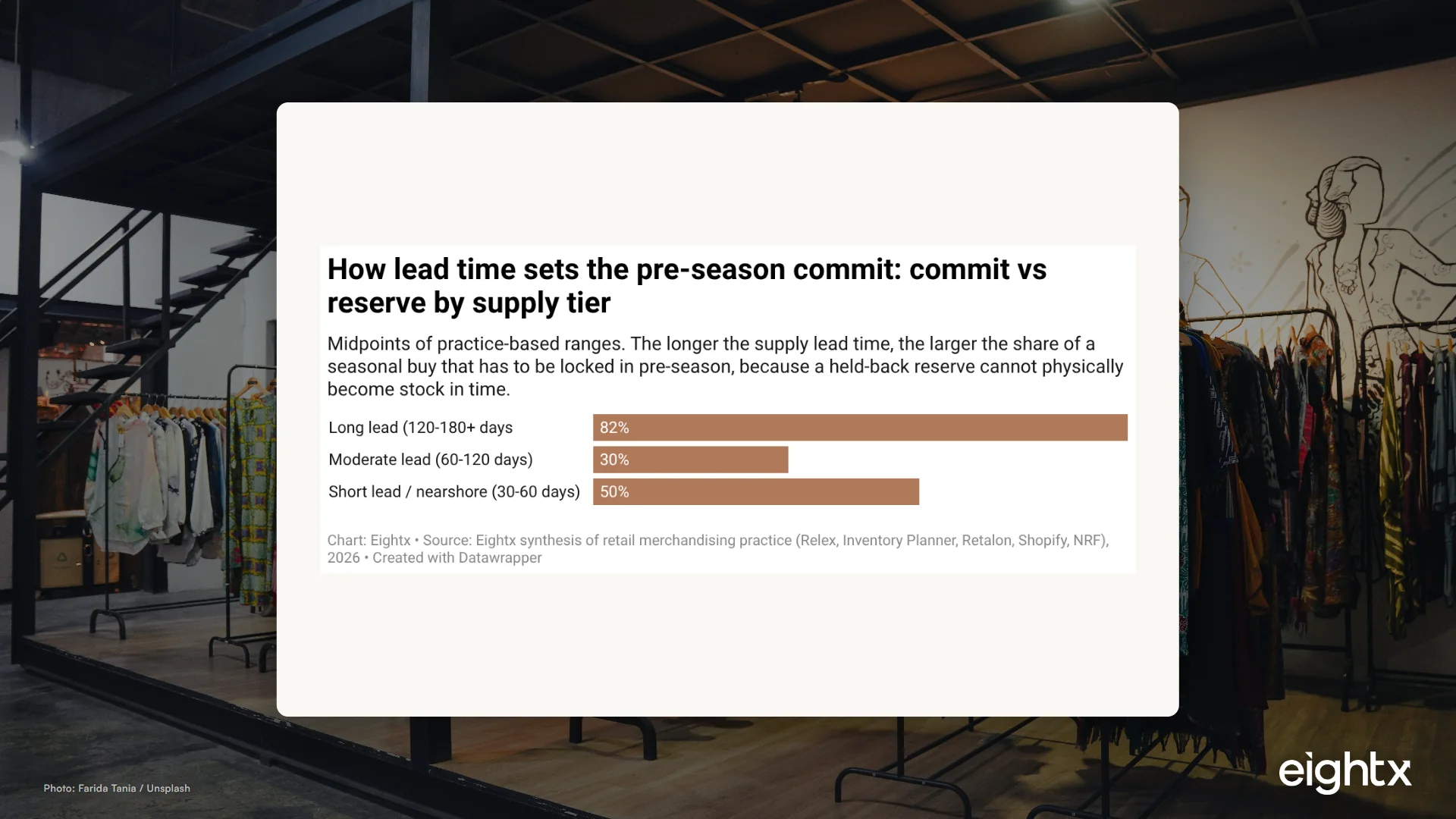
- Lead time longer than half the season. This is the dominant input. If production plus transit runs 90 to 120 days against an 8 to 10 week peak, an in-season reorder lands after the peak is gone. When that is true, the held-back reserve stops being inventory insurance and becomes promotional ammunition, so raise the commit toward 80 percent. For lead-time benchmarks by vertical, this is also why long Asian formulation cycles force beauty to carry so much stock; see our average inventory days by vertical 2026 analysis, where beauty runs a 168-day median against 38 days for food and beverage.
- Minimum order quantities. A factory MOQ can force you above your ideal buy at the style or color level. EOQ math assumes you can order any quantity; an MOQ breaks that assumption and pushes the commit up. We work through exactly where that breaks in what is economic order quantity, the punchline being that if MOQ is 6,000 and your math says 4,400, you order 6,000 and the holding cost on the extra 1,600 units is what you are buying.
- Volume discounts. If committing a larger up-front quantity earns a 10 to 15 percent cost break, that can swing unit margin enough to justify moving from 60/40 to 75/25 for that vendor, as long as your forecast confidence supports it.
The chart below puts numbers on the lead-time point: as supply lead time stretches, the share you must lock in pre-season climbs from about half to over 80 percent.
One operator I worked with put the supply side perfectly. A short-lead domestic supplier, in their words, is a cheat code: everyone else is buying from China, paying a 30 percent deposit, then waiting six months, so they have to forecast both when they will run out and what they will need for the whole next six. Short lead time is what lets you keep a real reserve. Long lead time is, more than anything, a cash-flow problem, because you commit deep and hold that stock for a long time before it sells. If MOQs are the thing forcing your hand, the better move is often to negotiate a cap with the supplier so you can order up to a ceiling and pull as needed, instead of locking the whole quantity at once. Whether your reserve can actually land in time also depends on your air vs sea freight decision.
What pushes you to hold more back
Two forces argue for a deeper reserve, and both are about the cost of being wrong on the high side.
Demand uncertainty is the first. Seasonal sell-through on a specific style or color can swing 20 to 40 percent from plan. The more uncertain the SKU, the more you want to see real sell-through data before you spend, which means a larger reserve and a shallower commit. The operators who get this right tend to order more often rather than forecast more precisely: monthly POs, then weekly POs once they have the muscle for it. It is a time killer, but it is the best way to optimize inventory you cannot perfectly predict.
Markdown risk is the second, and it is the one that shows up on the P&L. Keep three different markdown numbers straight, because the web blends them constantly. First, DTC brands typically budget 5 to 15 percent of sales as planned markdown dollars; that is the line that goes into the OTB formula above. Second, on a units basis, 15 to 30 percent of inventory needs some level of markdown in normal operations, with seasonal categories higher and staples lower. Third, audited inventory write-downs run about 1 to 2 percent of revenue for public DTC apparel. Those are three different bases, not three estimates of the same thing.
If your historical end-of-season markdown rate sits above the 15-percent-of-sales line, that is hard evidence you have been over-committing, and the fix is to hold more open-to-buy. Every unsold pre-committed unit clears at a steep discount; that loss is the tax on a commit that was too deep. We see this turn into the monthly fire sale: a deep buy that missed feeds a clearance event to grind through aged stock, month after month. For how to discount the leftovers without training customers to wait, see our apparel markdown strategy guide.
There is a macro reason this matters more in 2026 than it did two years ago. Apparel prices have flipped from deflation to inflation: US apparel CPI went from minus 0.10 percent year over year in September 2025 to plus 4.17 percent in April 2026 (FRED). Rising landed cost squeezes an already thin margin, so giving units back to clearance hurts more now. It is no surprise that retailers have been running leaner on apparel stock, with the clothing-store inventory-to-sales ratio falling from about 2.37 in early 2023 to 2.09 in March 2026.
The profit math: why the middle wins
Here is the model that settles the argument. Take a $1M seasonal category at a 50 percent gross margin, so $500K of margin if every unit sells at full price. Model net profit kept under three commit levels (50, 70, 90 percent) across three demand outcomes (down 25 percent, on plan, up 25 percent). Unsold pre-committed stock clears at a 60 percent markdown; held-back open-to-buy can only partly chase upside because of lead time.
Read the pattern. The 90 percent commit wins by a hair when demand lands exactly on plan ($500K versus $470K) but craters to about $300K when demand falls 25 percent, because all that over-bought stock gets marked down. The 50 percent commit is safe on the downside but leaves money on the table everywhere because you cannot chase enough of the demand you actually get. The 70 percent commit never wins by the most in any single scenario, but it never loses badly either: $360K on the downside, $470K on plan, $455K on the upside. Across the swing, the 70/30 split has the highest floor and the best risk-adjusted outcome. You are not optimizing for the best case, you are optimizing for the spread of cases you cannot predict.
The 70/30 split rarely wins any single scenario, and that is exactly the point. A deep commit wins only when your forecast is right and punishes you hard when it is wrong; the reserve buys you the option to be wrong cheaply. You are not buying the best case, you are buying a higher floor across every case you cannot predict.
Why an over-deep commit is so expensive for DTC
The reason the markdown tax bites is that a DTC apparel brand is already carrying a lot of inventory before the seasonal buy lands on top. Two verified FY2025 10-Ks make the point. Revolve, the cleanest public DTC comp, ran about 147 days of inventory on a 6.06 percent operating margin. American Eagle, a mall-specialty retailer, ran about 66 days on a 4.08 percent operating margin. DTC carries roughly twice the inventory days, on margins under 7 percent either way.
| Brand | Model | Gross margin | Operating margin | Inventory days |
|---|---|---|---|---|
| Revolve | DTC | 53.5% | 6.06% | ~147 |
| American Eagle | Mall specialty | 36.5% | 4.08% | ~66 |
When I talk to founders sitting on this much stock, the numbers get real fast. We have seen brands carrying roughly 250 days of inventory, which is super high, with a cash conversion cycle to match; the target is more like 3 to 4 months at the outside, and cutting to it frees real liquidity. The bigger surprise is usually how much the mix is costing them: one brand was holding eight months of cover in one SKU and four in another, and simply harmonizing the levels freed multiple millions of dollars. An over-deep pre-season commit on the wrong SKUs is exactly how you end up there. This is the same trapped-cash problem we quantify in average inventory turnover by vertical, where holding 180 days instead of 90 on a $10M brand strands roughly $1.23M in working capital.
What to do about it
- Segment your buy into basics, seasonal core, and fashion before you set any split. The blended commit percentage should fall out of the segmentation, not the other way around. Rank SKUs A/B/C and hold deeper only on the A's.
- Calculate OTB explicitly for the season. Planned sales plus markdowns plus ending inventory minus beginning inventory minus on-order. Do this in dollars at retail, then convert to cost by multiplying by one minus gross margin.
- Set the commit by lead time first. If production plus transit is longer than half your selling window, start at 80 percent commit and treat the reserve as promotional, not replenishment.
- Plan the markdown before you place the order. Budget 5 to 15 percent of sales. If your history says you run hotter than 15 percent, cut the commit and grow the reserve until the number comes down.
- Protect a 10 to 15 percent floor on open-to-buy until late season. Release the reserve in two to four waves tied to weekly sell-through; do not burn it on the first SKU that pops.
- Review monthly against actuals. Re-run sales, markdown run-rate, and ending inventory versus plan, then recompute the remaining reserve. OTB is a rolling plan, not a one-time number.
Two adjacent decisions feed directly into this one. How accurate your pre-season number is depends on your demand forecast without overordering, and whether your held-back reserve can land in time depends on your air vs sea freight decision. Pre-season buying is where forecasting, freight, and finance all collide.
Methodology
The 60 to 80 percent commit band, the segment-level splits, and the lead-time tiers are synthesized from retail merchandising practice (Shopify, Retail Dogma, Relex, Inventory Planner, Retalon, NRF planning guidance) via Perplexity and Parallel.ai research, 2026. Every source is explicit that there is no single published standard percentage, so the bands are practice-based, not a cited law. The OTB formula and the retail-to-cost conversion are the canonical retail definitions. The inventory-days and margin comps for Revolve and American Eagle are computed directly from FY2025 SEC 10-K filings (RVLV CIK 0001746618; AEO CIK 0000919012); inventory days use a year-end balance against full-year COGS, so they are directional comps, not audited DIO. Apparel CPI and the clothing-store inventory-to-sales ratio are FRED series CPIAPPSL and MRTSIR448USS. The three markdown figures (5 to 15 percent of sales planned, 15 to 30 percent of inventory needing some markdown, 1 to 2 percent of revenue written down) are three different bases and are not blended. The three-scenario profit chart is an illustrative model built on stated assumptions ($1M seasonal category, 50 percent gross margin, 60 percent markdown on unsold pre-committed stock, partial in-season chase), not a forecast of any specific brand. Operator-voice lines are anonymized composites drawn from the Eightx founder-call corpus.
Frequently Asked Questions
how much of a seasonal buy should i commit up front?
For most DTC and CPG brands, commit 60 to 80 percent of the seasonal buy pre-season and hold 20 to 40 percent as open-to-buy. Use 70/30 as the default. Move toward 80/20 for replenishable basics with long lead times and real volume discounts, and toward 50/50 for trend-driven SKUs where markdown risk is high.
what is the open-to-buy formula?
Open-to-buy equals planned sales plus planned markdowns plus planned ending inventory minus beginning inventory minus stock already on order. It tells you the merchandise dollars you still have to spend in a period after accounting for what you already hold and what is already coming.
should i calculate open-to-buy at cost or at retail?
Calculate it at retail first, because planned sales and markdowns are retail figures, then convert to cost by multiplying by one minus your gross margin. So $950K of OTB at retail on a 50 percent margin is about $475K at cost. Mixing the two bases is the most common OTB error we see.
how do lead time and moq change how much i commit pre-season?
Both push the commit up. If production plus transit is longer than half your selling window, an in-season reorder lands after the peak, so the reserve cannot help and you commit more. A high MOQ forces a minimum order that often exceeds your ideal reserve buy, which also raises the effective commit.
how does markdown risk change the pre-season commit?
Markdowns are the cost of over-committing. If your historical end-of-season markdown rate is above 15 percent of units, that is a signal to hold more open-to-buy and commit less up front. Plan markdowns explicitly in the buy so the cost of over-buying is visible before you place the order, not after.
what split should i use for basics versus fashion items?
Segment the assortment. Replenishable basics: commit 75 to 85 percent. Seasonal core: commit 60 to 75 percent. High-fashion or experimental SKUs: commit 40 to 60 percent and plan to chase winners with open-to-buy only once early sell-through confirms demand.
how often should i release my open-to-buy reserve during the season?
Release it in two to four waves tied to weekly sell-through, not all at once. Hold a 10 to 15 percent floor until late season so a second or third winner that emerges in week six still has dollars behind it. Burning the whole reserve on the first hot SKU is a classic mistake.
does open-to-buy work if my lead times are very long?
Partly. If production plus transit runs 120 days against a short peak, in-season reorders may not land before the peak passes, so open-to-buy becomes about promotions, quick-ship vendors, and channel rebalancing rather than fresh stock. With long lead times, raise the pre-season commit and keep a smaller, more tactical reserve.