
Margins
Apparel Returns: The True Cost and the Fixes (2026)
Apparel runs the highest ecommerce return rate, roughly 25 percent overall and 31 percent on shoes. The fully loaded cost of an apparel return in 2026 is about 30 dollars per item, covering return shipping, processing, inspection, refurb, markdown on returned stock, and lost margin. Fixes start with sizing tools, fit data, and final sale rules.
Key Takeaways
- Apparel has the highest return rate of any vertical: about 25 percent overall, 31.4 percent on shoes, 27.8 percent on women's fashion.
- Fully loaded cost of an apparel return is about 30 dollars per item in 2026, roughly 50 to 66 percent of product price on a 45 to 55 dollar item.
- Markdown on returned stock is the most underbudgeted line: only about 48 percent of returned items resell at full price.
- Size and fit drive 53 to 67 percent of apparel returns, which is why sizing tools and fit data move the number more than policy alone.
- About 65 percent of merchants now charge a return fee averaging around 9 dollars; charging for returns cuts return volume about 10 percent.
Apparel has a returns problem that no other ecommerce vertical comes close to. Roughly one in four apparel orders comes back. On shoes it is closer to one in three. And the cost of taking that item back is not the postage on the return label. It is a stack of charges that, fully loaded, runs about 30 dollars on a 45 to 55 dollar item, which is around 50 to 66 percent of product price.
Most apparel founders book returns as a single fuzzy reserve line and never see the real number. This post puts a dollar figure on it, walks a per order example, and lays out the fixes that actually move it. If you run an apparel brand, this is the margin leak hiding in plain sight, and it sits on a huge base: US clothing stores alone moved roughly 318 billion dollars in 2025, so a 25 percent return rate is compounding on a very big number.
Apparel has the highest return rate of any vertical
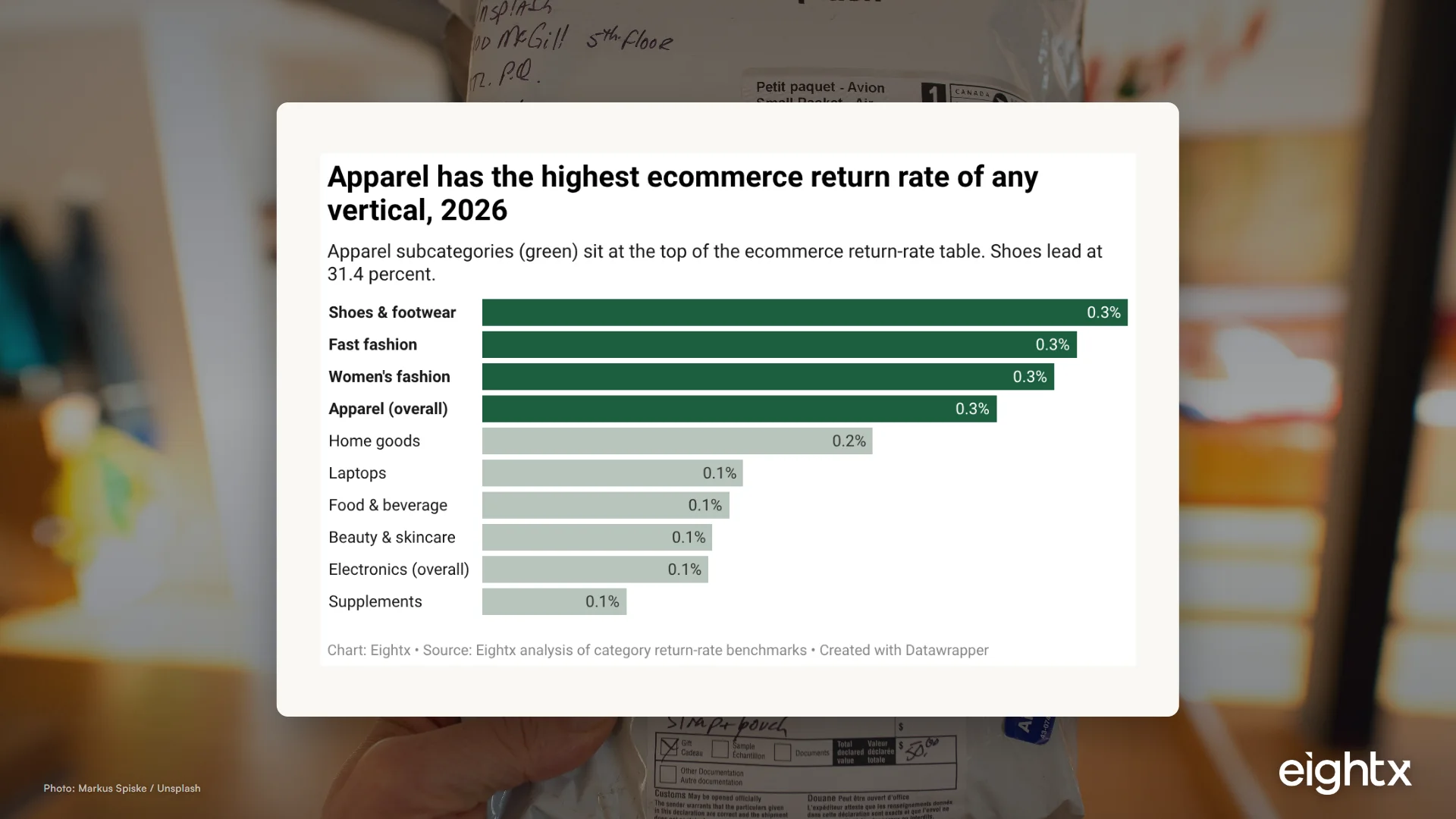
Start with the volume problem, because it is the multiplier on everything else. Apparel sits at the top of the return rate table and it is not close.
Apparel overall runs about 25 percent, versus roughly 11 percent for electronics, 12 percent for beauty, and 7 percent for supplements. Within apparel, shoes lead near 31 percent, women's fashion near 28 percent, and fast fashion near 29 percent. The cross vertical ecommerce average is about 20 percent, so apparel runs well above the line that already sits two to three times higher than brick and mortar. Sub items go higher still: external roundups put dresses at 33 to 38 percent and swimwear at 38 to 44 percent.
The driver is structural: size and fit account for 53 to 67 percent of apparel returns. Customers cannot try before they buy, so they bracket. When I talk to founders running a brand this size, the thing they keep saying is that the return rate feels like a fixed tax they cannot touch. It is not. That bracketing is the difference between apparel and every other category, and it is the part you can actually move.
The fully loaded cost of a single return
A return is not one charge. It is six. Here is where the dollars go on a single apparel return at a 55 dollar item, used here as the basis; the ratio to product price moves with your average selling price.
| Cost component | Apparel return (55 dollar item) | Notes |
|---|---|---|
| Reverse shipping | $10 | Largest single line, about a third of the stack |
| 3PL receive, inspect, restock | $8 | Labor heavy, rising with warehouse wages |
| Markdown or write down on returned stock | $6 | Only about 48 percent of returns resell at full price |
| Restocking materials and refurb | $4 | Rebag, re-tag, steam, rebox |
| Customer service touch | $3 | Refund handling, exchange coordination |
| Payment processor fee retention | $1 | Processors keep the original fee on most refunds |
| Fully loaded total | about $30 | Roughly 50 to 66 percent of a 45 to 55 dollar item |
The 30 dollar figure is the modeled apparel mid band, with an honest range of 20 to 45 dollars. It lines up with two independent anchors: Coresight Research puts apparel returns processing as high as about 66 percent of product price, and third party compilations peg the all in cost of a single return across categories at about 33 dollars. Apparel runs at the high end of that range because bracketing means you process more returns per order than you book in revenue.
The line operators miss is the markdown. One brand we worked with had a roughly 2 million dollar pile of returned inventory nobody had counted, and most of it could not go back on the shelf at full price. That is where the margin went. A returned garment that arrives worn, with tags removed, or simply out of season cannot go back on the shelf at full price. Across all returns, only about 48 percent resell at full price. The rest move at a discount, go to liquidation, or get written off, and that loss lands in COGS, not in your shipping cost. If you only track the return label, you are seeing a third of the real number.
Walk one order, all the way through
Take a customer who orders three sizes of the same 60 dollar dress to find the fit, the classic apparel bracket. AOV on that order books at 180 dollars. She keeps one, returns two.
- Revenue retained: 60 dollars on the kept dress.
- Returns processed: two, at about 30 dollars each fully loaded, so 60 dollars of return cost.
- Net on the order before product cost: roughly 60 dollars revenue against 60 dollars of returns cost, plus the cost of goods on the dress she kept.
That is the trap. The order looked like 180 dollars of revenue in your top line, but you shipped three units, took two back, and spent 60 dollars to do it. At a 60 percent gross margin on the kept dress, your 36 dollars of gross profit is wiped out by the 60 dollars of returns cost. The order loses money. Bracketing is not abuse, it is normal behavior. The pattern we see again and again is that it turns a healthy looking AOV into a margin sink, and it does not show up until you book returns at the order level instead of as a quarterly reserve.
The fixes that actually move the number
Because 53 to 67 percent of apparel returns are size and fit, the highest impact fixes attack fit accuracy first, policy second. The policy lever is shifting fast across the market, as the chart below shows, but it is the second move, not the first.
In our order of operations:
- Fix your size data before you buy software. Accurate size charts per style, on model fit notes (runs small, true to size, size up for a relaxed fit), and garment measurements beat a generic brand wide chart. This is free and it is the first thing to do.
- Mine your own returns reasons. Make return reason codes mandatory and read them monthly. The SKUs driving the most fit returns are usually a handful. Fix or discontinue them. You cannot manage what you do not measure.
- Add a fit or sizing tool on the high return SKUs. Virtual try on and fit recommendation tools cut returns 10 to 30 percent on the products they cover. Pilot on your worst offenders, not the whole catalog, and measure the lift against the subscription cost.
- Charge for returns, keep exchanges free. About 65 percent of merchants now charge a return fee averaging around 9 dollars, and roughly 74 percent now offer exchanges. Paid returns plus free exchanges nudges customers to swap sizes instead of refunding, which keeps the revenue. Expect a return volume drop of about 10 percent, with a roughly 5 percent conversion dip on the way in. Know the tradeoff is real: when I talk to founders who pull this lever, one women's heavy brand running around 15 percent returns turned off free returns, brought returns down, but lost women's business and was reconsidering. Another found the policy lever did not do anything one way or the other, which is exactly why fit fixes come first.
- Run final sale on clearance and deep discount. Bracketing on marked down stock is pure loss because there is no margin left to absorb the return cost. Final sale rules on clearance and last chance SKUs stop the bleed where it hurts most.
- Book returns as a five line P and L row, not a reserve. Reverse shipping, 3PL handling, write down, processor fee retention, and customer service. Book monthly at the order level. The pattern we see again and again is that operators who do this for the first time find the real cost is roughly double the reserve they had been carrying. See the real cost of returns calculator to build your own.
For the inventory side of the fit problem, the size curve you buy in is the other half of this equation, covered in apparel size curve inventory. And when returned stock does have to be cleared, do it deliberately, not reactively: see apparel markdown strategy.
How to book returns in your P and L
The accounting fix is simpler than founders expect, and it is where the real number finally becomes visible. The clean case is a net zero COGS reversal: if a garment costs 40 dollars and the customer sends it back unworn, you reverse the sale and put the 40 dollars back into inventory. No loss, just a wash. The problem is that the clean case rarely holds. Most returns arrive with some value loss, and the markdown is what turns a tidy reversal into a real expense.
So build the row with both halves. The revenue reversal and clean restock is the net zero part. The five operational lines, reverse shipping, 3PL handling, write down, processor fee retention, and customer service, are the part that actually costs you, and they hit contribution margin, not just gross. The gap between gross profit and contribution on most apparel brands is already shipping plus payment processing, roughly 6 percent and 3 percent of revenue; returns sit right on top of that. Book it monthly at the order level so you can react fast. We have seen operators carry a flat 5 or 6 percent reserve that reverses the next month, which tells you nothing. Daily or order level monitoring tells you which SKUs and which policies are moving the number while you can still do something about it.
| Metric | Value |
|---|---|
| Merchants charging a return fee | 65.2% |
| Average return fee | $9.04 |
| Merchants offering exchanges | 73.6% |
| Merchants offering "Shop Now" | 49.2% |
| Average bonus credit to retain revenue | $11.28 |
| Shoppers returning multiple times a month | 46% |
Sources and methodology
Return rate figures by subcategory come from the Eightx average ecommerce return rate benchmark, cross checked against external 2026 category benchmarks that put fashion at 20 to 35 percent and footwear at about 17 to 31 percent. Subcategory point estimates (31.4, 28.9, 27.8) come from benchmark roundups rather than a single primary source, so treat them as about figures with those bands around them.
The fully loaded cost per return is the Eightx returns processing cost by vertical apparel mid band of about 30 dollars, triangulated from Coresight Research (returns processing up to about 66 percent of apparel product price), a third party all in single return estimate of about 33 dollars across categories, and Loop Returns 2026 benchmarks. The cost stack is modeled on a 55 dollar item, so the percent of product price ratio is sensitive to your average selling price; the honest band is 20 to 45 dollars per return.
The 48 percent full price resale figure and the share of returns driven by size and fit (53 to 67 percent) are drawn from those same sources and external apparel returns research, including Coresight (53 percent top reason) and Bold Metrics. The per order bracketing example is illustrative math, not a published statistic.
The returns policy benchmarks (65.2 percent charge a fee, 9.04 dollar average fee, 73.6 percent offer exchanges, 49.2 percent offer Shop Now, 11.28 dollar bonus credit) are from the Loop Returns 2026 Global Ecommerce Report, accessed via primary source. The returns abuse figure (46 percent return multiple times a month, up 29 percent from 2023) is from Optoro Returns Unwrapped. Market size context (US clothing store sales of about 25.6 to 27.4 billion dollars per month through 2025, near 318 billion annualized) is from the US Census Monthly Retail Trade Survey, category 448, seasonally adjusted, used as a market anchor and not as the returns denominator.
For a deeper definition of the metric itself, see what is ecommerce return rate. This work sits alongside our fractional CFO for apparel brands practice.
Frequently Asked Questions
what is the average return rate for apparel ecommerce in 2026?
Apparel has the highest return rate of any ecommerce vertical, around 25 percent overall. Within apparel, shoes run about 31 percent, women's fashion about 28 percent, and fast fashion about 29 percent. External benchmarks put fashion in a 20 to 35 percent band and footwear in a 17 to 31 percent band, consistent with those point estimates.
how much does an apparel return actually cost in 2026?
The fully loaded cost of an apparel return runs about 30 dollars per item in 2026, with an honest band of 20 to 45 dollars. That covers return shipping, 3PL receive and inspect and restock, customer service, payment processor fee retention, and markdown on stock that cannot be resold at full price. On a 45 to 55 dollar item that is roughly 50 to 66 percent of product price.
why are apparel return costs higher than the cross vertical average?
Size and fit bracketing. One customer orders three sizes, keeps one, returns two. You book revenue once but process two returns per order, each carrying shipping, labor, and a write down risk. That is why Coresight lands as high as 66 percent of product price for apparel, well above the cross vertical norm where a single return runs closer to 33 dollars all in.
what is the biggest hidden cost in an apparel return?
The markdown on returned stock. Only about 48 percent of returned items resell at full price, so the rest move at a discount, into liquidation, or get written off. That write down lands in COGS, not your shipping line, which is why operators under 20 million in revenue consistently underbudget it when they decompose returns for the first time.
do sizing tools and fit data actually reduce apparel returns?
Yes, because size and fit drive 53 to 67 percent of apparel returns. Virtual try on and fit recommendation tools can cut returns 10 to 30 percent on the SKUs they cover. Cleaner size charts, on model fit notes, and true to size flags from review data move the number before you spend on technology.
should an apparel brand charge for returns or go final sale?
Most apparel brands above 3 million in revenue should charge a return fee or run final sale on clearance and deep discount SKUs. About 65 percent of merchants now charge a fee averaging around 9 dollars. Charging for returns cuts return volume about 10 percent, with a small conversion dip of around 5 percent on the way in, so fit fixes still do more of the work. Under 3 million, building repeat behavior, hold the free position.
are exchanges better than refunds for keeping the revenue?
Yes. About 74 percent of merchants now offer exchanges and roughly half offer a Shop Now flow, often with a bonus credit averaging around 11 dollars. Pairing free exchanges with a small mail in return fee nudges customers to swap sizes instead of refunding, which keeps the revenue on the books instead of reversing the sale.