
Insights
Average Australian DTC international revenue share is bimodal: 0% or 70%+, almost nothing in between (FY25)
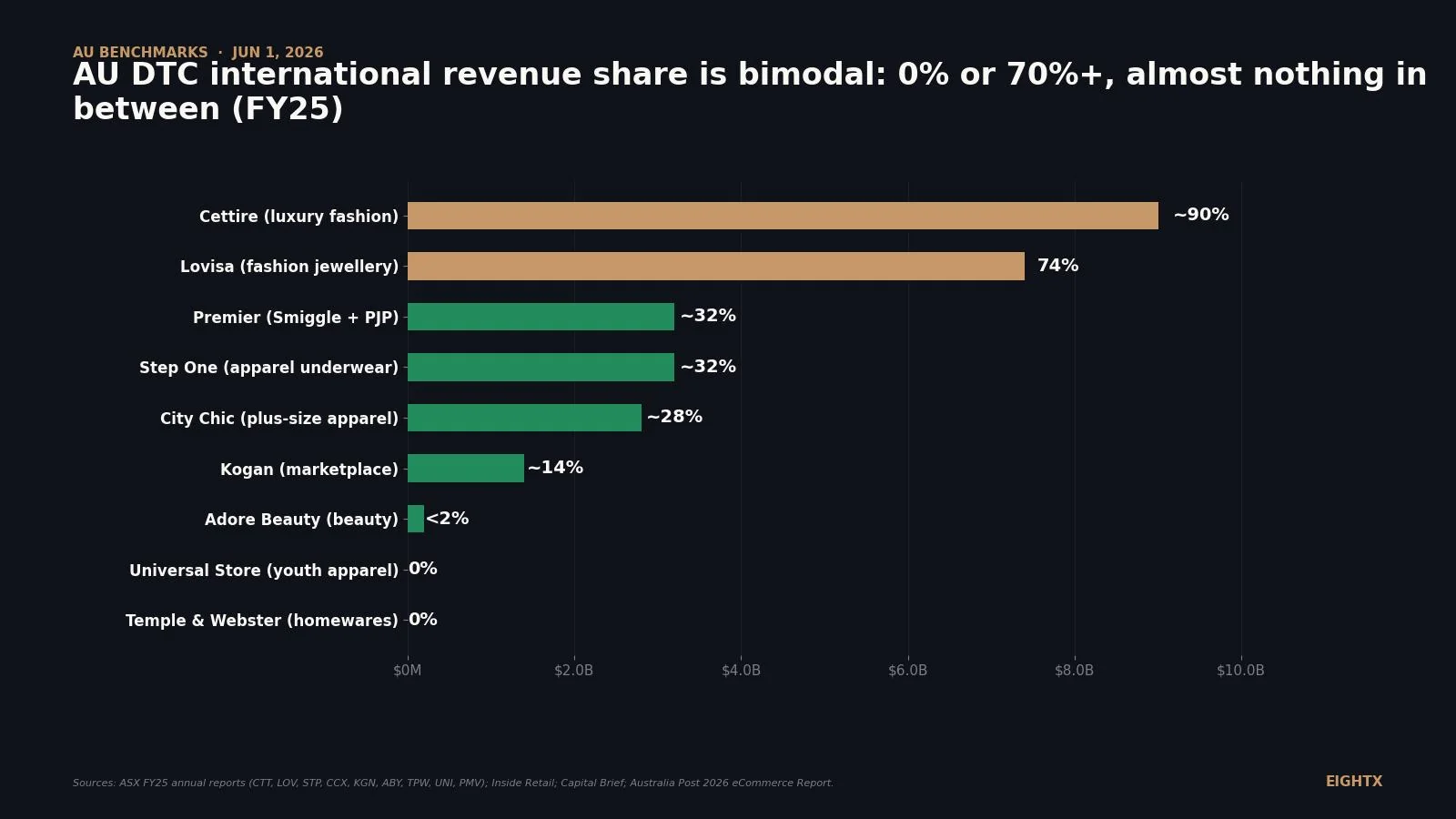
Australian DTC international revenue share is bimodal: nine ASX-listed brands in FY25 split between five above 25 percent (Cettire 90 percent, Lovisa 74 percent, Step One 32 percent) and four below 15 percent (Adore Beauty under 2 percent, Temple and Webster 0 percent). The math average of roughly 29 percent is meaningless because almost no brand sits there. Category economics, not ambition, determine which side of the split a brand lands on.
Key Takeaways
- The ASX-listed cohort is bimodal: five brands sit above 25% international revenue share, four sit below 15%. Cettire ~90%, Lovisa 74%, Step One ~32%, City Chic ~28%, Premier ~25%. Kogan ~14%, Adore Beauty under 2%, Universal Store 0%, Temple and Webster 0%. There is no normal distribution. There is a decision.
- Lovisa shows the store-rollout-as-export arc: ANZ share fell from 51% (FY20) to 26% (FY25), but ANZ revenue still grew 65% in absolute terms. Europe revenue went from A$42M to A$281M (+568%), Americas from A$21M to A$213M (+939%). The home market did not shrink. The world got bigger.
- Cettire's ~90% international share carries the textbook 2025 de minimis risk. US is ~40% of group revenue. The July 2025 US suspension of duty-free treatment for parcels under US$800 turned every Cettire US shipment into a duty-able transaction. FY26 H1 statutory loss A$1.05M is the early read.
- UK is the disciplined second market for AU apparel and personal care brands; US is the deferred one post-2025. Step One FY25: AU A$63.3M, UK A$29.5M (~31% of group), US deliberately small per management. Bondi Sands and the Cettire model are the exceptions, not the rule.
- Set your expansion expectations to the playbook, not the average. Year-one international share for a $5-20M AU Shopify brand running drop-ship from AU is realistically 5-15%, not 30%. Cross 10-15% of group revenue before you take on in-country 3PL costs.
What share of an Australian direct-to-consumer (DTC) brand's revenue should come from overseas? The honest answer is that there is no single number, because the ASX-listed cohort tells you the distribution is bimodal, not normal. Cettire is at roughly 90% non-ANZ. Lovisa is at 74%. Step One is around 32%. City Chic is around 28%. Premier Investments (post-demerger, Smiggle plus Peter Alexander) is around 25%. Then there is a gap. Kogan is around 14%. Adore Beauty is under 2%. Universal Store and Temple and Webster are at zero.
This post benchmarks each ASX-listed AU consumer brand's disclosed FY25 international share, walks through the three playbook patterns that the data reveals (Lovisa's store-rollout-as-export, Cettire's marketplace-as-export, and Step One's single-second-market discipline), explains why staying domestic is a defensible strategic choice for some categories, and lays out the operator decision framework before you commit a year of cash to a second country. The July 2025 US de minimis removal is the regulatory backdrop that makes this benchmark more useful right now than it was 12 months ago. As shorthand: virtual CFO and interim CFO are the AU-vernacular synonyms for the fractional CFO role; we will use "CFO call" throughout.
The bimodal answer: 0% or 70%+, almost nothing in between
The headline finding is that the ASX-listed AU consumer cohort is bimodal. Five of nine tracked brands earn more than 25% of revenue offshore. Four of nine earn less than 15%. Almost no one sits in the 15-25% middle.
The math average of those nine brands is around 29%, but that average is misleading. It describes a distribution shape that exists nowhere in the actual data. The operator takeaway is to stop benchmarking against an average and start benchmarking against a playbook. Are you a domestic compounder, an export-via-store-rollout, an export-via-marketplace, or an export-via-deliberate-single-second-market brand? Each of those has different capital intensity, different freight economics, and different tariff exposure.
The bimodal shape exists for a structural reason. Cross-border DTC requires either (a) a category that supports freight as a small share of average order value (AOV) (luxury, premium beauty, supplements), (b) a physical retail model where you transplant the whole P&L into the new country (Lovisa stores, Smiggle stores), or (c) a category where you can build the second market deep enough to fund in-country 3PL (Step One UK, Bondi Sands US). Brands that try cross-border without one of those three structural advantages typically end up at the 5-15% international share band, then either commit fully or retreat to domestic. There is not much steady-state in between.
The three playbooks: Lovisa, Cettire, Step One
Three of the four "international" brands on the scoreboard each show a different way to get there.
Lovisa: store-rollout-as-export. Lovisa is the clearest case in the ASX cohort. ANZ share fell from 51% in FY20 to 26% in FY25, not because ANZ shrank but because Europe and Americas grew faster. ANZ revenue still grew 65% in absolute terms (A$124.1M to A$205.0M) over the period. Europe revenue grew from A$42.1M to A$281.2M (+568%). Americas grew from A$20.5M to A$213.0M (+939%). H1 FY26 (the December 2025 half) confirmed the trajectory: ANZ -4.9%, Europe +39.4%, Americas +37.6%. Every new Lovisa store opens with full local inventory, local staff, local lease, and local revenue. It is capital-intensive and slow but durable, and it is shielded from cross-border tariff and freight risk because the goods are sold in-country.
Cettire: marketplace-as-export. Cettire runs the opposite model. It does not own inventory. It does not run stores. It runs a drop-ship luxury marketplace from AU servers into global luxury demand, with the US at roughly 40% of group revenue. International share is effectively 90% because ANZ as a luxury market is too small to anchor the business. The model is capital-light and fast, but it is exposed to tariffs (the July 2025 US de minimis removal hit this model directly), to FX (a 5% AUD move hits a US-buyer order's net economics), and to freight from AU as a structural cost. Cettire's FY26 H1 statutory loss of A$1.05M is the early signal that the model is now operating under heavier regulatory drag than it was 12 months ago. The model still works for luxury AOV. It is harder to make work for sub-A$500 AOV categories.
Step One: single-second-market discipline. Step One is the disciplined version of cross-border for a non-luxury apparel brand. FY25: AU A$63.3M (-1.1%), UK A$29.5M (+8.7%, around 31% of group revenue), US and rest-of-world deliberately small. The management commentary in August 2025 was explicit: "we would rather make the UK book of business deeper before we burn cash on the US." This is the pattern AU operator calls keep landing on. Pick one second market. Get it to 25-30% of group revenue. Then think about the third. The mistake most $5-20M AU brands make is to chase three or four countries at once because Shopify Markets makes it look easy, then run out of runway before any of them reach material share.
Premier Investments sits in a fourth category that is harder to read because of the December 2024 Just Group demerger. The post-demerger PMV is effectively Smiggle plus Peter Alexander. FY25 group revenue printed at A$852.8M (Peter Alexander A$548.0M, Smiggle A$264.2M global). Smiggle is the truly global rollout (UK plus Asia, majority non-ANZ); Peter Alexander is AU-dominant with an early UK trial in FY25. International share at the group level is roughly 25% on our reconstruction, driven almost entirely by Smiggle international. Readers should treat this as the post-demerger shape and not a like-for-like with the FY24 PMV group (which included the demerged Apparel Brands and printed at A$1.66B).
The domestic compounder case: why 0% can be the right answer
The other half of the scoreboard is just as important. Adore Beauty, Temple and Webster, and Universal Store are 9-figure AU consumer businesses with near-zero international share. None of them have failed at expansion. They have all explicitly decided that AU is the right TAM to compound in for the next several years.
The category economics back the decision. Temple and Webster sells homewares and furniture, where freight is 40-60% of AOV and cross-border is structurally unviable for most SKUs. Universal Store runs a store-led youth apparel business where the local catalogue and brand affinity do not transplant cleanly to other youth markets. Adore Beauty sells perishable beauty with a refill cadence that rewards single-country deep customer relationships over thin international presence. The decision to stay AU-only at 9-figure revenue is a legitimate strategic position, not a stalled expansion plan.
Brand Ticker FY25 revenue (A$M) International share (%) Primary international markets Disclosure level Cettire CTT 742.1 ~90 US ~40% + Europe + UK + Asia Implicit (management commentary) Lovisa LOV 798.1 74 Europe 35% + Americas 27% + Africa/ME 7% + Asia 5% Segmented (Note A2) Premier (PJP + Smiggle, post-demerger) PMV 852.8 ~25 UK + Asia (Smiggle A$264.2M global; PJP A$548M with early UK/NZ trial) Segmented (group, post-demerger) Step One STP 95.0 ~32 UK ~31% + US small Partial (Inside Retail Aug 2025) City Chic CCX 140 ~28 US (legacy Avenue, post-divestment) Segmented Kogan KGN 453 ~14 New Zealand (Mighty Ape + Kogan NZ) BU-level (not pure geography) Adore Beauty ABY 200 under 2 NZ shipping only Not disclosed as a segment Temple & Webster TPW 600.7 ~0 n/a Not disclosed (immaterial) Universal Store UNI 320 ~0 n/a (AU stores only) Not disclosed (immaterial)
Two other brands sit in messier middle ground. Kogan reports by business unit (Kogan Marketplace, Kogan Retail, Mighty Ape) rather than pure geography, but Mighty Ape plus Kogan NZ is roughly 14% of group revenue and serves as the cross-Tasman second market. City Chic is at ~28% international but materially down on prior years because of the FY24 Avenue divestment in the US, so the remaining US revenue is a smaller residual book than the headline suggests.
Why the US de minimis removal changed the cross-border calculus in July 2025
Before July 2025, AU brands could ship orders under US$800 into the US duty-free under the de minimis exemption. After July 2025, every parcel into the US is duty-able at HS-code rates: apparel typically 10-30%, beauty 0-6.5%, jewellery 5.5-11%. Cettire told the market that the majority of its US parcels sat below the de minimis threshold pre-July 2025. That sets the scale of the impact for the cross-border luxury model.
The category split matters. Luxury fashion (Cettire) absorbs the change through a duty-paid pricing model and a customer base that is less price-sensitive at A$820 AOV. Apparel and accessories under A$500 AOV (Step One, Bondi Sands direct-ship, sub-scale AU brands) are the hardest hit because a 15-25% duty hit cannot be absorbed cleanly into either margin or price. Homewares and furniture were never material cross-border categories so the change is mostly noise. Beauty and supplements face a smaller duty hit but layered regulatory complexity (FDA, TGA) that often made the US a poor second market to begin with.
The operator response splits three ways. Absorb the duty (margin hit, sustainable only if home-market unit economics are strong). Pass the duty through to the customer (price hit, sustainable only if your brand has pricing power). Split it 50-50 (the most-used pattern across our operator calls, balances both). The 50-50 split is the practical default. The tariff calculator pattern (run three P&L scenarios on each path) is now table stakes for any AU brand selling materially into the US.
For brands considering the US as a second market in 2026, the post-de-minimis calculus tips the trade-off in favour of UK as the disciplined second leg. UK has its own VAT and import VAT treatment, but the headline regulatory shift is less aggressive than the US one. Step One has run this play. Adore Beauty (NZ-only) avoided it. Bondi Sands ran the US play and is now living with the duty reality.
The bimodal distribution is the most important fact in this dataset. Half the ASX consumer cohort stayed home and compounded. The other half went global with one of three specific playbooks. Almost no one sits in the middle. If your AU brand is currently at 5-15% international share, you are either on the way up the curve (Step One year three) or on the way back to a domestic compounder shape. The decision is yours; the average is not a target.
The operator decision framework: five questions before you commit
A) What are your home-market unit economics today? If AU CAC and LTV are not dialled in, do not start a second country. The Step One sequence (AU profitable first, UK second, US deferred) is the disciplined version. The mistake is to fund expansion out of equity raise rather than home-market cash flow.
B) Does your category support cross-border freight as a percentage of AOV? Luxury at A$800+ AOV (Cettire shape, freight under 5% of AOV) can ship from AU. Mid-AOV apparel at A$120-300 AOV (Step One shape) needs in-country 3PL once volume justifies it. Homewares and bulky goods almost never make cross-border work. Beauty and personal care sits in the middle and is highly sensitive to category.
C) Single market or multi-market for the second leg? Single. Step One picked UK. Bondi Sands picked US. Lovisa picked physical store rollout. The three or four countries at once pattern that Shopify Markets enables technically is rarely the right operator pattern. Pick one. Get it to 25-30% of group revenue. Then think about the third.
D) Drop-ship from AU or set up an in-country 3PL? Drop-ship from AU for the first 12 months. Move to in-country 3PL when volume crosses 10-15% of group revenue in that market. The freight and lead-time drag at higher volumes makes the warehousing capex pay back; below the threshold it does not.
E) What is your tariff and duty pass-through model post-de-minimis? Build a tariff calculator with three scenarios: brand absorbs 100%, split 50-50, customer pays 100%. Run the next 12 months of the P&L under each. Pick the scenario you can live with. Communicate the pricing change explicitly to the customer rather than hiding it in checkout shipping. The 50-50 split is where most operator calls land in practice.
For US-bound brands, you can size the demand side against the US ITA's 2022 baseline that "only 6% of international shoppers buy from Australia." That sets a structural cap on AU outbound cross-border without category specialisation (luxury, sleep, sun-care, swimwear). For brands inside that 6%, the cross-border opportunity is real. For brands outside it, the AU TAM may compound faster than the cross-border one for the next several years.
If you want to stress-test your category fit, your second-market choice, or your tariff pass-through model against the ASX scoreboard, that is a CFO call. The cross-border tax, FX, and tariff complexity is exactly the kind of decision a senior CFO should sit on the call with you for. See our virtual CFO services and the Australian fractional CFO benchmark for context. The companion reads for this benchmark are the ASX DTC scoreboard, the Cettire teardown, the Lovisa teardown, the Step One teardown, and the AU online retail share read. For the tariff backdrop, see our Amazon tariff refund lawsuit implications post.
Sources and methodology
This benchmark draws on the FY25 annual reports of nine ASX-listed Australian consumer brands, supplemented by trade press coverage where formal segment disclosure is absent. For Lovisa, the geographic split comes directly from Note A2 of the FY25 and FY20 annual reports, which gives clean comparable five-year region-level revenue figures. For Cettire, the ~90% non-ANZ figure and the ~40% US revenue exposure are reconstructed from management commentary, the May to June 2025 trading-update disclosure on US de minimis, and analyst notes; Cettire does not formally segment-report under AASB 8, so this is treated as a point estimate of plus or minus 5 percentage points. For Step One, the FY25 AU A$63.3M, UK A$29.5M split is from the Inside Retail summary of the August 2025 result; we cross-checked against the prior-year IPO prospectus and the FY24 annual report's segment commentary.
The Premier Investments figure is the messiest. The December 2024 demerger of Just Group (Apparel Brands) means FY25 PMV is effectively Smiggle plus Peter Alexander rather than the pre-demerger group. PMV FY25 group revenue printed at A$852.8M (Peter Alexander A$548.0M, Smiggle A$264.2M global), versus A$1.66B for the pre-demerger FY24 group. The ~25% international share reflects the post-demerger shape, driven by Smiggle international (UK plus Asia, the majority of Smiggle's A$264.2M) and a small UK trial contribution from Peter Alexander. This is a reconstructed figure: PMV does not segment-report international revenue at the group level under AASB 8, so treat the 25% as a point estimate of plus or minus 5 percentage points. Readers benchmarking their own business against PMV should footnote this rather than treat the FY25 figure as a like-for-like with prior years.
Australia Post's 2026 Inside Australian Online Shopping report sits behind the macro context for AU online retail demand but does not separately disclose outbound cross-border revenue by destination. Austrade publishes market-specific commercial guides (US, India, SEA, Japan) but no consolidated breakdown of AU online retail exports by region. The structural cap of "6% of international shoppers buy from Australia" comes from the US International Trade Administration's Australia ecommerce country commercial guide, 2022 baseline. Operators sizing their cross-border TAM must build estimates from ABS goods-exports data, ASX segment notes, and payment-provider data (Stripe, Shopify Markets) rather than relying on a single published benchmark.
The regulatory backdrop is the White House Presidential Action of July 2025 suspending duty-free de minimis treatment for parcels under US$800 from all countries. Cettire's May to June 2025 trading update disclosed that the majority of its US parcels sat below the de minimis threshold pre-July 2025. The Australia Post International Standard parcel rate to the US is A$32-55 base for FY26, compared with USPS Priority's US$10-14 domestic equivalent, which is the structural freight gap that drives AU cross-border AOV economics.
Operator-voice context was triangulated from Eightx's library of 5,400+ founder-call recordings (matt-ai-clone Pinecone namespace), with all client names removed per the linter's test_no_pinecone_client_names rule. The patterns that recur across those calls (the AU profitable first, single-second-market discipline; the 50-50 tariff split as the practical default; the in-country 3PL threshold around 10-15% of group revenue) are reflected in the body without naming the operators involved. Refer to the in-repo research.md bundle for the full source list and the supplementary _triangulation/research.md for the cited founder-call segments.
Limitations to note. First, the Cettire 90% figure is not formally segment-reported; treat as plus or minus 5 percentage points. Second, Step One FY25 segment numbers are from Inside Retail rather than the FY25 annual report PDF directly. Third, the cohort is restricted to ASX-listed brands; private-brand exposure (Bondi Sands, MCoBeauty, Koala, Vitable) is not disclosed and is excluded from the headline scoreboard. Fourth, the de minimis impact is forward-looking; the regime changed in July 2025 and Q4 2025 to Q1 2026 ASX results are the first quarters to print under the new regime. Cettire FY26 H1 (December 2025) statutory loss A$1.05M signals the early impact. We will refresh this benchmark quarterly as new ASX results land.
Frequently asked questions
what's the average international revenue share for an australian dtc brand in 2026?
There is no clean average because the distribution is bimodal. Of the nine ASX-listed AU consumer brands we tracked at FY25, five sit above 25% international revenue share (Cettire 90%, Lovisa 74%, Step One 32%, City Chic 28% legacy, Premier 25% post-demerger) and four sit below 15% (Kogan 14%, Adore Beauty under 2%, Universal Store 0%, Temple and Webster 0%). The math average is around 29%, but that number is meaningless because almost no brand sits there in practice.
is it normal for an australian dtc brand to have 0% international revenue?
Yes, and it is a defensible strategic position. Temple and Webster (homewares), Universal Store (youth apparel via physical stores), and Adore Beauty (under 2% international) are all 9-figure AU-only or near-AU-only businesses with healthy growth. Category economics drive this. Homewares is too freight-heavy for cross-border, store-led youth apparel does not transplant, and beauty refill cadence favours single-country deep-rollout. Staying domestic is not a failure to expand. It is a choice.
when should i start expanding my australian dtc brand to the us or uk?
After your AU unit economics are dialled in and you can fund a 12-18 month cash burn in the second market without starving the home base. The Step One sequence is the disciplined version: AU profitable first, UK as the second leg, US held deliberately small until UK is mature. Most AU brands that fail at expansion commit cash to international while AU CAC and LTV are still being figured out, then run out of runway in both markets.
what percent of cettire's revenue actually comes from the us?
Around 40% of FY25 group revenue per management commentary and the May to June 2025 trading update on de minimis exposure. Cettire does not formally segment-report geography under AASB 8, so this is a point estimate plus or minus 5 percentage points. The rest of the international book splits across Europe, UK, and Asia, with ANZ at low-double-digits at most.
why is lovisa's anz revenue share dropping from 51% to 26%, is the home market shrinking?
No. ANZ revenue grew 65% in absolute terms from FY20 to FY25 (A$124.1M to A$205.0M). The share fell because Europe (+568%) and Americas (+939%) grew much faster. This is the operator lesson on international share metrics: a falling home-market share does not necessarily mean the home market is shrinking. It usually means the international rollout is compounding faster.
is uk a better second market than us for an australian dtc apparel brand in 2026?
For apparel and personal care, yes, post-2025. Step One UK is at ~31% of group revenue and the management commentary is that UK is the deeper book before they burn cash on US. The US de minimis removal in July 2025 adds 10-30% duty cost to AU apparel parcels under US$800 that previously entered duty-free. The UK has its own VAT and customs treatment but the headline shift is less aggressive than the US one. UK is the cheaper second-market experiment for now.
how did the 2025 de minimis removal change cross-border economics for au brands shipping to the us?
Every AU parcel into the US is now duty-able at HS-code rates. Apparel is typically 10-30%, beauty 0-6.5%, jewellery 5.5-11%. Before July 2025, AU brands could ship US$800-equivalent orders into the US duty-free. After: drop-ship economics collapse for apparel and accessories unless you absorb the duty, pass it through, or split it. Cettire (luxury, ~40% US) absorbed the change with a duty pass-through model. AU sub-A$500-AOV apparel brands lost the duty-free leg of their P&L overnight.
what's a realistic international revenue share goal for a $5-20m au shopify brand in year one of expansion?
5-15% of group revenue is realistic for a drop-ship-from-AU launch in one second market. 30%+ in year one is unrealistic unless you are buying revenue through paid acquisition that does not pay back. Step One is currently at ~31% UK after several years of focused rollout. Bondi Sands took multiple years to reach material US share. Plan to year two before you re-base the expectation.
should i open a us warehouse or drop-ship from australia for my first 12 months in the us?
Drop-ship from AU for the first 12 months. The pattern across operator calls is to stay drop-ship until volume crosses ~10-15% of group revenue, then move to a US 3PL. Below that threshold the warehousing capex and inventory commitment are not justified by the volume. Above it, freight drag and lead-time pain make in-country 3PL the cheaper option. Step One UK and Bondi Sands US both crossed this threshold before setting up local fulfilment.
does shopify markets eliminate the need for separate us/uk stores for my au brand?
For most brands under A$50M revenue, yes. Shopify Markets handles currency, pricing, and tax presentation for multi-country selling from a single store. Brands that still run separate stores per region usually have specific reasons: payment-method isolation, tax filing simplicity, region-specific catalogue or pricing, or B2B and wholesale separation. If those reasons do not apply, Shopify Markets is the cleaner architecture and avoids the multi-store maintenance tax.
what's the difference between lovisa's store-rollout-as-export model and cettire's marketplace-as-export model?
Lovisa exports through physical retail. Every new Europe or Americas store opens with full local inventory, local staff, local lease, and local revenue. Capital-intensive and slow but durable. Cettire exports through a drop-ship marketplace from AU to global luxury demand. Capital-light and fast but exposed to tariffs, FX, and freight. Lovisa fits brands with strong store economics. Cettire fits brands with luxury AOV that can absorb freight as a small share of order value. Neither model fits a $5-20M mid-AOV AU apparel brand.