
Insights
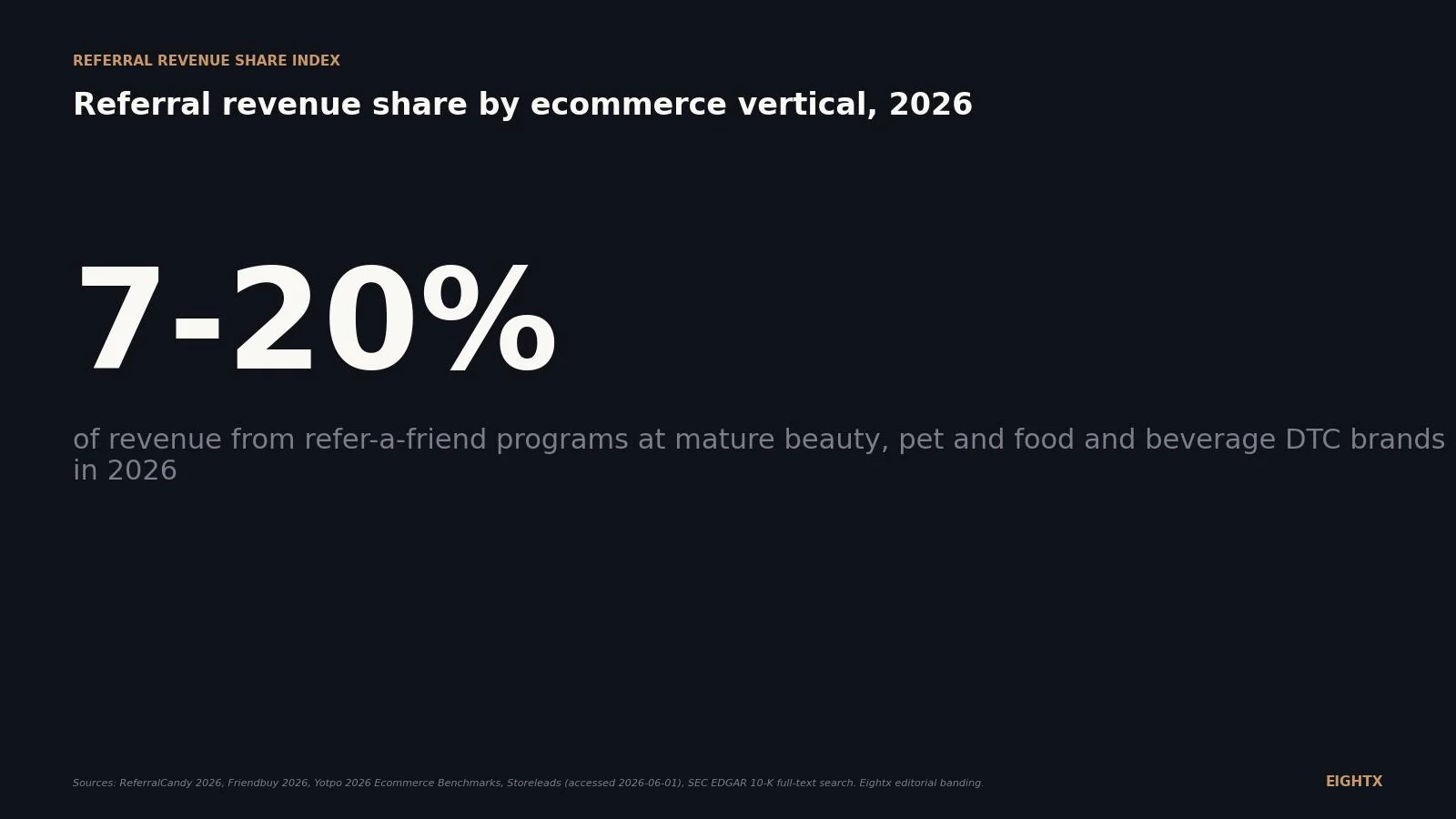
Average referral revenue share by ecommerce vertical, 2026: why beauty, pet and food and beverage hit 7-20% and electronics stalls at 4-10%
Mature DTC referral programs drive 5 to 10 percent of revenue at the median and 12 to 30 percent in the top quartile. Beauty leads with a 4.1 percent median referral conversion rate (ReferralCandy 2026) because of high repeat-purchase frequency and social shareability. Electronics and home lag at 4 to 10 percent. Below 5 percent referral share on a program over 18 months old means the give-and-get offer is under-priced or post-purchase placement is buried.
Key Takeaways
- Mature DTC refer-a-friend programs drive 5-10% of revenue at the median and up to 30% at the top quartile (Friendbuy 2026, ReferralCandy 2026 ROI analysis). The 10-30% spread between median and top is the headline story.
- Beauty leads on referral conversion at 4.1% median, food and beverage at 4.8%, health and supplements at 3.6%, apparel at 3.2% (ReferralCandy 2026 benchmarks). Conversion rate times AOV equals revenue share, which is why beauty, F&B and pet stack at the top.
- Yotpo 2026 loyalty benchmarks show beauty members spend 66.3% more, health 56.7% more, and apparel 50.2% more over 90 days versus non-members. Loyalty uplift is the cleanest proxy for which categories already carry the repeat-purchase behavior referral programs need.
- Referral CAC runs 60-80% lower than paid social or paid search at mid-market DTC (Friendbuy and Mention Me case studies). The structural reason referral programs survive down cycles: zero incremental media spend, only the give-and-get cost (typically $10-$25 each side) which sits inside contribution profit.
- Only Okendo (bundled reviews and loyalty) is net-positive on Shopify installs over 90 days at +1,587. Growave is down 442, Refersion down 336, Yotpo Swell down 115, ReferralCandy down 51 (Storeleads, accessed 2026-06-01). The category is consolidating around reviews-bundled retention, not standalone referral.
Customer referral programs (refer-a-friend, give-and-get) are the one acquisition channel that gets cheaper as paid social CPMs flatten and as AI search compresses organic traffic. The catch: there is no canonical "% of ecommerce revenue from customer referrals, by vertical" dataset. The platforms (ReferralCandy, Friendbuy, Mention Me, Yotpo) publish conversion rates and AOV uplift. They do not publish per-vertical channel share. So this page triangulates the ReferralCandy 2026 benchmarks, Friendbuy 2026 referral marketing statistics, Yotpo's 2026 Ecommerce Benchmarks (loyalty uplift as a behavioral proxy), and a sample of public-company 10-K filings (Grove Collaborative, Stitch Fix, Airbnb, Block, Wealthfront) to give private operators a planning benchmark by category. Read on for the 2026 ranges, the give-and-get math, and what to do if you run a $5M to $50M brand.
What "referral revenue share" actually means (and the three definitions that get blurred)
Before you compare yourself to any benchmark, make sure you are measuring the same thing the benchmark is measuring.
Customer-to-customer referral is a retention play. You ask existing customers to recommend the brand to a friend in exchange for a discount or store credit on both sides (the "give" and the "get"). Attribution is usually a unique referral link or code, captured by a platform like ReferralCandy, Friendbuy, Mention Me, Smile, Okendo or Yotpo. The customer is the advocate. The brand pays the give-and-get out of contribution margin, not out of media spend.
Affiliate is a different mechanic. Publishers (content sites, cashback portals, deal aggregators, creators) drive traffic via tracked links and earn a commission on conversions. The publisher is the advocate. The brand pays a commission rate (often 5-20% of order value) usually negotiated network-by-network. We covered the affiliate revenue-share ranges separately in our average affiliate revenue share by ecommerce vertical, 2026 post.
Influencer is a third mechanic. Creators publish content (paid, gifted, or both) and may or may not run a tracked link. The brand pays a flat fee or a commission, often through an affiliate network for tracking but booked as influencer spend on the P&L. Modern creator deals blur the line because they sit on top of an affiliate platform but report separately.
For the rest of this page, "referral revenue share" means: percent of online revenue attributed to a customer-to-customer refer-a-friend program by a mature program (24+ months in market) at the brand level. Not network-aggregated. Not affiliate-bundled. Not influencer.
Referral revenue share by vertical: the 2026 ranges
Here is the headline data. Mature beauty, pet and food and beverage programs drive 7-20% of online revenue from refer-a-friend. Apparel and footwear sit mid-band at 6-15%. Home and furniture and consumer electronics lag at 4-12%. Travel and hospitality is structurally different (12-25%) because Airbnb-class host-and-guest network effects compound the referral mechanic on both sides of the transaction.
The same data in table form, with notes on each band and the recommended give-and-get offer design:
Vertical Revenue share (median / top quartile) Conversion rate (median) Recommended give-and-get Notes Beauty and personal care 7% / 20% 4.1% 15% give / 15% get Highest conversion. Subscription LTV supports richer first-customer offers. Food and beverage 7% / 18% 4.8% $15 give / $15 get Highest conversion. Meal-kit and subscription box skew the top quartile up. Pet and subscription boxes 7% / 18% 4.0% 15% give / 15% get Strong repeat purchase. Subscription drives top quartile. Apparel and fashion 6% / 15% 3.2% 10-15% give / 10-15% get Mid-band. Mass-market lower, premium and contemporary higher. Footwear 7% / 15% 3.5% 10% give / 10% get Strong word-of-mouth but lower frequency than beauty. Health and supplements 5% / 15% 3.6% $15 give / $15 get Compliance-heavy advocates. Smaller pool, higher LTV. DTC general (cross-category) 5% / 15% 3.0% 10% give / 10% get Broad planning band when category is unclear or mixed. Home and furniture 5% / 12% 2.5% $25 give / $25 get Lower frequency. Higher AOV justifies flat-dollar offers. Consumer electronics 4% / 10% 2.0% $10 give / $10 get Thin margins cap offer. Low repeat purchase. Travel and hospitality 12% / 25% 5.0% Variable Network effects (host plus guest). Airbnb-class outliers skew the band up.
The structural read: high-frequency-purchase categories outperform low-frequency. Beauty buyers reorder 4-8 times a year. Supplement buyers reorder monthly via subscription. Pet and meal-kit subscription customers reorder by default. Apparel reorders 2-3 times a year. Home and electronics reorder once every 2-5 years. Referral revenue is a function of how many customers love the product enough to recommend it. High-frequency categories naturally produce more advocates per dollar of revenue.
The behavioral reason: Yotpo 2026 loyalty uplift mirrors referral conversion
If you want a single proxy for "which categories carry the repeat-purchase behavior referral programs need," look at the Yotpo 2026 Ecommerce Benchmarks loyalty member spend uplift over 90 days. Beauty members spend 66.3% more than non-members. Health members spend 56.7% more. Apparel members spend 50.2% more.
The same categories that lift retention spend at 50%+ uplift are the same categories that convert referrals at 3-5%. The behavioral root is the same: repeat purchase frequency drives both. A category where customers reorder monthly produces both loyalty engagement and referral conversion. A category where customers reorder every five years produces neither.
This is the strongest single argument for sequencing your retention stack as loyalty first, referral second, never the other way round. If your loyalty member 90-day spend uplift is in the Yotpo top tier (beauty, health, apparel, F&B), you have the repeat-purchase base to support a referral program. If your loyalty uplift is in the bottom tier (electronics, home, lifestyle), referral will struggle until you fix the underlying repeat-purchase economics.
Note on the chart: Beauty, health and apparel are Yotpo-disclosed numbers in the 2026 benchmark. Food and beverage, pet, home and electronics are Eightx interpolated planning bands based on cross-reference with ReferralCandy 2026 conversion rates and our own founder-call patterns. Treat the non-disclosed bars as ranges, not point estimates.
Platform adoption signal: Shopify loyalty and referral apps consolidating around bundled retention
The Shopify app install data is telling a clear story about where SMB DTC is heading. Of the top ten loyalty and referral apps by review count, only Okendo (bundled reviews and loyalty) is net-positive on installs over the last 90 days. Every standalone referral and pure loyalty app is net-negative.
The structural read is two parts.
First, the category is consolidating around reviews-bundled retention suites. Okendo (reviews plus loyalty) added 1,587 net installs over 90 days. Growave (loyalty plus wishlist) lost 442. Yotpo Loyalty Rewards (pure loyalty, formerly Swell) lost 115. ReferralCandy plus Affiliate (standalone referral plus affiliate) lost 51. Refersion (standalone affiliate, included for cross-reference from our affiliate post) lost 336. SMB DTC operators are consolidating their retention stack and the platform that offers reviews plus loyalty in one product is winning that consolidation.
Second, standalone referral is the most exposed category. Brands that bought a standalone referral app are either rolling it into their reviews and loyalty platform or churning the app entirely. If you are evaluating a referral tool today, default to your existing reviews and loyalty platform's referral module first. Only buy a standalone if you have an enterprise hypothesis (multi-step offers, fraud-screening at scale, custom journeys) that the bundled platform cannot serve.
A caveat: this Shopify install data does not capture Friendbuy or Mention Me, which are enterprise-managed platforms not distributed via the Shopify app store. If you are above $10M in revenue and evaluating those vendors, you need to pull their direct disclosures or trial them with attribution measurement.
Public-company referral disclosure pattern: named as a channel, never quantified
We pulled SEC EDGAR full-text search for "referral program," "customer referral," and "refer-a-friend" in 10-K filings between 2025-01-01 and 2026-05-31. The search returned 131 results. Filtering to DTC, travel and consumer fintech where referral is a named acquisition channel produced this sample:
Company Ticker Vertical 10-K filed Referral disclosure Grove Collaborative GROV DTC CPG 2026-03-05 Names referral as acquisition channel. No percent disclosed. Stitch Fix SFIX Apparel 2025-09-25 Names referral as acquisition source. No percent disclosed. Airbnb ABNB Travel 2026-02-12 Names referrals as primary acquisition channel. No percent. Block (Cash App) XYZ Fintech 2026-02-26 Cash App refer-a-friend disclosed. No percent. Wealthfront WLTH Fintech 2026-04-24 Referral program referenced in customer acquisition strategy. DraftKings DKNG Gaming 2026-02-13 Refer-a-friend disclosed (regulated category mechanic). Oportun Financial OPRT Consumer finance 2026-02-27 Customer referral as named channel.
The pattern is what matters more than the count. Every public DTC, travel and consumer fintech company in the sample names referral as a channel. None disclose channel share. That is consistent with how the SEC disclosure regime works: companies disclose material customer-acquisition risks and dependencies, not channel-by-channel revenue attribution. So you cannot benchmark your referral share against Grove or Airbnb directly. What you can take from the disclosure pattern is that referral is structural enough to mention in the 10-K, which is itself a useful signal.
Mature DTC refer-a-friend programs drive 5-10% of revenue at the median and up to 30% at the top quartile. The gap between median and top is mostly category (beauty, pet, F&B at the top; electronics and home at the bottom) and program maturity (24 months in market, give-and-get tuned, post-purchase placement above the fold). If your program is sub-5%, the problem is rarely the platform.
What to do with this if you run a $5M to $50M DTC brand
Three concrete moves this quarter.
Set a vertical-targeted revenue-share target and measure against it monthly. If you are beauty, pet, F&B or supplements, aim for 5-7% in year one, 8-12% in year two, 12-20% as a steady-state mature program. If you are apparel or footwear, aim for 4-6% year one, 6-10% year two, 10-15% mature. If you are home or electronics, aim for 3-5% year one, 5-8% mature. Numbers below those bands signal a tuning problem (give-and-get under-priced or post-purchase placement buried), not a platform problem.
Tune your give-and-get to your AOV and gross margin, not to industry default. The platforms ship default offers (10% off plus 10% off, or $10 plus $10) that are calibrated for $50-$100 AOV. If your AOV is $30-$45 you need flat-dollar offers, not percentages, because percentages on low-AOV orders do not move the conversion needle. If your AOV is $150+ you need richer dollar offers ($25 plus $25 or higher) because $10 off a $200 order is not a recommendation trigger. The right offer leaves your contribution margin per referred order positive (zero ad spend, full give cost, full get cost) and is high enough that the give-side advocate actually shares.
Test incrementality before declaring your referral channel a hero. Run a hold-out test on the post-purchase referral CTA for 30 days, suppress for a random 10-20% cohort, and compare attributed revenue. If the suppressed cohort shows a 60%+ revenue decline vs. control, your program is meaningfully incremental. If the suppressed cohort shows minimal decline, your referral program is intercepting demand that other channels (email, SMS, organic) would have closed anyway. Most DTC referral programs fail this test in the first 90 days and pass it after 12-18 months as compounding takes over.
Sources and methodology
ReferralCandy 2026 referral program benchmarks. Conversion rate by vertical was pulled from ReferralCandy's 2026 benchmark post (Beauty 4.1%, F&B 4.8%, Health 3.6%, Apparel 3.2%). These are platform-aggregated rates across ReferralCandy's customer base, which skews toward SMB Shopify DTC. The ROI analysis on the companion ReferralCandy post is the source for the 10-30% top-quartile revenue-share ceiling we use as the upper bound of the mature-program range.
Friendbuy 2026 referral marketing statistics. Friendbuy's 54-data-point statistics page is the source for the "top performers hit 30% of revenue" headline and several of the conversion-rate cross-checks. Friendbuy is enterprise-focused (mid-market and above) so its top-quartile numbers skew higher than a pure SMB sample.
Yotpo 2026 Ecommerce Benchmarks. Beauty, health and apparel loyalty member 90-day spend uplift (66.3%, 56.7%, 50.2%) are Yotpo-disclosed. Food and beverage, pet, home and electronics are Eightx interpolated planning bands cross-referenced against ReferralCandy conversion rates. Yotpo's benchmark is the cleanest behavioral proxy for which categories already carry the repeat-purchase behavior referral programs need.
Storeleads Shopify loyalty and referral app data. Queried Storeleads.app for the loyalty-and-rewards category on Shopify, sorted by review count, accessed 2026-06-01. Category total: 461 apps. Top ten retained for the install-momentum chart. Cross-referenced sibling affiliate-program data (Refersion, ReferralCandy plus Affiliate) from our affiliate post research bundle. Negative install counts reflect net app uninstalls.
SEC EDGAR 10-K full-text search. Queried for "referral program" OR "customer referral" OR "refer-a-friend" in form 10-K filings between 2025-01-01 and 2026-05-31. 131 results returned. Filtered to DTC, travel and consumer fintech principal business. Retained Grove Collaborative, Stitch Fix, Airbnb, Block, Wealthfront, DraftKings and Oportun. The 10-Ks name referral as a channel; none disclose channel-share percent.
Limitations. No canonical "referral share of ecommerce revenue, by vertical" dataset exists. All vertical revenue-share figures in this post are synthesized ranges from conversion-rate times AOV times repeat-rate math, validated against the Friendbuy and ReferralCandy top-line "10-30% top performer" disclosures. They are planning benchmarks, not authoritative figures. Friendbuy and Mention Me are enterprise platforms not distributed via the Shopify app store, so their adoption signal is not captured in the Storeleads data. Public-company 10-Ks rarely disclose channel-share for referrals; the public-company table is structural evidence ("referral matters here"), not numeric evidence.
Update cadence. This is a Group A living-index post. Refreshed quarterly when Yotpo, ReferralCandy and Friendbuy publish their next benchmark updates. Next refresh target: August 2026 (Yotpo mid-year benchmarks plus ReferralCandy 2026 ROI analysis update).
For related reading on the broader retention stack, see our average loyalty program adoption by ecommerce vertical, 2026, our average loyalty member AOV lift by ecommerce vertical, 2026 read, and our interim CFO services overview if you want help putting these benchmarks against your channel mix.
Frequently asked questions
what percent of revenue should come from referrals if i run a $20m dtc beauty brand?
5-10% if your program is 18-24 months old, 12-20% if you have a mature program (2+ years) with a tuned give-and-get and post-purchase placement. Beauty sits in the top tier on conversion (4.1% median per ReferralCandy 2026) because high repeat-purchase frequency plus social shareability stacks. Below 5% means your give-and-get is under-priced, post-purchase placement is buried, or you have not asked existing customers since they bought.
is a 5% referral revenue share good or bad for a 1-year-old apparel brand?
It is fine for year one and the trajectory matters more than the level. Apparel runs at a 3.2% median conversion rate (ReferralCandy 2026), so a 5% revenue share at 12 months in market is on pace to hit the 6-15% mature band. Watch repeat-purchase rate at 90 days. If repeat is climbing, your referral share will climb with it because referrals compound on the share of customers who already love you enough to recommend the brand.
how do i tell the difference between a referral program, an affiliate program, and an influencer program when i am reading benchmarks?
Referral is customer-to-customer (give-and-get, refer-a-friend). Affiliate is publisher-to-customer (cashback, content sites, creators with tracked links). Influencer is creator-to-audience (paid or gifted content, may or may not have a tracked link). A founder we recorded on a 2026 channel-attribution call classified referral as "earned" and affiliate as "paid earned", which is a useful operator shorthand. When a benchmark says 30% of revenue, check whether it bundles the three. ReferralCandy and Friendbuy both ship affiliate and influencer modules so their headline numbers often blur the line.
what is the right give-and-get offer for a $60 aov skincare brand?
15% off for the referrer plus 15% off for the friend, or $10 plus $10 if you want a flat-dollar offer that protects margin. The math: at $60 AOV and 65-72% gross margin (typical beauty), a 15-15 percentage offer costs you roughly $9 on the referred order (the friend's get) plus a $9 credit liability that lands on the referrer's next order (the give). Contribution margin stays positive on both. The mistake most operators make is over-paying the give-side. Friends convert because they trust the friend, not because the offer is rich.
why do beauty and supplements always show higher referral conversion than apparel?
Repeat purchase frequency and shareability. Beauty buyers reorder 4-8 times a year and tell friends in person and on TikTok. Supplement buyers reorder monthly via subscription and have a built-in conversation about results. Apparel buyers reorder 2-3 times a year and have lower social-recommendation behavior outside of one-off statement pieces. The behavioral root is the same root that drives loyalty uplift in the Yotpo 2026 benchmark.
should i build referral on shopify with referralcandy, friendbuy, or my reviews and loyalty platform?
If you are under $5M revenue start inside your reviews and loyalty platform (Okendo, Yotpo, Smile, Growave). The bundled product gives you 80% of the upside at no marginal vendor cost. Above $5M with a clear referral hypothesis, look at Friendbuy or Mention Me for enterprise features (multi-step offers, fraud screening, custom journeys). ReferralCandy is a fine standalone but Storeleads shows it net-down 51 installs over the last 90 days. The category is consolidating around bundled retention suites.
how do i make sure my referral channel is incremental and not just cannibalizing email and sms?
Three tests. One, hold-out test by cohort. Suppress the post-purchase referral CTA for a random 10-20% of customers for 30 days and compare attributed revenue. Two, redemption window analysis. If 70%+ of referral redemptions happen inside 7 days of a refer-from-email, the program is intercepting demand email would have closed anyway. Three, segment overlap. Pull referred customers and check whether they are already on your email list at time of referral. If 60%+ are existing subscribers, your referral program is largely a discount channel for known customers, not net-new acquisition.
what referral commission rate actually moves the needle for a low-aov dtc brand?
At $30-$45 AOV you need flat-dollar offers, not percentages. $10 give plus $10 get is the floor that converts. Below that the friend-side discount is too thin to overcome the form-fill friction. The math forces you to think about contribution margin per order, not gross margin. If your contribution margin per $40 order is $12, a $10 give-side leaves $2 of contribution. That works for a referred order because the customer was net-new and zero ad spend. It does not work as a default discount for paid traffic.
how long does it take a new referral program to hit the 5-10% revenue band?
12-18 months in mature DTC categories (beauty, supplements, pet, F&B). 18-24 months in apparel and home. Referral revenue compounds on repeat purchase, and you need 2-3 purchase cycles before enough customers have the lived-experience confidence to recommend. Programs that hit 5% in month 3 are usually riding a launch wave and decay. Programs that hit 5% steady state in month 12 are real.
do public dtc 10-ks actually disclose referral revenue share or do i have to infer it?
You have to infer. Grove Collaborative, Stitch Fix, Airbnb, Block (Cash App) and Wealthfront all name referral as an acquisition channel in their 10-Ks but none disclose the percent of revenue. Airbnb is the closest because referral is structural to the host-and-guest network effect, but even Airbnb does not break out the channel-share percent in the filing. The disclosure pattern matches affiliate: named as a channel, never quantified.