
eCommerce
Gorgias vs Zendesk in 2026: the real cost-per-ticket math for DTC brands
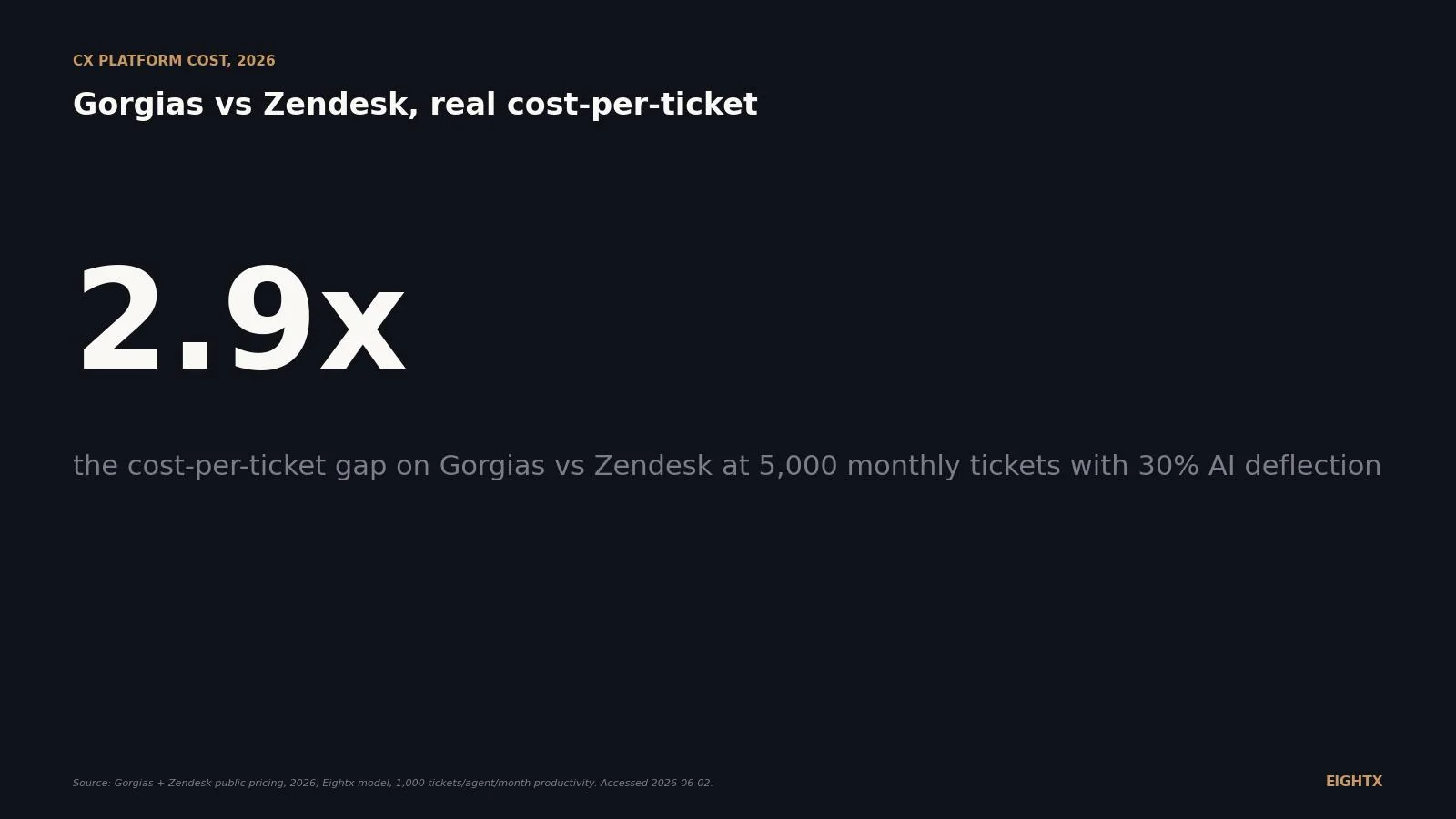
At 5,000 monthly tickets with 30% AI deflection, Gorgias costs roughly $0.48 per ticket versus $0.165 on Zendesk, a 3x gap that flips the decision. Gorgias wins below roughly 2,000 tickets per month where its Shopify-native context (order lookup, tagging, macros) cuts handle time, while Zendesk's lower per-ticket cost at scale and broader AI automation suite make more sense for brands above that threshold.
Key Takeaways
- Gorgias is priced per ticket, Zendesk is priced per agent. Those two pricing models cross over at a predictable point and most growing DTC brands are on the wrong side of it without realising.
- At 5,000 monthly tickets without AI, Gorgias runs ~$0.18 per ticket vs Zendesk ~$0.115 per ticket. Zendesk is ~36% cheaper at that scale assuming 1,000 tickets per agent per month productivity.
- Layer in AI and the gap blows out. Gorgias charges $1 per AI-resolved conversation on top of the ticket fee. Zendesk charges a flat $50 per agent for Copilot. At 30% deflection, Gorgias is roughly 3x the per-ticket cost.
- Gorgias AI conversations also consume your ticket allocation. You pay the $1 AI fee AND burn a ticket. Most pricing decks do not explain this.
- The real question is not 'which platform is better.' It is 'at what monthly ticket volume does the per-ticket model stop being cheaper, and what does the migration cost when we cross it?'
Most DTC operators evaluating Gorgias vs Zendesk argue about features. Shopify-native UX. Macros. Voice channel depth. Reporting flexibility. Those debates miss the actual decision. Gorgias is priced per ticket. Zendesk is priced per agent. Those two pricing models cross over at a predictable monthly ticket volume, and most growing brands are on the wrong side of it without realising. This post lays out the 2026 math so you can run it against your own forecast before you sign a renewal.
We see this pattern regularly in finance reviews: a $25M-band DTC brand discovers their Gorgias bill is burning roughly $0.50 per ticket once AI Agent is on, while a comparable Zendesk-using peer sits closer to $0.16 (composite numbers from our client base, not a single named brand). The platform choice was right when they made it at $3M revenue. It is wrong now. The post covers what changed, what the crossover looks like, and what the migration costs if you have to make it.
The unit-economics question, not the feature question
The thing your helpdesk vendor will not lead with: pricing model matters more than feature parity once you cross 2,000 monthly tickets. Gorgias' per-ticket model is brilliant at the bottom of the market because a 100-ticket-a-month brand pays $10. Zendesk's $19-per-agent Support Team plan is harder to justify at that scale. But every ticket above your plan allowance on Gorgias is $0.36 to $0.40 in overage, and AI conversations stack a second fee on top. Zendesk's per-agent model scales linearly with headcount and is invariant to ticket volume, which means cost per ticket falls as your team gets more productive.
The decision is unit economics. You should not be reading review-site comparisons. You should be running your forecasted Q4 ticket volume through both vendors' pricing pages and looking at the cost per ticket each model produces. Then you should compare the gap to your contribution margin per order. A brand with $40 AOV and 25% contribution margin per order has $10 of margin per order to play with. A $0.40 swing in cost per ticket at 0.30 tickets per order is $0.12 per order, or 1.2% of contribution margin. Not nothing.
This is also the moment to decide whether you are evaluating Gorgias vs Zendesk as a binary or whether Help Scout, Front, Re:amaze, or Kustomer should be in the bake-off. They should, especially at the $5M to $20M band. But for the rest of this post we hold the comparison at Gorgias vs Zendesk because that is where the real money sits and where 80% of the DTC market lands.
The 2026 price list, plain English
Both vendors restructured pricing in late 2025 and again in early 2026, so the 2024 comparison posts you find on Google are stale. Here is what 2026 looks like at list.
Item Gorgias Zendesk Pricing model Per ticket + base plan Per agent + add-ons Entry plan Starter $10/mo, 50 tickets Support Team $19/agent/mo Mid plan Pro $360/mo, 2,000 tickets Suite Growth $89/agent/mo Scale plan Advanced $900/mo, 5,000 tickets Suite Professional $115/agent/mo Enterprise Custom, 5,000+ tickets Suite Enterprise $150 to $169+/agent/mo Overage cost $0.36 to $0.40 per ticket (~$0.32 Enterprise) N/A (add agents) Native AI add-on AI Agent: $1.00 per resolved conversation ($0.90 annual) Copilot: $50/agent/mo AI billing logic Per-conversation AND consumes ticket allocation Per-seat flat fee Annual discount ~10% (e.g., AI drops to $0.90) Standard annual discount
The piece most operators miss is the AI billing logic row. Gorgias AI consumes your ticket allowance AND charges per resolved conversation. Zendesk Copilot is a flat per-seat fee that does not touch ticket counts because there are no ticket counts. That single architectural difference drives most of the cost gap once AI deployment crosses 20% of total volume.
Cost per ticket at 1k, 5k, 25k volumes (no AI)
Run the no-AI math first so you have a clean baseline. At 1,000 monthly tickets, you are on Gorgias Pro at $360/mo (well under the 2,000-ticket allowance, so $0.36 per ticket on actual volume). Zendesk Suite Professional with one agent costs $115/mo, or $0.115 per ticket. At 5,000 tickets, you graduate to Gorgias Advanced at $900/mo ($0.18 per ticket on the bundled 5,000 allowance). Zendesk needs five agents to handle that volume at 1,000 tickets per agent per month, so $575/mo total, or $0.115 per ticket. At 25,000 tickets you are deep in Enterprise territory; Gorgias Enterprise overage on top of base lands around $8,000/mo on list ($0.32 per ticket) and Zendesk Suite Pro with 25 agents is $2,875/mo (still $0.115 per ticket). Every Zendesk number in this section assumes 1,000 tickets per agent per month productivity. If your team runs slower or faster, the per-ticket number moves with it (we model the sensitivity in the benchmarks section). Enterprise negotiation on either platform also compresses these numbers; the list-price math is the starting point, not the contract.
The U-curve is the story. Gorgias is most expensive per ticket at the smallest scale (sub-allocation waste, you pay for an empty Pro bucket) and at the largest scale (Enterprise overage). It bottoms out in the middle band where ticket volume fills the Advanced plan but does not blow past it. Zendesk's flat per-agent line passes through every volume tier at ~$0.115 per ticket, because adding seats to handle more tickets keeps the unit cost constant.
What this means for your business: if your Q4 forecast pushes you over 2,500 monthly tickets, run the model. If you are still under 2,000, the Gorgias UX advantage probably still wins. If you are above 4,000 and headed higher, you are paying a per-ticket-pricing tax that compounds every month.
What AI does to the math
The 2024 cost comparison falls apart the moment you turn on AI. Gorgias AI Agent and Zendesk Copilot are not priced the same way at all.
Gorgias charges $1.00 per AI-resolved conversation (drops to $0.90 on annual). That fee is on top of your plan price, and the AI conversation also burns one of your plan's included tickets. Effectively double-billed. Zendesk Copilot is a $50 per agent per month flat add-on, regardless of how many AI interactions the agents handle. The Suite Pro plus Copilot bundle comes out to roughly $155 per agent per month.
At 30% AI deflection on 5,000 monthly tickets, Gorgias' total bill is the $900 Advanced base plus 1,500 x $1.00 = $2,400 a month, or $0.48 per ticket. Zendesk Suite Pro plus Copilot for the same 5,000 tickets handled by 5 agents is $575 + $250 = $825 a month, or $0.165 per ticket. That is a 2.9x gap and it gets worse at scale.
At 25,000 tickets with 30% deflection, Gorgias is ~$15,500 a month versus ~$4,125 on Zendesk (assuming 1,000 tickets per agent per month on the Zendesk side). The gap is nearly $11,000 a month, or $137,000 a year, on list price. Negotiated Enterprise compresses it materially: Eightx has seen Gorgias Enterprise land at $0.20 to $0.25 per ticket, which at 25,000 tickets pulls Gorgias down to roughly $5,000 to $6,250 a month before AI fees, and Zendesk Enterprise typically discounts 20 to 30% off list. Most operators we work with do not realise this gap exists because Gorgias bills it across two line items (plan + AI fees), which often land as separate invoices in our clients' finance stacks.
The honest counter-argument: Gorgias Automate's native deflection ceiling is roughly 35 to 45% of total volume in a tuned mid-market setup, while Zendesk's native AI lands at 20 to 35%. If you push to the top of the Gorgias range you partially offset the per-conversation cost by reducing human-handled tickets. The third-party AI overlays (Yuma, Siena, Decagon, Rep AI) get Gorgias-based stacks to 50 to 80%+ deflection in published case studies (Petlibro at 79%, EvryJewels at 89% on Yuma). Both are Yuma's own marketing case studies, so treat them as vendor-reported ceilings, not independently audited. Overlay tool pricing per Eightx client engagements typically lands at $0.20 to $0.50 per resolved conversation on top of the Gorgias AI fee, so the total cost per AI interaction climbs further.
The benchmarks the cost model depends on
The cost-per-ticket numbers above only mean anything if your contact rate and agent productivity are in the normal range. If they are not, the platform decision is a distraction from a bigger problem.
Three benchmarks to gut-check before you renew anything.
Tickets per order. Healthy DTC sits at 0.25 to 0.35. Tuned brands cut to 0.15 to 0.25. Top-tier operators hit 0.15. High-touch verticals run 0.40 to 0.80 by design. If you are above 0.50 outside a complex category, fix self-serve, WISMO, and returns flow before you swap helpdesks. The platform will not save you 0.20 ticket-per-order points.
Agent productivity (tickets per agent per day). Email-heavy queues run 40 to 70 tickets per agent per day. Chat-heavy or simple queues run 60 to 90. AI lifts top-tier teams to 75 to 100. We've used 1,000 tickets per agent per month in the Zendesk model above (about 45 to 50 per day), which is mid-band. An efficient team at 1,500 tickets per agent per month drops Zendesk's per-ticket cost to ~$0.077 and the gap to Gorgias widens further. A slow team at 600 per month pushes Zendesk to ~$0.192 per ticket, comparable to Gorgias Advanced.
Average handle time (AHT). Retail and ecom AHT runs 4 to 6 minutes per ticket. If yours is 8+ minutes, agent productivity is the bottleneck, not the platform. If yours is 3 minutes or less, you may be closing tickets without resolving them and quality signals (CSAT, reopen rate) will tell you.
The cost-per-ticket model breaks if any of those three are out of band. Fix the inputs, then re-run the platform math.
Scenario Volume (tickets/mo) Gorgias monthly Gorgias $/ticket Zendesk monthly Zendesk $/ticket No AI, small 1,000 $360 (Pro) $0.36 $115 (1 agent Suite Pro) $0.115 No AI, mid 5,000 $900 (Advanced) $0.18 $575 (5 agents Suite Pro) $0.115 No AI, scale 25,000 ~$8,000 (Enterprise overage) $0.32 $2,875 (25 agents Suite Pro) $0.115 30% AI, small 1,000 $660 (Pro + 300 AI conv) $0.66 $165 (1 agent + Copilot) $0.165 30% AI, mid 5,000 $2,400 (Advanced + 1,500 AI conv) $0.48 $825 (5 agents + Copilot) $0.165 30% AI, scale 25,000 ~$15,500 (Enterprise + 7,500 AI conv) $0.62 $4,125 (25 agents + Copilot) $0.165
What we would do in your seat
Three operator reads by revenue band.
Under $5M, fewer than 2,000 tickets a month. Stay on Gorgias Starter or Basic. The Shopify-native UX is worth the small per-ticket premium because your team is small and switching costs are dominated by setup time, not contract value. Do not turn on AI Agent yet; the per-conversation fee at low volume is a tax for a marginal lift.
$5M to $20M, 2,000 to 8,000 tickets a month. This is the band where you should actually run the math. If you are forecasting growth that pushes you over 5,000 monthly tickets in the next 12 months, model Zendesk Suite Pro with 5 to 8 agents against Gorgias Advanced plus your projected AI deflection. The Zendesk migration runs 3 to 6 months and $15K to $50K in implementation, macro rebuild, and training. If the per-ticket gap is $0.20+ and your annual ticket volume is 60,000+, the payback is under a year.
Over $20M, 8,000+ tickets a month. Either negotiate Gorgias Enterprise hard (target $0.20 to $0.25 per ticket on list with AI at $0.70 per conversation) or budget the migration. Both vendors discount 20 to 30% off list at this scale, which compresses the gap meaningfully. Bring your own modeled volume forecast, your peer-rate intel, and a credible alternative quote. Without those three, you are negotiating against yourself.
The cost of being on the wrong platform is not the monthly fee. It is the migration when you cross the crossover. A 12-month delay to switch off Gorgias when your ticket volume tripled costs you $50K to $150K in unnecessary AI fees, which would have funded most of the Zendesk implementation.
Stop arguing about Shopify-native UX vs enterprise depth. The Gorgias vs Zendesk decision is a unit-economics decision. Per-ticket pricing wins under 2,000 tickets a month and loses above 5,000 with AI on. If your forecast crosses that line in the next 12 months, run the math now, not at renewal.
What to do this week
Pull three numbers off your last 90 days of CX data: monthly ticket volume, ticket-per-order ratio, and current AI deflection rate (or your forecast if you have not turned it on yet). Plug them into the Gorgias and Zendesk pricing pages and compute the per-ticket cost each model produces at your current scale and at 2x your current scale.
If the gap is over $0.15 per ticket and your annualised volume is over 50,000, get a second quote from the other vendor before your next renewal. If the gap is under $0.10 per ticket, stay where you are and revisit at the next renewal. If you cannot get clean ticket-volume data, that is the first problem to fix.
For the broader picture on what your CX function should cost as a percentage of revenue, see our ad spend percent of revenue index and our DTC operating cost benchmarks. For the migration playbook, the Shopify tech stack benchmarks cover what good looks like.
Sources and methodology
Gorgias plan pricing sourced from the Gorgias pricing page (https://www.gorgias.com/pricing) and triangulated against 2026 third-party breakdowns from Featurebase, Rep AI, Lindy, and HappyFox. All four sources converge on $10, $60, $360, $900 base prices with $0.36 to $0.40 overage. Re-check the live Gorgias pricing page at publish time, plan names and ticket allocations have shifted twice since 2023.
Gorgias AI pricing confirmed at $1.00 per AI-resolved conversation monthly ($0.90 annual) across all 2026 third-party analyses. The "AI conversations also consume ticket allocation" double-billing point is explicitly called out in the Featurebase and Lindy 2026 write-ups.
Zendesk plan pricing sourced from the Zendesk vs Gorgias comparison page (https://www.zendesk.com/service/comparison/zendesk-vs-gorgias/) and pricing page (https://www.zendesk.com/pricing/), cross-referenced with Desk365 and HelpCrunch. Suite Professional consistently shows ~$115 per agent per month; Copilot add-on at ~$50 per agent per month; Suite Pro plus Copilot bundle at ~$155.
Contact-rate and AI-deflection benchmarks from the Forrester Total Economic Impact of Zendesk study (https://tei.forrester.com/go/zendesk/advancedaisupport/), composite organisation baseline of 0.30 tickets per order with 25% reduction post-Zendesk; AHT reduction of 3 minutes per ticket from AI Workspace. Eightx applied additional segmentation by brand maturity from the Gorgias CX metrics guide and the QEval 2025 agent-performance benchmark.
Productivity assumption disclosure. The Zendesk cost-per-ticket calculations assume 1,000 tickets per agent per month productivity, roughly 45 to 50 tickets per agent per day at a 4-week month. This is mid-band. An efficient team at 1,500 per agent per month drops Zendesk to ~$0.077 per ticket. A slow team at 600 per agent per month pushes Zendesk to ~$0.192 per ticket, comparable to Gorgias Advanced.
Negotiated Enterprise pricing. Both vendors negotiate hard at Enterprise. The model in this post uses list prices. Real Enterprise Gorgias can land at $0.20 to $0.25 per ticket and Zendesk Enterprise often discounts 20 to 30% off list. The list-price math is not the final answer for $25M+ brands.
Disclosure. Eightx works with brands on Gorgias, Zendesk, Help Scout, and others. We do not take referral fees from any helpdesk vendor.
Frequently asked questions
is gorgias actually cheaper than zendesk for a shopify brand doing 5,000 tickets a month?
Without AI, no. At 5,000 monthly tickets Gorgias Advanced is $900 a month ($0.18 per ticket) while Zendesk Suite Professional with 5 agents lands around $575 a month ($0.115 per ticket). Zendesk is roughly 36% cheaper per ticket at that volume assuming your team handles ~1,000 tickets per agent per month. The Shopify-native UX is the reason to stay on Gorgias, not the price.
what's the real cost per ticket on gorgias once you turn on the ai agent?
Worse than the headline price suggests. Gorgias AI is $1.00 per AI-resolved conversation ($0.90 annual) AND each AI conversation still consumes one of your plan's ticket allocations. So a brand on the Advanced plan at 5,000 tickets with 30% AI deflection pays the $900 base plus 1,500 x $1.00 = $2,400 a month, or $0.48 per ticket. The AI billing is additive, not a substitute for ticket fees.
how does zendesk's $50/agent copilot compare to gorgias' $1 per ai-resolved conversation?
Copilot is a flat per-seat fee, so its cost is capped by your headcount. With 5 agents and Copilot you add $250 a month. At 1,500 AI-resolved conversations that is $0.167 per AI interaction. Gorgias charges a flat $1 per AI interaction regardless of volume. The gap is small at low ticket counts and gets brutal above 3,000 monthly tickets.
at what monthly ticket volume does zendesk start beating gorgias on cost?
On list price with no AI, Zendesk Suite Pro is cheaper per ticket at virtually every volume we modeled, including 1,000 tickets ($0.115 vs Gorgias Pro at $0.36). What changes above 2,000 monthly tickets is the size of the gap, not the direction. At 2,001 tickets Gorgias Pro flips to $0.36 to $0.40 overage on top of the $360 base, which widens the per-ticket gap further. Once you add AI, the gap widens again at every tier because Copilot at $50 per agent grows linearly with seats while Gorgias AI grows linearly with conversations. This assumes 1,000 tickets per agent per month productivity on the Zendesk side.
do gorgias ai conversations also use up my ticket allocation?
Yes. This is the part that surprises operators in renewal conversations. An AI-resolved conversation is billed at $1.00 AND counts as one of the tickets included in your plan. If your Advanced plan includes 5,000 tickets and AI resolves 1,500 of them, you only have 3,500 human-handled tickets in your allowance before overage kicks in at $0.36 each.
what's a normal ticket-per-order ratio for a dtc brand on shopify?
Healthy DTC sits at 0.25 to 0.35 tickets per order. Tuned brands with good self-serve and post-purchase comms cut to 0.15 to 0.25. High-touch verticals (health, hardware, high-AOV apparel) run 0.40 to 0.80 by design. If you're above 0.5 and not in a complex category, the platform isn't your problem. WISMO (where-is-my-order), returns flow, and subscription friction are usually upstream.
is it worth migrating from gorgias to zendesk once we cross $20m revenue?
On pure platform cost, probably yes, especially if your ticket volume is above 8,000 a month and you have a stable 5+ agent team. On total cost (migration + macro rebuild + automation rework + training) you need to net at least $30 to $50K of annual platform savings to justify the lift. The honest answer is to negotiate Gorgias Enterprise hard first; Eightx has seen Enterprise contracts land at $0.20 to $0.25 per ticket on list, which compresses the gap meaningfully.
should i count agent salaries or only platform cost when modelling cost per ticket?
Both, in two separate models. Platform cost per ticket is what determines vendor choice. Total cost per ticket (platform + agent salary + AI + tooling) is what determines whether your CX function is too expensive. A healthy DTC brand at $10M to $50M runs total cost per ticket of $3 to $6 depending on AHT and offshore mix. The platform line is 5 to 15% of that. Negotiate it, but do not let the helpdesk decision distract from the salary line.